


Now say you're building an AI agent that answers questions like that across a company's CRM, help desk, and call recordings. Before it ships, you'd want to know it gets most of them right.
To check, you need an actual company's data and the right answer to every question you plan to ask.
Real customer data is off limits, for good reason. And the test data you can get your hands on doesn't come with answers.
So we built a company from scratch, down to its CRM, help desk, and call recordings. We generated every record so that we could compute the right answer to every question. Then we pointed nine AI models at it.
The best model got 76.8% of its answers right. The worst got 42.4%. Most of the gaps in between were too small to call.
The bigger jump came in a follow-up, on a separate set of 27 questions. When two models got to write and run Python, one went from 8 correct answers to 24. The other went from 1 to 22.
The fake company came out of Era, a generator we built at Eon for exactly this kind of testing. We posted the method and full results in a research paper on arXiv. Here's the short version.
How Era builds a fake company
Era by Eon generates a fictional company from four settings and a seed: industry, size, business model, and the applications the company runs.
Same seed, same company, on any machine. Every evaluation is exactly repeatable.
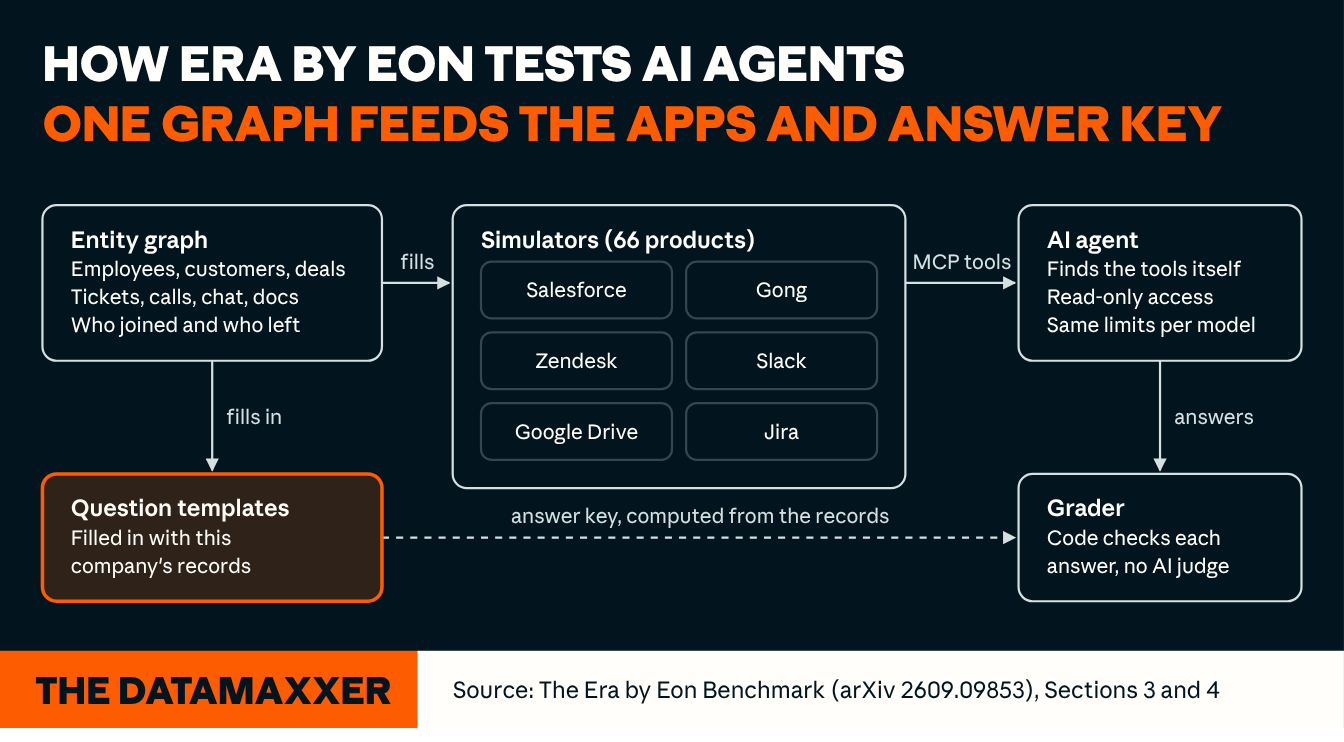
It starts by building one entity graph:
- Employees, with managers, hire dates, and working hours in their own time zones
- Customers, split into sales territories
- Deals, with their full stage history
- Support tickets, recorded calls, chat messages, and documents
Later records point to earlier ones. A ticket's requester is a contact at a real account. A deal's owner is on the sales team.
The graph also carries the mess of a real company, on purpose. People who left still own records. Some customers appear twice in the CRM, courtesy of the usual typos. There's a large pile of inactive prospects, and a few service accounts that aren't people at all. The paper calls this the texture that separates an operating company from a demo dataset. Anyone who has run an access review will recognize it.
Each application is a simulator that implements the real product's REST API and MCP server. There are 66 of them, including Salesforce, HubSpot, Zendesk, Jira, Gong, Slack, Stripe, S3, and Google Drive. Together they form a digital twin of the company.
A simulator doesn't make up its own data. It serves its slice of the same graph, in its own product's format. The account on a Salesforce deal is the same account on a Zendesk ticket and a Gong call, so a question that spans systems has one answer. Record IDs follow each vendor's real format, so vendor client libraries accept them.
What's already out there
The usual stand-ins don't give you realistic data with known answers. Vendor sandboxes have little data and no history. Hand-built test setups cover one or two systems and cost a lot to extend.
Research benchmarks get closer. τ-bench, CRMArena, TheAgentCompany, and WorkArena are carefully engineered, and Era builds on several of their design decisions. But each covers a few systems at most, uses hand-written tasks, takes real engineering to extend, and assumes its data is realistic rather than measured.
How every question gets an exact answer
Questions come from templates written in code. Each template pairs a question with the computation that answers it: the total value of the open pipeline, the salesperson with the highest won revenue, the median resolution time of a support ticket.
For each generated company, every template is filled in with that company's accounts and people. Nobody writes an answer by hand.
That also makes the benchmark cheap to extend. A new company needs its settings and a seed. A new question needs one template, and it applies to every company.
The corpus holds 83 generated companies. A CI test regenerates them from their seeds and checks that the output is byte-identical, so the benchmark can't quietly drift as the generator changes.
Twelve composed questions span systems and steps, like the recorded call minutes of the account with the largest open pipeline. Two of the twelve ask for something no system stores, such as a Net Promoter Score. The right answer is to say so. Making one up gets marked wrong.
Three rules keep the questions fair:
- Joins use only keys an agent can see in the products. Gong doesn't expose Salesforce IDs, so calls are matched to accounts by participant email.
- Each question states its own definitions and tie-breaking rule. No model is graded against a convention it was never told.
- If the data doesn't settle a question (say, two accounts tie for the largest pipeline), the question is dropped for that company instead of graded against an arbitrary pick.
An answer computed from the graph is correct by construction. It also has to be reachable through the interfaces an agent actually uses.
So an audit reads every answer back through each simulator's API and MCP tools and checks that the values match. It has caught real defects.
One early question joined calls to contacts through an internal record ID. The join worked in the stored data. Through the product, it was impossible, because the call system issues its own participant IDs and only the email address shows on both sides. Left in, that question would have penalized every agent that did the right thing.
Generating everything creates an obligation a hand-built benchmark doesn't have: the data has to look real. So a realism scorecard grades each company on five axes (distributions, correlations, timing, structure, and text) against statistics from Eon's operational data and published sources. An adversarial detector hunts for the tells of generated data, like a customer list that reads Dunn, Dunn2, Dunn3, or the same filler sentence on hundreds of records.
Both were built before the generator was tuned against them. Across 23 companies, five rounds of fixes took the mean realism score from 61.8 to 97.0, and the detector went from flagging 55.2% of records to none. Some checks proved unfair to small companies. A company with three support tickets can't show a realistic vocabulary, no matter how well it's written. We fixed those checks and rescored the original generator with the fixed scorecard, so 61.8 and 97.0 are measured the same way.
The test: 9 models, 33 questions, 3 runs each
We ran nine models on one generated fintech company from Era's "small" size tier: 40 customer accounts, 240 support tickets, and questions over its Salesforce, Zendesk, and Gong data.
There were 33 questions: 21 that needed one system and 12 composed of multiple systems. Each model answered each question three times. That's 891 runs.
Each model started with three tools: list the systems, describe a system's tools, and call one. No schemas, no description of the data, and no tool list in the prompt. It had to find the right tool among about 290 on its own, through MCP, the way a deployed agent would.
Every run got its own isolated, read-only copy of the company and the same limits: 25 turns, 40 tool calls, and 8,000 characters per tool response. Any request that would change data is refused, so an agent that tries a prohibited write fails the test, which beats failing the deployment.
Code grades every answer against the key. No AI judge, no partial credit. Each answer declares how it's compared: an exact value, a set, an ordered list, a mapping, or a correct "can't answer."
The full run cost $343.27 at list price.
Most gaps between models didn't hold up
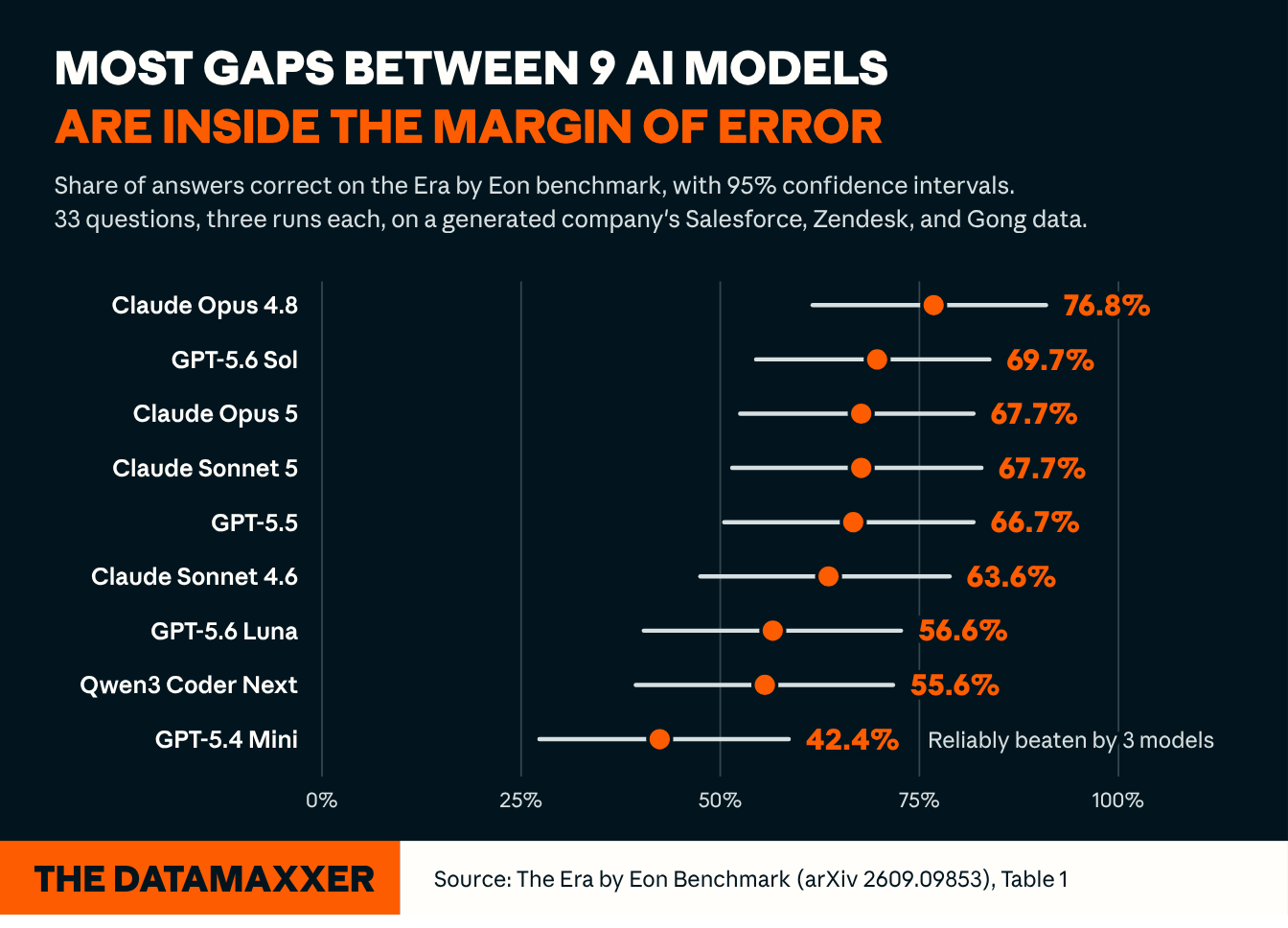
The chart looks like a leaderboard, with Claude Opus 4.8 on top and GPT-5.4 Mini at the bottom.
With only 33 questions, luck plays a big part in each score. A different set of questions could move any score about 15 points up or down. We compared every pair of models to see which gaps were real.
Only three of the gaps held up. Claude Opus 4.8, GPT-5.6 Sol, and Claude Sonnet 4.6 all did better than GPT-5.4 Mini. Every other gap in the chart is small enough to be luck. So when a model tops a leaderboard by a few points, it may not be the better model.
Simple questions were easy. When a question only asked for the records that match a condition, the models got 92.6% right on average. They struggled when they had to go through every relevant record and combine them. That includes adding records up, ranking them, and following a chain of links from one record to the next.
Three questions were among the five hardest for every model: finding the single longest Gong call, adding up all Gong call time, and reporting the ticket priorities for the account with the most tickets. The median ticket question from the top stumped all nine models in every run.
Of the 891 runs, 561 were right (counting correct "can't answer" responses to the two unanswerable questions), 119 were wrong, 99 declined a question the data could answer, and 112 ended without a usable answer. The totals hide that the models failed in different ways.
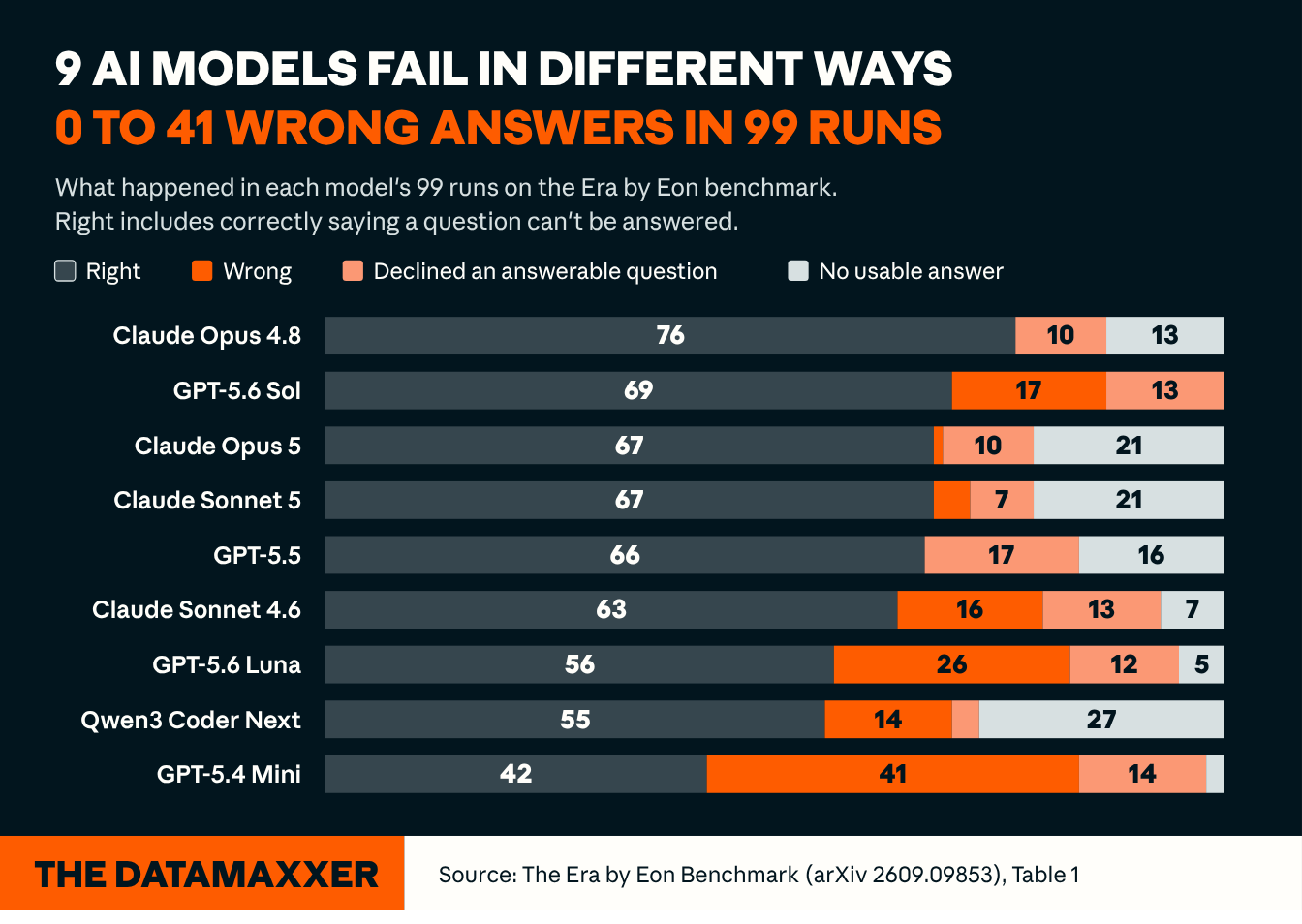
Claude Opus 4.8 didn’t give any wrong answers. It also declined or ended without a usable answer in 23 of its 99 runs. GPT-5.4 Mini ended without a usable answer only twice, and was wrong in 41.
Which of those you'd rather have depends on what a wrong answer costs you.
What changed when agents could run code
The benchmark also has a ceiling. In our follow-up paper, we used a larger generated company and an agent program that can run Python. The four strongest of six models answered 22 to 25 of 27 computable questions, one run per question.
Code made most of that difference. The two jumps in the intro were GPT-6 Astra and GPT-5.6 Sol, and their no-code runs already had a much looser budget than ours: 165 turns, 165 tool calls, and up to 32,000 characters per tool result. A script can read every record and hand the model only the result, which the paper says likely explains the jump.
Our second paper, Era by Eon: Benchmarking Enterprise Agents on Hidden Knowledge, used a bigger company, different questions, and looser limits. So its scores can't be compared with the scores earlier in this post. But one thing was clear. Once the agents could run code, the best models got almost every question right. The test could no longer show which of them was better.
So the same paper added harder questions. In each one, the answer depends on a fact that nobody wrote down directly. The record that should hold the fact says something else, and the agent has to figure out the truth from other data. For example, the sales system says a customer dropped a purchase because of timing. But on a recorded sales call, the customer says it was because of an outage.
These questions were much harder. The best agent got 18 of 24 tries right. Four of the six models got 6 or fewer right.
Five checks for testing your own agent
Building the benchmark taught us a few lessons. They apply to anyone who tests an AI agent on company data:
- Compute the answer key from the data itself, not by hand or with a model as the grader.
- Include questions the data can't answer, and count a correct "can't answer" as right.
- Join only through keys your agent can actually see in the product, then check that each answer is reachable through the interface the agent uses. Stored data can support a join that the product doesn't.
- Run each question several times and report an interval. With a few dozen questions, check whether the gap between two models is bigger than the noise before you switch.
- Count wrong answers, refusals, and runs that hit a limit separately. One accuracy score hides which of them you're getting.
You don't need a copy of production data to start. That's what Era is for. Generate a company to your spec, with your industry, size, and systems, then point your agent at it over MCP or the vendor-compatible APIs. Era is free for builders, and the link is at the end.