


How Eon Complements AWS Backup at Scale
Centralized posture across AWS estates
AWS Backup lets teams centralize and automate backup across many AWS services. At enterprise scale, service-by-service limitations can make consistent coverage harder to maintain across accounts and regions.
At higher assurance levels (like logically air-gapped vaults), capabilities can vary by resource type, and cross-account/region restores can introduce extra configuration and copy requirements. Some workloads also rely on service-managed backup features that aren’t fully governed through AWS Backup.
Policy conditions in AWS Backup are limited to resource tags or all resources in a given region. Teams that need dynamic classification (by VPC, data sensitivity, or application tier) must maintain manual tagging, which leads to over-backing-up or under-backing-up when tags drift.
Eon adds Cloud Backup Posture Management (CBPM) that discovers and inventories resources across accounts and regions, continuously checks coverage, and keeps policies aligned as environments change.
One operational view for recovery, compliance, and cost
Eon brings backup posture, recovery actions, and cost into one dashboard. Teams spend less time switching accounts or chasing down evidence during audits and incidents.
Granular recovery for everyday cloud failures
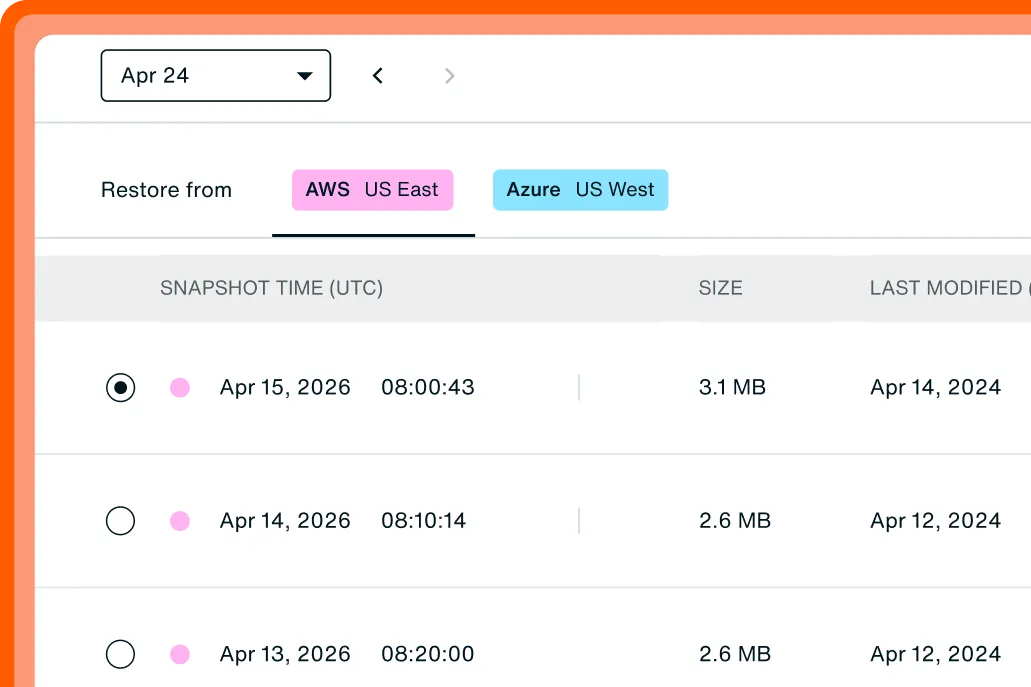
Most incidents don’t require full resource restores. Eon helps teams recover only what broke, at the file, object, or database level, without having to restore first.
Granular restore
Recover a specific file/object/table without rebuilding everything.
Ransomware resilience in the backup layer
AWS Backup provides building blocks for isolation. Ransomware detection relies on a third-party integration (Elastio), while malware scanning uses GuardDuty Malware Protection, which is a paid add-on typically 3× the cost or more. GuardDuty scans data offline, so there can be considerable delay between a malware event and detection. Teams end up assembling multiple services to approximate what should be a single workflow.
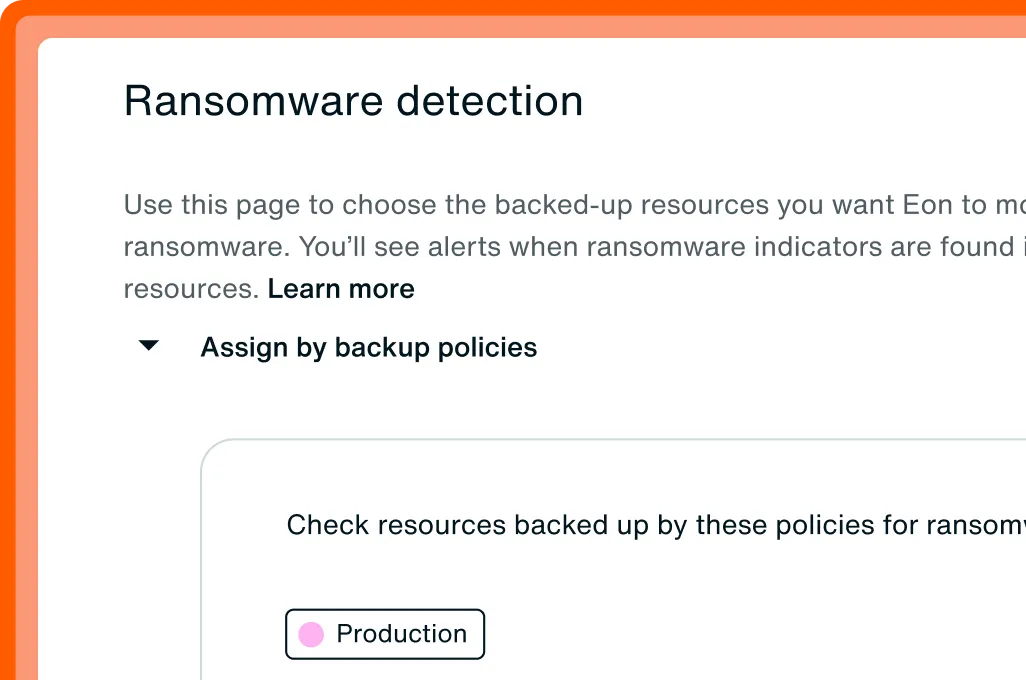
Eon makes ransomware readiness the default: immutable, logically air-gapped backups plus anomaly signals tied to backup activity, and clean recovery points teams can roll back to across compute, object storage, and databases.
Eon helps teams quickly identify what to restore and what to avoid, without turning ransomware response into a multi-service project.
Ransomware: find + recovery
Investigate signals, then restore from a known-good point.

100% first-year ROl. Recovery time reduced from 1 day to minutes.

35% cost reduction. Recovery time from 24 hours to 3 hours.

Petabyte-scale protection deployed in 25 days.
FAQs
AWS Backup works well for AWS teams that want native snapshot orchestration and retention inside AWS. Teams compare Eon vs. AWS Backup when they need org-wide posture across many accounts and regions, faster granular recovery, clearer cost attribution, and backup data access for audits, investigations, analytics, or AI.
AWS Backup fits well when you:
- Run everything in a small number of accounts and regions
- Mostly need resource-level snapshot orchestration and restore
- Don’t need org-wide posture reporting
Teams add Eon when they:
- Run multi-account or multi-region AWS and need org-wide posture visibility without manual work
- Want file-, object-, and database-level recovery
- Aim to reduce backup storage costs (often 30–50%)
- Need to search or query backup data for audits, investigations, analytics, or AI
- Plan for multi-cloud now or later
- Have long-retention requirements for Aurora (where manual snapshots are full copies, not incremental)
- Back up S3 and want to avoid the ~2× cost penalty or versioning/replication workarounds
No. Eon supports AWS, Azure, and Google Cloud from a single dashboard view.
Yes. Eon lets teams search and query backup data directly, so audits and investigations don’t start with a full restore.
Eon stores backups incremental-forever and deduplicates and compresses backup data across accounts and regions. Many environments see 30–50% lower storage spend versus snapshot- and versioning-heavy approaches, depending on retention and change rates.
AWS Backup is a free orchestration layer, but customers pay for the underlying snapshots, storage, and replication. Some services (e.g., RDS) include limited free backup up to the provisioned storage size with up to 35-day automated retention. Beyond that, manual snapshots, longer retention, and cross-region copies all incur charges — spread across multiple line items that make actual backup spend difficult to track.