


Anthropic recently announced Mythos, a frontier AI model with advanced cybersecurity capabilities. While not yet publicly available, models like Mythos signal a broader shift already underway in the security landscape.
AI is rapidly lowering the cost and effort required to discover vulnerabilities, scan infrastructure, generate phishing campaigns, abuse credentials, and automate attacks. Attackers can move faster, test more paths in parallel, and adapt techniques in real time, shrinking response windows from days or weeks to potentially hours.
Most organizations are responding with more security tooling, but AI security infrastructure now requires deeper architectural changes. Many modern systems still rely on broad trust relationships, persistent connectivity, and centralized access models that become harder to defend as attack speed increases.
Preparing for this shift requires architectures designed to reduce blast radius, isolate critical systems, automate response, and ensure recovery infrastructure remains operational when compromised.
How AI Is Changing the Threat Landscape
Historically, security teams relied on having time to detect and respond to threats. Even serious vulnerabilities still required attackers to manually perform reconnaissance, adapt exploits, move laterally, and scale attacks across environments. That gave defenders time to evaluate exposure and contain incidents before they spread broadly.
AI is compressing that timeline significantly. Attackers can now automate large parts of the attack lifecycle, including analyzing cloud environments and trust relationships, generating exploit paths, testing lateral movement strategies, and rapidly adapting malware to evade detection. The result is more pressure across the entire security lifecycle, and manual review and coordination quickly become bottlenecks.
At the same time, backup and recovery systems are increasingly becoming targets themselves. Many backup platforms rely on centralized control planes, long-lived credentials, shared infrastructure, and persistent access into customer environments. In some cases, the systems designed to protect data can also become high-value attack paths.
Preparing for AI-Native Threats: What Organizations Need to Change
Protecting against AI-native threats requires rethinking how systems are designed, secured, and maintained. As attackers move faster and automate more of the attack lifecycle, organizations should focus on a few core areas:
- Reduce unnecessary exposure: Limit internet-facing infrastructure wherever possible. Reduce standing privileges, tighten IAM policies, eliminate overly broad trust relationships, and minimize persistent access between systems.
- Design for containment: Assume breaches will happen. Use segmentation, isolated environments, scoped permissions, and tightly controlled access paths to limit lateral movement and reduce blast radius.
- Automate response and remediation: Continuous vulnerability monitoring, SBOM tracking, automated triage workflows, runtime detection, and policy enforcement help accelerate response times.
- Treat backup and recovery systems as part of the cyber resilience architecture: Recovery infrastructure must remain operational during active ransomware and cyber attacks.
- Prioritize isolation and recovery independence: Immutable backup architectures, logically air-gapped backup environments, and isolated recovery paths are increasingly essential for cloud ransomware protection and cyber recovery.
How Eon Enables Cyber Recovery and Cloud Ransomware Protection
Eon is designed to keep backup and recovery infrastructure isolated, resilient, and operational at all times with:
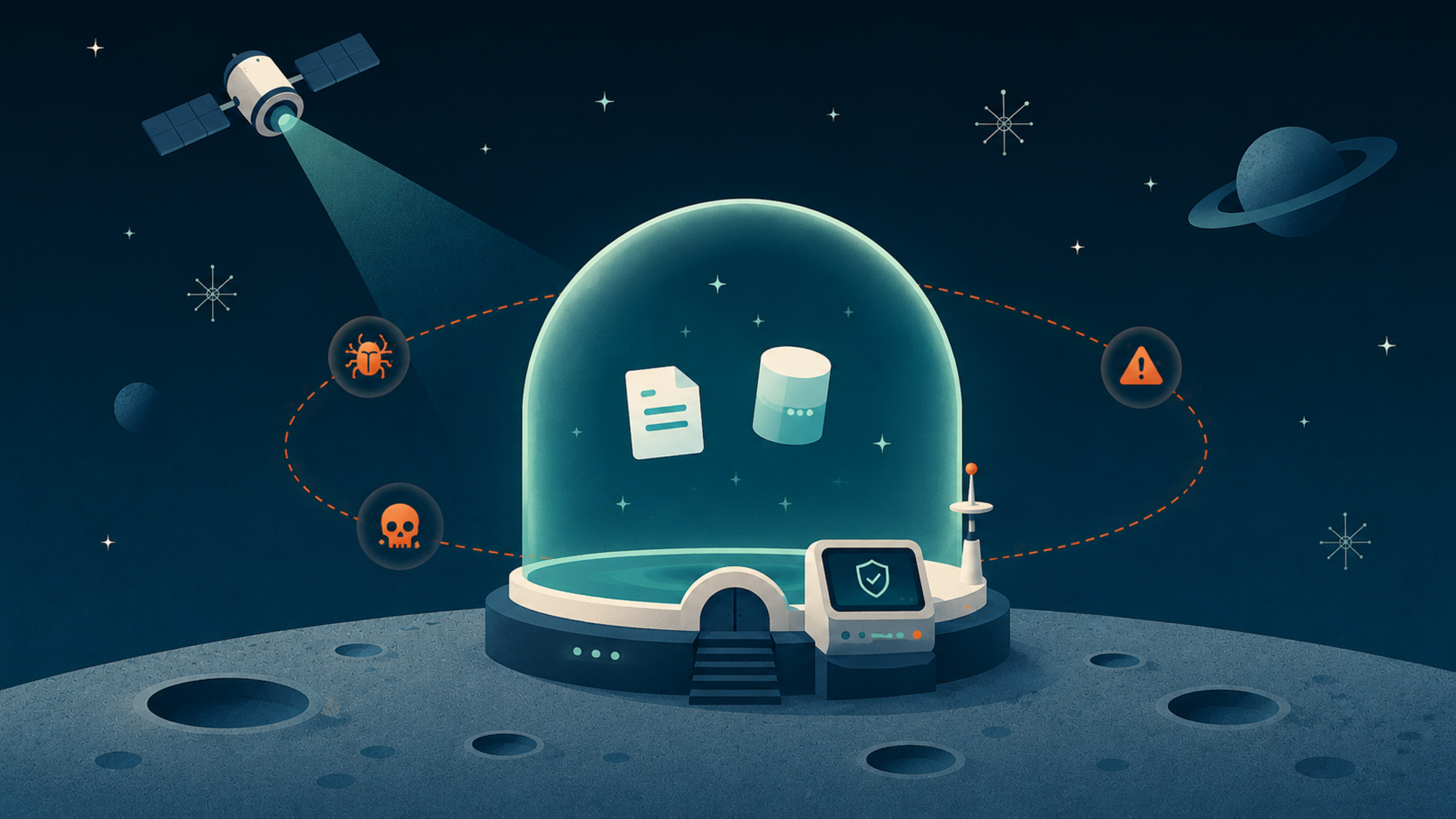
- Architecture designed to reduce blast radius: Customer recovery environments are separated from centralized infrastructure, with the only externally reachable component being the control plane protected behind hyperscaler-managed Layer 4 and Layer 7 defenses.
- Single-tenant, isolated recovery environments: Backup environments run as dedicated scanning and vault accounts inside the customer’s own cloud account, region, and hyperscaler, with backup data encrypted under customer-controlled KMS keys. This creates an immutable, logically air-gapped backup architecture designed for ransomware recovery.
- No centralized access or exfiltration paths: Data plane accounts have no internet egress, access is restricted through tightly scoped cross-account IAM roles, and there is no shared multi-tenant storage layer or centralized path to customer backup data.
- Built-in ransomware, malware, and anomaly detection: Eon continuously monitors databases, VMs, and object storage for AI-driven ransomware behavior, suspicious encryption patterns, corruption, and compromised recovery points before restore.
- Continuous backup posture validation: Cloud Backup Posture Management (CBPM) continuously validates backup coverage, policy enforcement, retention compliance, and recovery readiness across cloud environments.
- Additional operational security controls: Eon layers CNAPP coverage across AWS, Azure, and GCP alongside SBOM tracking, endpoint protection, and automated response workflows designed to improve detection and containment speed.
Looking ahead
The longer-term impact of AI-native threats is that cyber resilience architecture and recovery infrastructure matter more than ever. As AI compresses attacker timelines, the most resilient systems will be the ones designed around constrained trust boundaries, isolation, automation, and recovery independence from the start.
Want to learn more about how Eon is protecting enterprises from AI-driven incidents and enabling instant, granular recovery? Book a demo today.
FAQs
What are AI-native cyber threats?
AI-native cyber threats are attacks accelerated or automated using AI systems. These threats can compress traditional attack timelines by automating reconnaissance, vulnerability discovery, phishing, credential abuse, lateral movement analysis, and exploit generation.
How are AI cyber attacks changing ransomware and recovery?
AI cyber attacks allow attackers to move faster, automate exploitation, and adapt techniques in real time. This increases pressure on organizations to improve ransomware recovery, reduce blast radius, and ensure recovery infrastructure remains operational during active compromise.
What is cyber resilience architecture?
Cyber resilience architecture refers to infrastructure designed to withstand and recover from cyber attacks through isolation, segmentation, scoped access controls, immutable backups, and independent recovery systems.
Why are backup systems becoming attack targets?
Backup and recovery systems often contain privileged access, centralized control planes, and persistent connectivity into production environments. Attackers increasingly target these systems to disrupt recovery operations, destroy recovery points, or gain broader access to cloud infrastructure.
What are immutable and air-gapped backups?
Immutable backups prevent backup data from being modified or deleted, while air-gapped backups isolate recovery data from production systems and persistent access paths. Together, they are critical for cloud ransomware protection and modern cyber resilience strategies.
Why does recovery infrastructure need to remain operational during compromise?
Modern attacks increasingly target identity systems, management planes, and operational tooling. Recovery infrastructure must remain isolated and independently accessible so organizations can restore operations even during broader infrastructure compromise.