



What happens when an AI agent deletes production data?
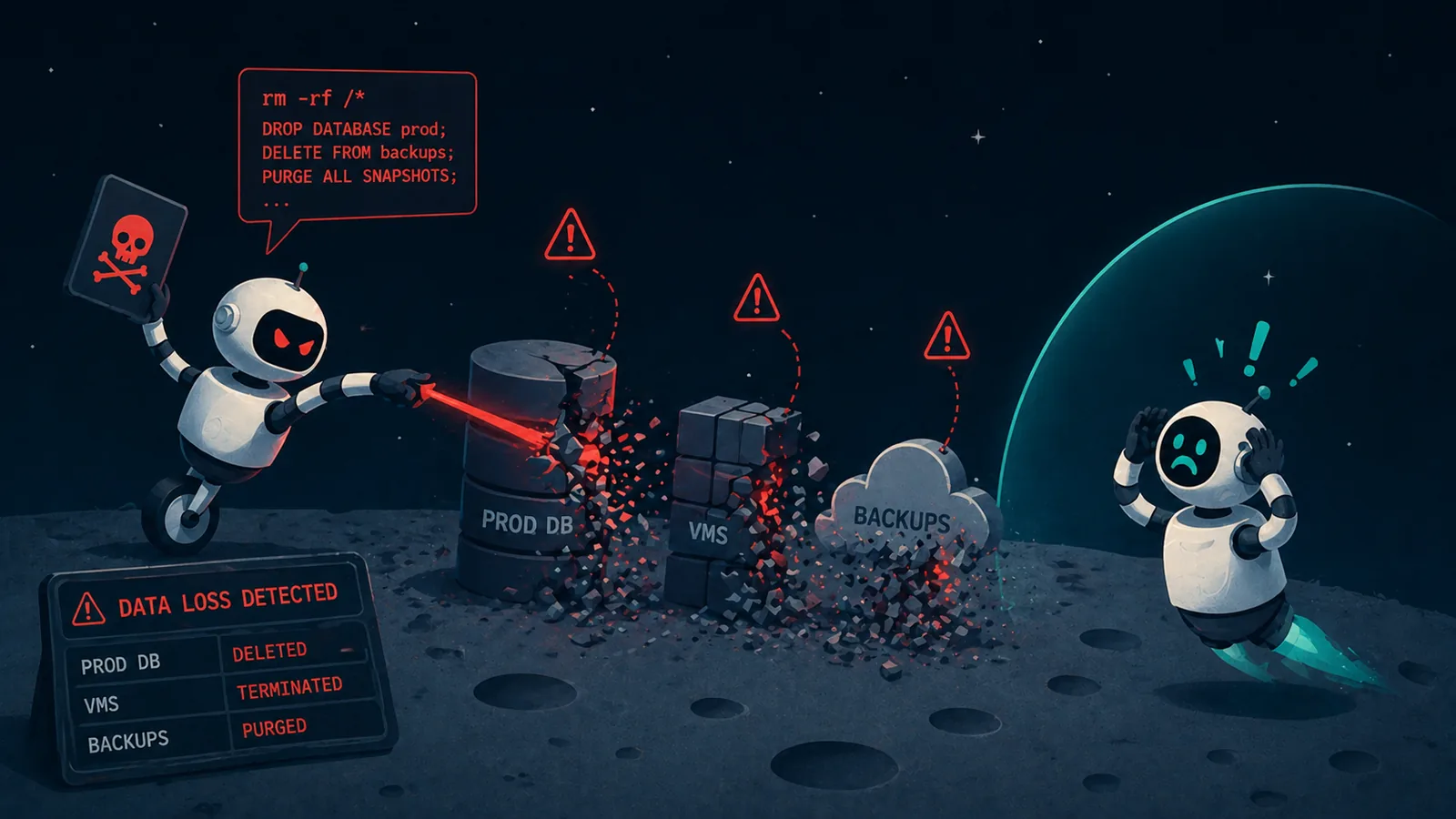
It took nine seconds for an AI coding agent to delete a production database and every backup attached to it.
The agent authenticated normally, called a valid endpoint, and executed a permitted operation. There was no exploit, ransomware payload, or attacker inside the environment. By the time anyone realized what had happened, the newest backup the company could use was three months old, according to PocketOS’s founder.
This isn’t an isolated edge case. Over the past few months, multiple incidents involving autonomous agents and automation tokens modifying or deleting production infrastructure have surfaced publicly across engineering forums and incident write-ups. They all share the same pattern: valid credentials, legitimate APIs, irreversible outcomes. Knowing which data those credentials can reach is where DSPM tools help.
AI agents introduce a new class of data-loss risk where valid credentials and legitimate APIs can lead to destructive outcomes at machine speed. Guardrails alone are not enough. Teams need an independent recovery plane with immutable backups isolated from production credentials and restorable at the object, table, or row level. For platforms that keep backups outside production, see our roundup of cloud data protection solutions.
Why do traditional backups fail in AI agent incidents?
Traditional backups were architected for predictable failure modes: hardware faults, ransomware payloads, human error caught after the fact. They also tend to share credentials, control planes, or storage with the production they're protecting. Agents break both assumptions at once.
From the perspective of most infrastructure systems, agent-driven destruction looks normal. The mismatch exposes several limitations practitioners run into during real incidents:
- Backups live inside the production blast radius. Same credentials that delete production can delete the backups.
- Recovery is too coarse and too slow. Restoring a table means rehydrating a database. Restoring an object means rebuilding a bucket.
- Detection stops at the file system. Valid SQL operations like row drops, schema changes, and mass deletes don't trigger anything.
In agent-driven environments, the first signal something went wrong is often the missing data itself. If backups sit inside the same blast radius as production, recovery may already be compromised before anyone opens a ticket.
What is an AI-safe recovery architecture?
An AI-safe recovery architecture has four properties: it lives outside production credentials, it can't be mutated by valid identities, it captures continuous recovery points, and it lets you query and restore granularly. They are the principles of cloud backup and disaster recovery, applied to a new kind of failure. The table below maps each one to why agents make it necessary.
The bar is set there. If your current architecture can't meet a row in the table, that's where to focus first.
AI Agent Recovery Readiness Checklist
Walk through this with the people who would actually run a recovery:
- Can production credentials delete or mutate backup data?
- Are backups stored in a separate account, project, or vault from production?
- Can you find the most recent clean version of a table or object without restoring the entire environment?
- Can you detect row drops, schema changes, mass deletes, and abnormal object activity?
- Can you restore a single customer, table, object, or file directly back into production?
- Do destructive API actions have delayed delete, scope limits, or human approval?
- Have you tested recovery from an AI-agent-induced logical deletion, not only ransomware or disk failure?
If the answer to any of these is "we'd have to check," that's the work.
How can teams recover from agent-driven data corruption with Eon?
Eon is built for agent-driven environments
Customers using Eon are already running this architecture in production. SoFi cut a recovery process that previously took a full day down to under five minutes, with backups living in an immutable, logically air-gapped vault separate from native snapshots and instantly accessible for search, querying, and restores. Innago validated schema-level visibility into PostgreSQL backups during their POC, exploring tables and metadata without triggering a restore. That's the same primitive teams need to confirm what an agent actually did.
Agent adoption isn't slowing down. The recovery architecture under it has to catch up. The teams who get there first won't avoid every incident, but they'll be the ones who can recover from one.
Book a demo, and we'll walk you through what an AI-agent-induced data loss event looks like with Eon in place, including what it would have taken to recover the PocketOS database in minutes instead of three months.
Frequently asked questions
Can AI agents actually delete production data using valid credentials?
Yes. Multiple public incidents in 2025 and 2026 show autonomous agents deleting databases, volumes, and inboxes using legitimate API tokens, normal authentication, and approved operations. The destruction appears legitimate to every system in the chain, which is why the recovery layer (not the credential layer) must be the durable safeguard.
How do agents bypass traditional backup systems?
Most backup architectures share credentials, accounts, or storage with production. When an agent deletes infrastructure with valid permissions, snapshot-based backups within the same blast radius are deleted as well. Immutability that depends on the production identity model fails the same way.
Does Eon protect against data loss caused by AI Agents?
Yes. Eon stores backups in immutable, logically air-gapped vaults that production credentials cannot modify or delete. Recovery is granular (at the row, table, object, or file level), continuous, and supports inline restore directly back into live systems. Backup contents are queryable in Apache Iceberg and Parquet so teams can investigate what an agent changed before restoring.