




A ransomware hit on cloud data turns recovery into a manual correlation job. You pull findings from a detection service, match them by hand against snapshots in a backup vault, then drive a restore API to roll back. Three separate products, none of which knows what the others found. Working out what's compromised, when the data was last clean, and where it's safe to restore from is work you do under pressure, in the worst hour to be doing it. That's an integration tax.
The Eon MCP (Model Context Protocol), from Eon, the cloud-native data backup company, now collapses that loop onto one surface. Your own AI agent, whether Claude, Cursor, or whichever you run, queries the Eon MCP server and drives the entire ransomware incident response conversationally, from posture through investigation to remediation. It's available now, where the integration previously supported only inventory queries.
Phase 1: Posture
Posture isn't something you check only once an attack lands: protection status and detector verdicts are continuously available through the MCP, so the view you'd monitor day to day is also where a response starts. The agent pulls protection status across the account: which resources have active threat detection, the latest verdict from each detector, and the open security findings. Eon evaluates every snapshot across three detectors (ransomware behavior, malware, and data anomalies), so posture reads straight off the backups instead of a report stitched together from a separate scanner. The verdict is a property of each snapshot, because detection runs against the data Eon already holds in the vault rather than a live host. And because it's standard MCP, Eon's backup-side verdicts can sit alongside your other security tools' MCP servers in the same agent: endpoint detection cross-referenced against vault detection, in one conversation.
Phase 2: Investigation
For an infected resource, the agent parses snapshot scan history into an attack timeline and pins the compromise window between the last known-clean snapshot and the first infected one. It surfaces concrete evidence, such as a ransom-note table inserted into a PostgreSQL database, and classifies every snapshot as verified-clean, infected, or unscanned.
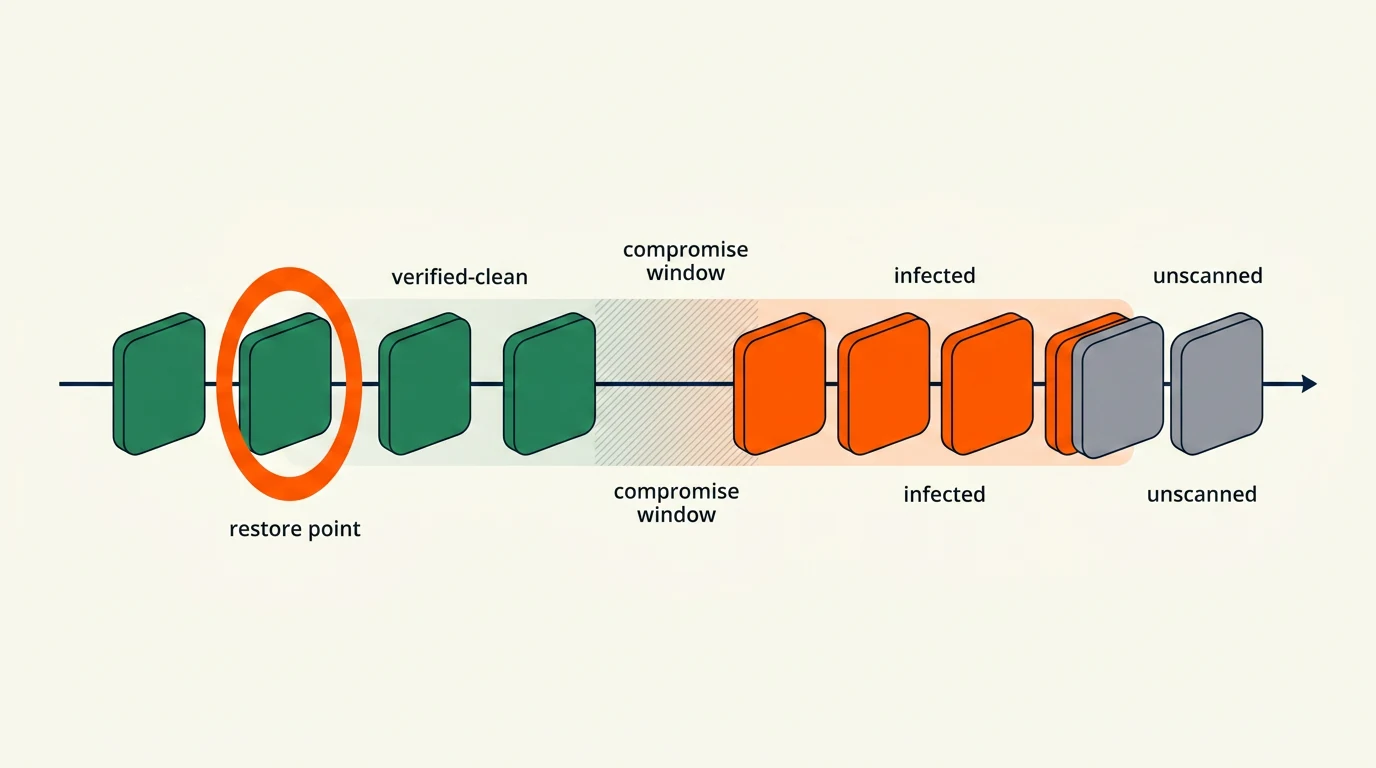
Then comes the hard part of ransomware investigation: choosing where to restore from. The newest “clean” snapshot may sit between two infected ones, which means it could be genuinely clean or simply not-yet-detected. The provably safe choice can be an earlier pristine baseline, at the cost of a worse recovery point. That trust decision is what recovery hinges on, and it's exactly the reasoning the agent runs across the full timeline.
Phase 3: Remediation
The agent selects the optimal verified-clean restore point, prepares a bulk restore, then stops for explicit authorization.
Guardrails
AI in a security workflow raises a fair question: what stops it from doing damage? The answer is separation. Everything up to remediation (posture, timelines, findings) is read-only. The one destructive step, restore, sits behind an explicit approval gate: the agent prepares it and stops, and a person owns the irreversible decision. Access runs through OAuth: users authenticate with their Eon subdomain and credentials, and tokens refresh automatically. And detection runs against snapshots in Eon's vault, never against production.
The integration is already done
The agent works because Eon collapsed the integration into one surface it can drive end-to-end.
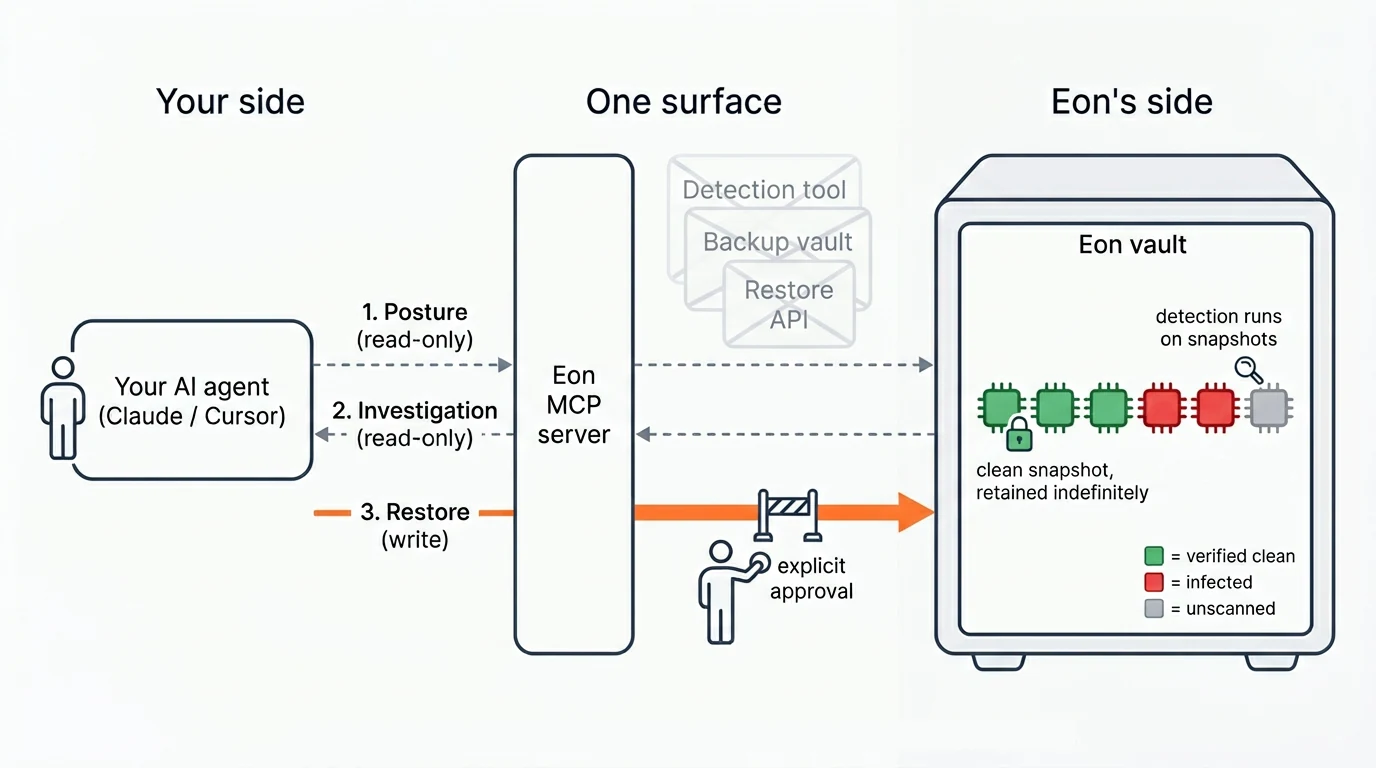
- Detection lives on the backups. Eon analyzes each snapshot's logical contents (files, rows, schemas) rather than scanning a live host, so a clean-or-infected verdict is a property of every snapshot. There is no second system to correlate against.
- A clean recovery point is guaranteed to exist. Eon retains a protected resource's latest clean snapshot indefinitely, even after retention periods expire, so the agent never gambles that its chosen restore point still exists.
- One programmatic surface drives the whole loop: infected resources, the full snapshot timeline, finding counts, and restore. The agent reads detection, the clean point, and recovery as one thing.
Minutes instead of hours
Collapsing the integration turns hours of cross-product correlation into minutes of guided reasoning, with the trust decision spelled out for the person who owns it. The whole response runs conversationally, from posture to restore, without leaving the agent.
For the architecture behind this, and why agentic ransomware recovery is an integration problem rather than an intelligence one, read the companion post, “The wall between immutable backups and agentic recovery is integration, not intelligence.”
Ransomware resilience shouldn't depend on how fast you can wire three products together under pressure. Contact Eon to see how unified cloud data and ransomware protection keeps a verified-clean restore point always ready and a full response one conversation away.
FAQ
What can the Eon MCP do for ransomware recovery?
The Eon MCP now runs the full closed-loop ransomware response: posture assessment, resource investigation, and automated remediation and restore, all driven conversationally from an AI agent, with an explicit action-approval gate before anything destructive executes.
How does Eon guarantee a clean restore point exists after a ransomware attack?
Eon retains a protected resource's latest clean snapshot indefinitely, even after retention periods expire, so there is always a verified-clean recovery point to restore from.
How does Eon detect ransomware in backups instead of on production?
Eon analyzes each snapshot's logical contents (files, rows, and schemas) inside a logically air-gapped vault, running three detectors for ransomware behavior, malware, and data anomaly, so the clean-or-infected verdict is a property of every snapshot rather than a separate scanner watching a live host.
How does an AI agent connect to the Eon MCP?
The Eon MCP server lives at https://mcp.eon.io/mcp and connects through OAuth; users authenticate with their Eon subdomain and credentials, and tokens refresh automatically.