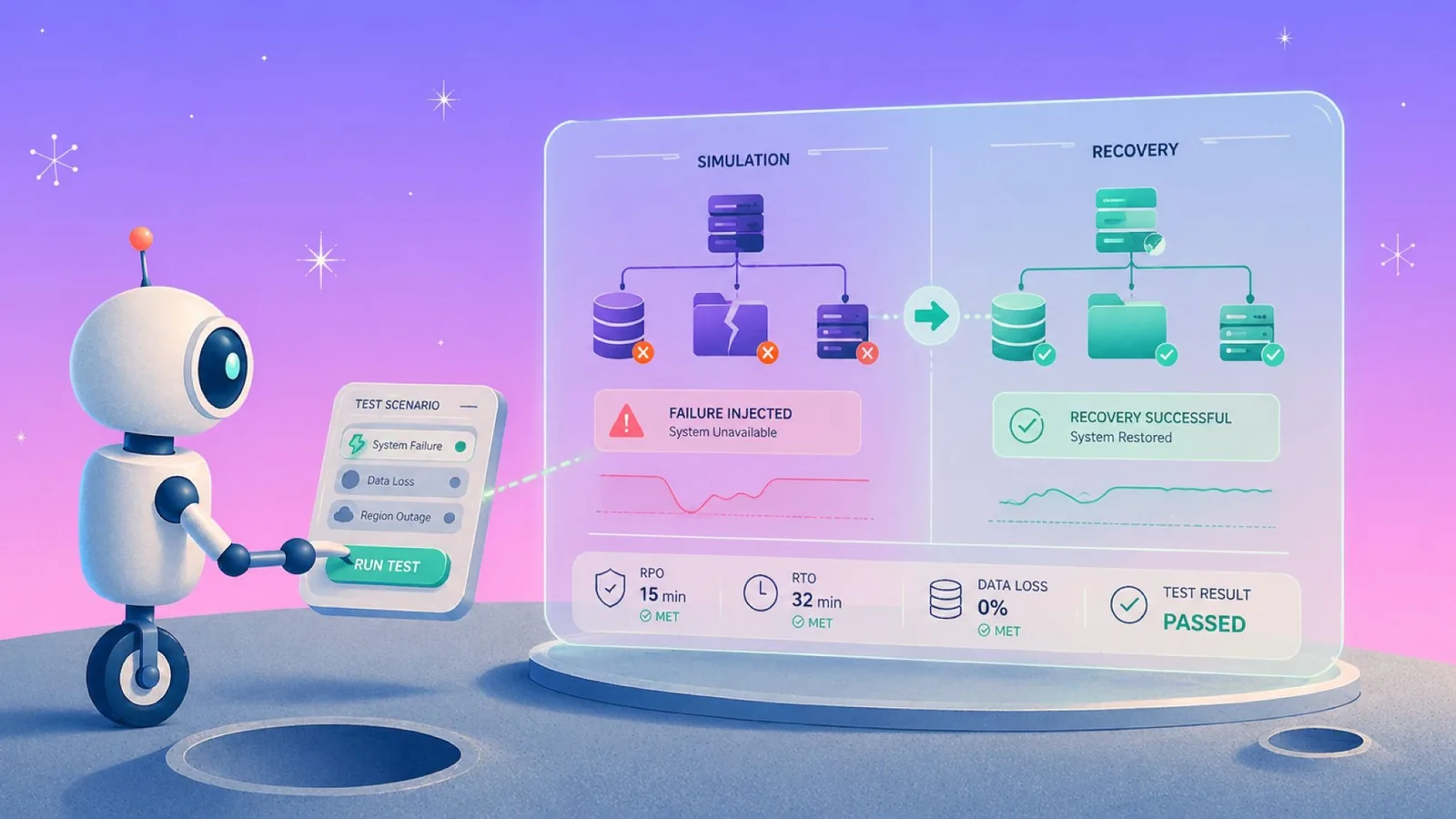



Why Cross-Account Recovery on AWS Breaks Down When You Need It Most
AWS cross-account recovery breaks down because the restore path often still depends on source-account permissions, KMS grants, snapshot-copy behavior, and human coordination. In an incident, those dependencies turn a valid recovery point into a stalled recovery.
Production is down. The target account is ready. The recovery point exists. The runbook says the restore should work. Then it fails because the source-account KMS grant doesn’t include the destination role.
Or the snapshot copy finished, but the copied snapshot is still tied to a source CMK policy that your recovery team can’t change. Security has already locked down the source account, so the “easy” fix suddenly depends on a source-account owner, a break-glass path, and time you do not have. Whether a snapshot counts as a recovery point at all is covered in when to use a snapshot vs a backup.
Recovery often fails in the real world for the same reasons. The restore path still depends on IAM roles, KMS permissions, snapshot copy behavior, backup policies, AWS Backup settings, and human coordination.
Using multiple AWS accounts is still the right call for security, compliance, ownership, and blast-radius isolation. But splitting workloads across accounts doesn’t automatically give you independent recovery.
And the volume of cross-account recovery scenarios is growing. AI coding agents operating across dev, staging, and production accounts can trigger schema corruption or table drops through valid credentials, turning cross-account recovery from a quarterly DR exercise into a real-world Tuesday afternoon problem.
Why AWS Native Recovery Paths Become Bottlenecks During Incidents
AWS gives you plenty of pieces to work with: snapshots, AWS Backup, backup vaults, copy jobs, IAM, KMS, and cross-account restore workflows. The problem is that the restore is usually a chain, and chains break where you least want them to.
Why IAM Trust and KMS Permissions Block AWS Cross-Account Restore
AWS cross-account restores often get blocked before any meaningful data movement begins. In practice, the issue is the permission chain around the recovery point:
- The recovery role in the destination account may not be trusted by the source account role.
- The source backup vault policy may prevent the target account from accessing the recovery point.
- The incident team may need a break-glass role, a change to the trust policy, or assistance from the source account owner before the restore can begin.
Even if the permissions technically exist, the path can still be shaky. Role assumptions, account boundaries, service-linked permissions, organization controls, and AWS Backup policies must all be in sync in real time.
KMS makes the same point more painfully. A snapshot can be copied into the target account, but the target role still cannot decrypt it unless the key policy or grant is right. If the source CMK policy needs to be updated before the copied snapshot becomes usable, that policy is part of the outage.
Why Native Snapshot Recovery on AWS Doesn’t Mean You Can Restore the Workload
Native snapshot recovery AWS workflows are useful, but teams often treat snapshot availability as much closer to service recovery than it really is.
The presence of a snapshot doesn't guarantee that you can restore the workload to the correct account and region. Snapshot copy workflows can carry dependencies on encryption settings, key policies, snapshot chains, regional setup, and account-level configuration. After the copy completes, the target environment still needs VPCs, subnets, routes, security groups, IAM profiles, database settings, secrets, DNS, monitoring, and application configuration.
The trap in many AWS multi-account backup strategy conversations is right here. Backup coverage is only part of the problem. Recoverability is the hard part.
Why AWS Cross-Account Recovery Slows Down When Too Many Teams and Consoles Are Involved
Security owns one piece, the platform team owns another, and application teams own their own priorities. Backup admins control policies; account owners control access. None of those boundaries dissolve during an incident. The arrangement is common in large AWS environments, and it’s why recovery slows down more than people expect.
During an incident, the team trying to restore to the target account may not be the team that owns the source account. Security may freeze changes. The platform team may control the recovery account. The application team may know what needs to come back first, but may not have the permissions to do so.
Engineers may need to bounce between consoles, accounts, regions, KMS keys, CloudTrail logs, backup vaults, copy jobs, and restore jobs just to answer a basic question: What’s blocking this restore? Without one clear view of protected assets, valid targets, and what is recoverable, the team burns time hunting while the bridge keeps asking for updates.
The Hidden Control-Path Problem: Why Clean AWS Cross-Account Designs Stay Fragile
The deeper issue is the control path. A cross-account design can look reasonable in a review and still stay attached to the source account once recovery begins:
- Restore may still depend on the source account behaving cleanly during the incident.
- The source CMK policy may still need to be updated before the recovery point is usable.
- The source snapshot chain may still need to remain intact.
- The right source-account owners may still need to be available when the restore starts.
What looks like independence is actually a delayed dependence.
You may have backups. You may even have a snapshot copy in another account. But if the target environment isn’t ready or the restore still needs source-side permissions and key changes, recovery is still tied to the thing you’re trying to get away from.
AWS backup across accounts isn't sufficient on its own. Good cross-account recovery should reduce the extent to which the source account can slow you down once the incident has started.
What Good AWS Cross-Account Recovery Should Look Like
A strong cross-account recovery model should be:
- Recovery that doesn't require modifying the source account's CMK policy or IAM during the incident.
- A vault that lives outside your AWS org's identity boundary, not just outside your region.
- Restore paths that are policy-driven across accounts, not ticket-driven inside them.
- Granular recovery into any target account, without rebuilding the full workload first.
- Centralized visibility across every protected account, with audit logs by default.
The goal is to make recovery predictable enough that the team does not have to improvise permissions and key changes while production is already down.
How Eon Decouples Recovery from Fragile Native Paths
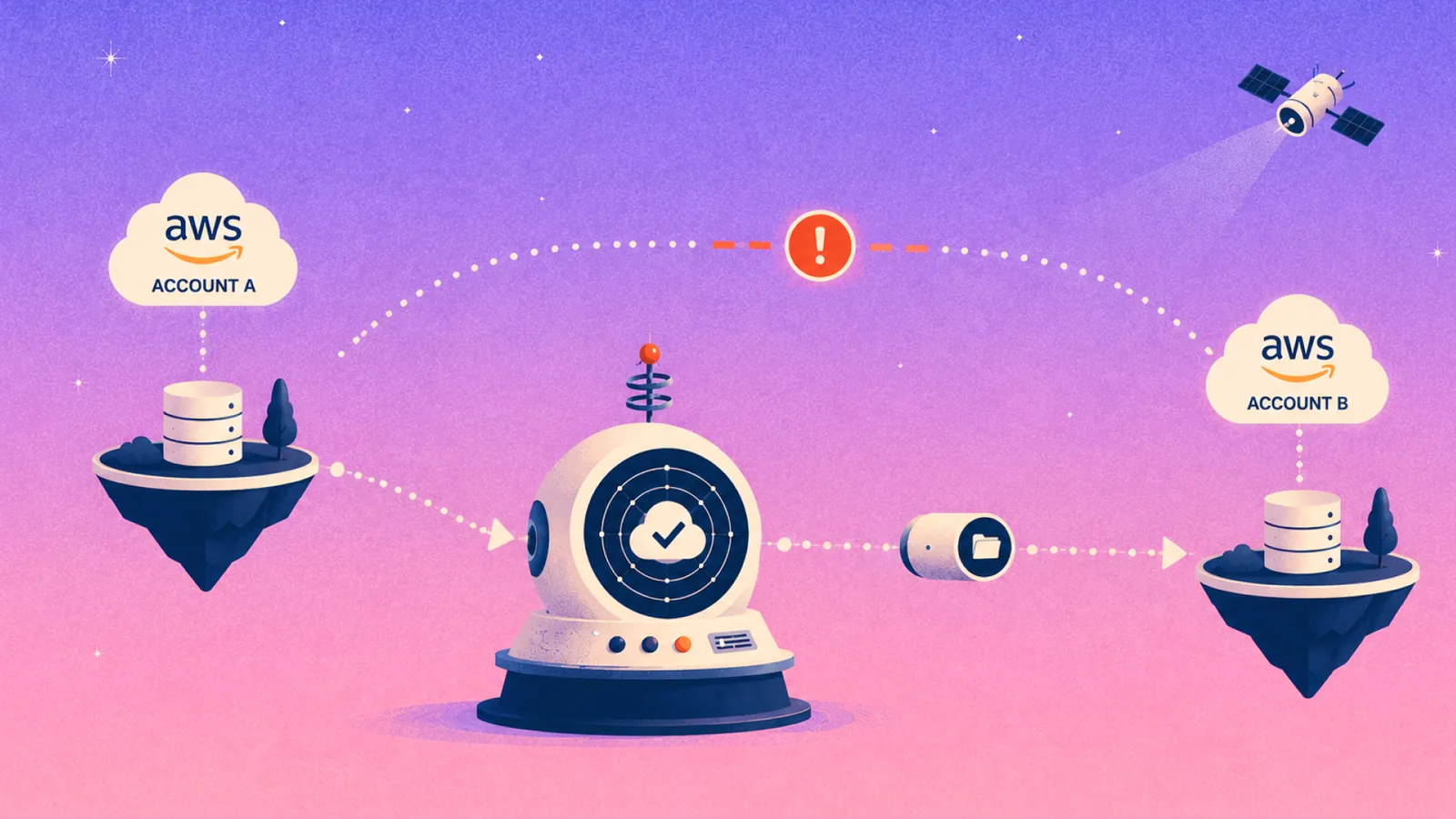
For AWS multi-account recovery, the architectural point is that Eon's persistent backup data lives outside native snapshot chains, in a vault account managed by Eon. Native snapshots are used briefly during ingest, but the data you actually restore from sits in a layer that doesn't depend on the source account's snapshot lifecycle.
The real question isn't whether you can make one more copy. The question is whether you can recover across accounts without dragging the source account's control path into the incident.
Eon’s public AWS architecture makes more sense when you look at it as four layers working together:
Eon's AWS Cross-Account Architecture
| Layer | Role in cross-account recovery |
|---|---|
| Customer source account | Eon discovers and protects workloads in the customer environment. |
| Eon-managed scanning account | Eon scans, maps, classifies resources, and applies policy-driven protection. |
| Eon-managed vault account | Backups live in a separate, immutable, logically air-gapped vault outside your AWS organization. |
| Customer restore target | Restores land in any customer account you designate, including the original source account or a different one entirely. |
AWS Backup supports cross-account vaults today, and on the surface, that looks like the same answer. The difference is where the vault actually lives.
Standard AWS Backup cross-account vaults reside within your AWS organization and are governed by the same IAM, KMS, and control plane as the workloads they protect. During an incident in which any of those layers is degraded, the recovery layer is degraded as well. AWS Backup's logically air-gapped vaults go further, with AWS-owned encryption keys, sharing to other accounts through AWS RAM, and multi-party approval for recovery when the owning account is compromised, but they still live inside AWS and restore at the resource level. Eon's vault account sits outside your AWS org's identity boundary, is managed by Eon, is logically air-gapped, and is immutable by default. The recovery layer doesn't share a control path with the thing it's recovering.
The practical effect is that during a real incident, you're not waiting on the same systems that just failed.
The vault account is the key piece. Protected data sits outside the source account in a separate Eon-managed vault, so recovery doesn’t depend on native snapshots staying usable as the primary restore path.
The operating model shifts for AWS teams.
Instead of starting with “Who owns this snapshot?” or “Who can approve this key-policy change?” teams can work from centralized visibility and policy-based controls. In practice, protected data sits in a separate vault, the team has a clearer view of what’s recoverable, and recovery can land in the target account it needs.
Proof From the Field: SoFi
SoFi was running AWS across five regions, but the backup setup was still spread out and heavily tied to native snapshots. Then a firewall outage exposed the problem. The result was a full-day recovery delay.
The incident made the larger issue obvious. Retention changes could take hours or days, visibility across regions was limited, and recovery depended too much on manual coordination.
Eon replaced that snapshot-heavy setup with an automated, cloud-native backup layer across all five AWS regions. It mapped SoFi’s environment, applied policy-driven protection, and stored backups in a separate immutable vault. Engineers could restore data themselves rather than wait for tickets and handoffs.
Recovery time dropped from a full day to under five minutes, retention policy updates moved from hours or days to seconds, and the full multi-region rollout finished in under four weeks. SoFi achieved over 100% ROI in the first year.
Beyond the Snapshot: Future-Proofing AWS Recovery
Using multiple AWS accounts helps limit the blast radius when something breaks. It doesn’t guarantee that you can restore quickly or recover without depending on the source account.
Native recovery paths can still rely on IAM, KMS, snapshots, backup policies, AWS Backup, target account readiness, and human coordination. In a real incident, those dependencies become bottlenecks.
Three questions to ask before your next cross-account restore
- Can we recover without modifying the source account's CMK policy or IAM permissions during the incident?
- Does our recovery vault live outside our AWS org's identity boundary, or inside it?
- Is restore policy-driven across accounts, or does it still require ticket-based coordination between source-account and target-account owners?
If two or more of these are uncertain, the recovery layer is still attached to the thing it's supposed to recover.
Eon gives AWS teams centralized visibility across accounts, policy-driven protection, granular restore into the target environment you need, and a separate vault account to decouple recovery from source-account dependencies. The same protected data is also queryable from day one, so your recovery layer doubles as a foundation for analytics and AI without separate pipelines. Learn more about Eon or book a demo.