

Quick verdict
Cohesity is a strong enterprise backup platform for hybrid environments with large VM fleets and stable infrastructure, earning consistent praise for reliability and centralized management.
However, reviews from cloud-first teams point to challenges as environments scale, particularly around cost predictability, recovery flexibility, and keeping backup coverage aligned with constant infrastructure changes.
If you're primarily on-prem or in a hybrid environment, Cohesity fits well. If you're cloud-first and scaling across accounts and regions, many teams look at platforms built for automated Cloud Backup Posture Management (CBPM), a category Eon created.
What is Cohesity?
Cohesity is an enterprise data protection platform built to centralize backup, recovery, and data management across hybrid environments. It supports virtual machines, databases, file systems, NAS devices, SaaS workloads like Microsoft 365, and cloud workloads across AWS, Azure, and GCP. It sits alongside the other major vendors in our roundup of enterprise backup platforms.
Most teams adopt it to replace fragmented backup setups. Instead of running separate tools for VMs, databases, and file shares, Cohesity consolidates everything into a platform managed through its Helios console, available as self-managed clusters or as a managed service.
It is most commonly used by mid- to large enterprises with significant on-prem or hybrid infrastructure and dedicated IT teams managing complex backup operations.
Key Cohesity features
Cohesity’s feature set is built around centralizing backup and simplifying management across hybrid environments.
Centralized backup management through Helios
Cohesity's Helios console provides teams with remote management, job scheduling, and policy enforcement from a single interface. This is one of the most praised features across review platforms. It reduces fragmentation, but it also means that your entire backup operation depends on a single system.
In multi-cloud environments, this creates a single point of visibility that can become a bottleneck if the platform doesn't keep pace with infrastructure changes.
Data deduplication and compression
Cohesity reduces storage usage by eliminating redundant data across backup jobs. Users frequently cite this as a storage efficiency win, particularly in large environments with repeated datasets.
The question for cloud teams is whether that deduplication offsets the cost of running and maintaining Cohesity clusters in cloud infrastructure, where compute and storage costs compound differently than on-prem. Teams weighing that tradeoff against the other major hybrid platform can compare both in our Rubrik vs Cohesity breakdown.
Ransomware protection
Immutable backups and anomaly detection help identify compromised data. One Gartner review noted that Cohesity saved their hospital after a ransomware attack that encrypted 600+ servers and 2,500 PCs, allowing them to recover systems and verify clean data before bringing applications back online.
Users highlight this as one of Cohesity’s strongest areas, particularly for organizations with large, mission-critical environments that need reliable recovery from major incidents.
That said, some users note that more advanced detection and response workflows can require additional licensing and setup, depending on the environment and level of protection needed.
Cloud integration
Cohesity supports AWS, Azure, and GCP through two delivery models: self-managed clusters (customer-deployed) and DataProtect as a Service (SaaS).
The rest of this review's operational analysis focuses on the self-managed model, which is still how most Cohesity environments run in the cloud.
In the self-managed model, Cohesity's architecture relies on clusters, and running those clusters in the cloud means managing compute, networking, and storage on top of the backup platform itself.
Across reviews, this added layer of infrastructure is often cited as a key consideration for cloud-first teams, especially as environments scale. Teams that reach that point usually start weighing Cohesity alternatives built without the cluster layer.
Costs can extend beyond storage alone as cluster footprints grow, and some users note that managing this infrastructure adds operational overhead compared to more cloud-native approaches.
DataProtect as a Service removes cluster overhead but retains the capacity-based licensing model, so cost-predictability concerns carry over to both deployment models.
Recovery workflows
Cohesity automates failover and recovery with policy-based orchestration. At scale, this works well for VM-heavy restores. The friction appears when teams need to recover smaller, more targeted pieces of data.
Cohesity supports file-level and object-level restores across many workloads. Database recovery works at the database instance level via RMAN mounting and NFS views.
Recovering a specific record or table typically requires restoring to an alternate location and manually extracting the required data, which adds time for teams handling compliance requests or targeted incidents. Our roundup of the best cloud backup for compliance and security compares the platforms on exactly that.
This highlights a broader trade-off: Cohesity’s recovery model is optimized for full-environment restores, but can be less efficient for granular, day-to-day recovery needs.
Policy-based automation
Backup policies apply across workloads, reducing manual configuration. Cohesity lets administrators set SLA-based policies and assign them to protection groups, automatically flagging missed backups and SLA violations.
Cohesity offers both self-managed clusters (customer-deployed) and DataProtect as a Service (SaaS) in the cloud. Self-managed adds cluster overhead in the cloud.
The SaaS option reduces operational overhead but still relies on capacity-based licensing, and neither option provides the automated discovery and classification that cloud-first teams need as environments evolve.
Eon's Cloud Backup Posture Management (CBPM) handles this differently. It continuously discovers new cloud resources, auto-classifies them based on data type (PII, financial data, production data), and assigns backup policies without manual tagging. When resources drift out of compliance, CBPM flags it automatically.
Cohesity reviews: What real users are saying
Across G2, Capterra, and Gartner Peer Insights, Cohesity is well-reviewed by hybrid and on-prem teams, particularly for reliability and consolidation. In cloud environments, feedback more often points to cost, recovery limitations, and management overhead.
Pros
Centralized management that simplifies operations
Cohesity consolidates backup, recovery, and ransomware defense into a single platform, which simplifies management for teams juggling multiple tools across hybrid estates.
Reviewers running mid-market environments highlight the balance between powerful performance and day-to-day ease of use.
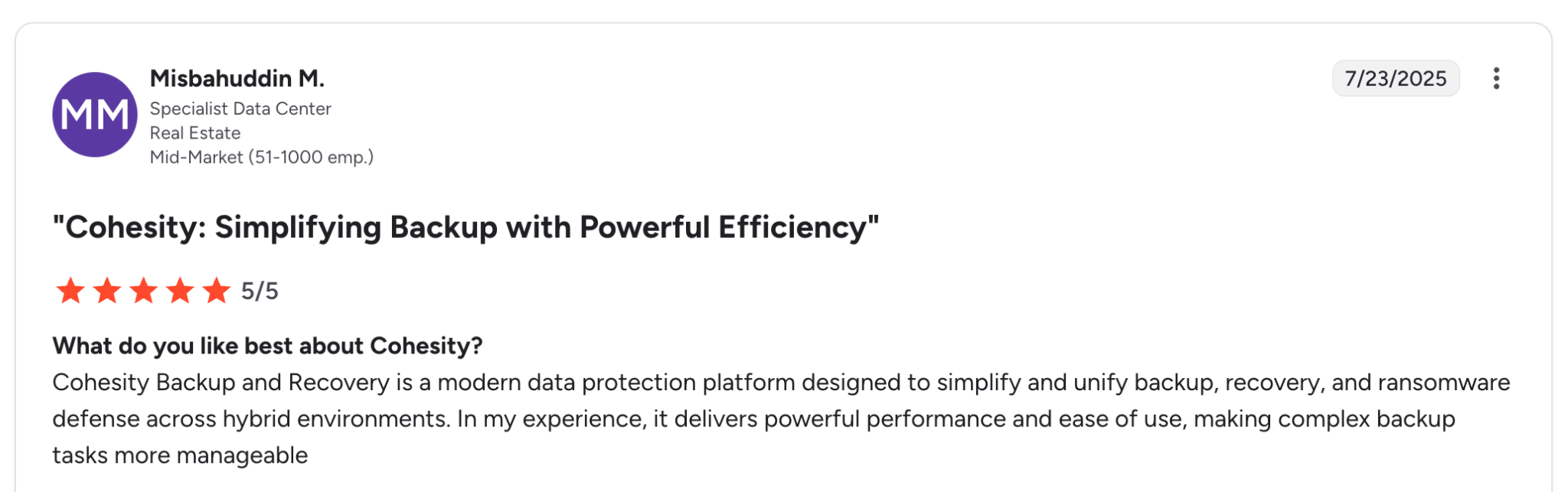
"It delivers powerful performance and ease of use, making complex backup tasks more manageable." — Misbahuddin M., G2
Strong SaaS integration and remote management
Cohesity's M365 integration covers mailboxes, OneDrive, and other SaaS workloads without friction. Paired with the Helios console, teams get secure remote cluster management from a single interface.
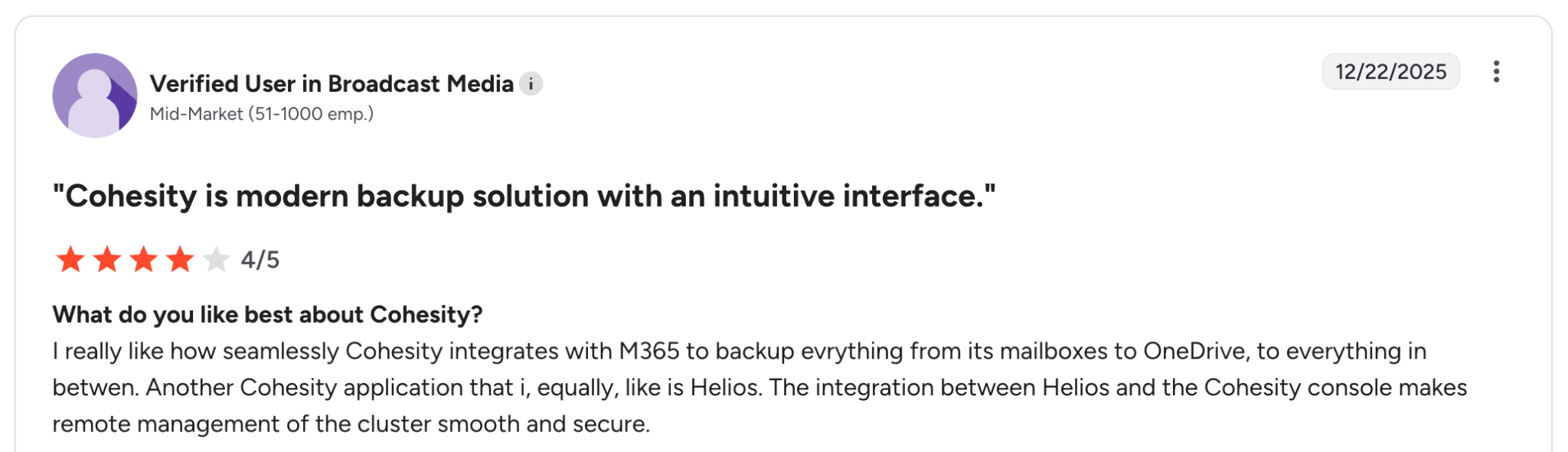
"I really like how seamlessly Cohesity integrates with M365 to back up everything from its mailboxes to OneDrive, to everything in between.” — User in Broadcast Media, Gartner Peer Insights
Efficient storage through deduplication
Global deduplication reduces redundant data across backup jobs, which helps control storage growth in large environments. Multiple reviewers highlighted that Cohesity allowed them to eliminate tape backups and consolidate legacy NAS devices onto a single platform. The mechanics behind that reduction are set out in our guide to backup deduplication benefits.
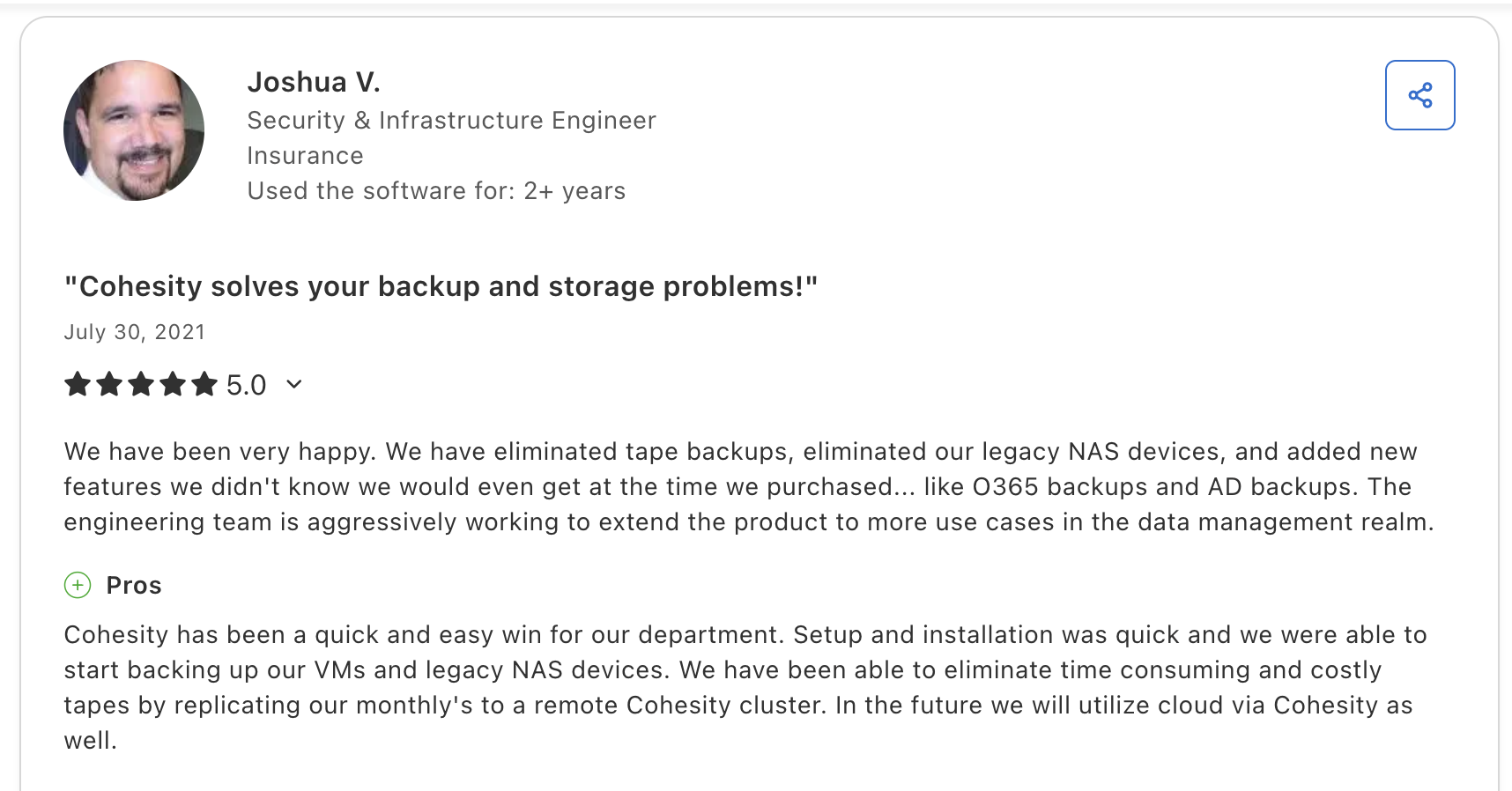
"We have been able to eliminate time consuming and costly tapes by replicating our monthly's to a remote Cohesity cluster." — Joshua V., Security & Infrastructure Engineer, Capterra
Cons
Instant recovery is too slow for real-world use
Cohesity's instant recovery feature promises fast restores, but reviewers find the actual performance doesn't hold up under production conditions. The vMotion component, in particular, introduces enough latency to make the feature impractical for teams that need quick turnarounds.
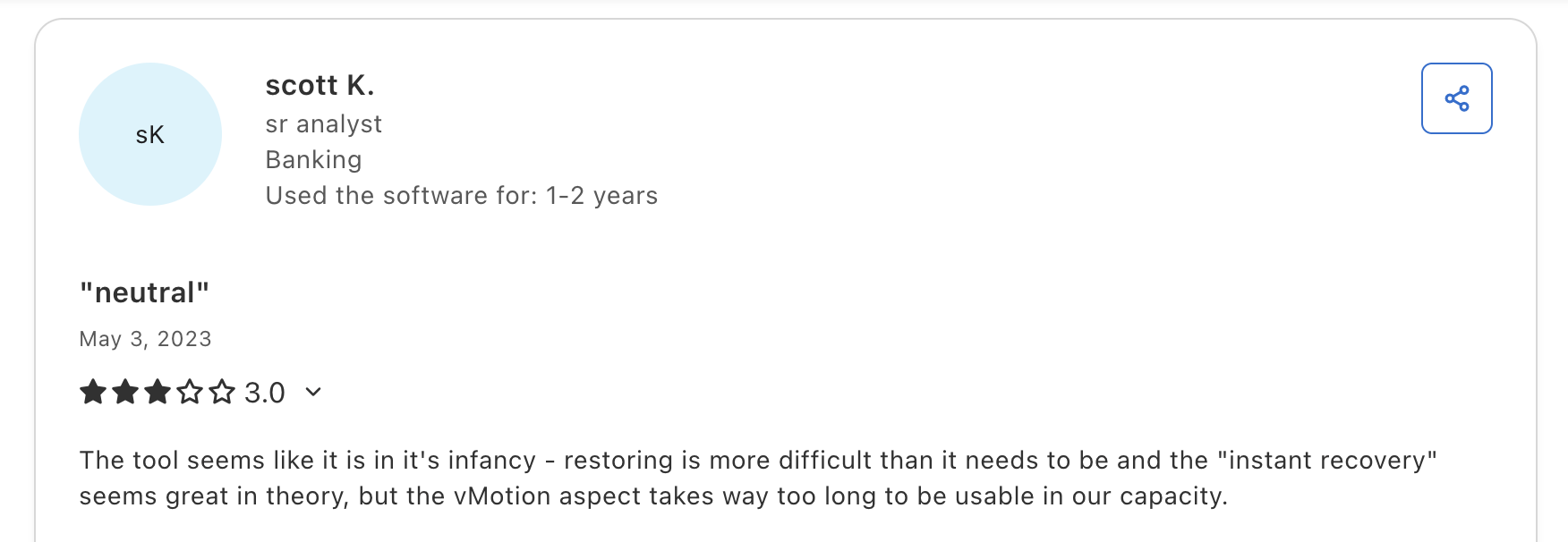
"Restoring is more difficult than it needs to be and the 'instant recovery' seems great in theory, but the vMotion aspect takes way too long to be usable in our capacity." — Scott K., Sr. Analyst, Banking, Capterra
Setup and ongoing management require dedicated resources
Deployment takes planning, and ongoing operations often require a dedicated backup team. Multiple reviewers describe the initial configuration as complex, with one Gartner reviewer in a regulated environment noting that the platform struggled to comply with their segmentation standards.
Cohesity does not offer company-sponsored user training, which several users flagged as making the onboarding period steeper than necessary.
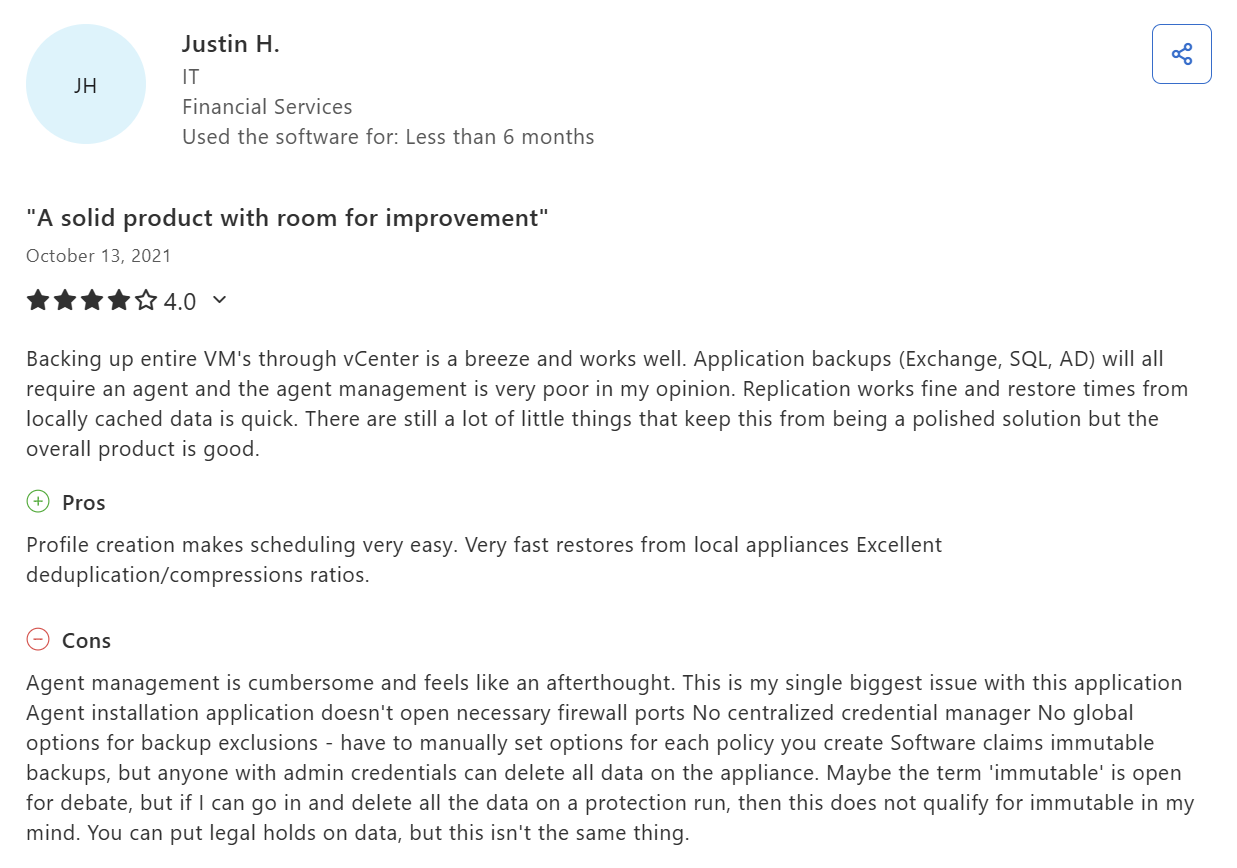
"No centralized credential manager. No global options for backup exclusions. Have to manually set options for each policy you create." - Verified Reviewer, Capterra
Cloud policy drift requires manual intervention
In dynamic cloud environments, Cohesity's policy model requires someone to actively track infrastructure changes and manually assign new resources to protection groups. There's no automated discovery or classification. If a new workload isn't manually added, it won't be covered, and issues can go unnoticed until an incident surfaces them.
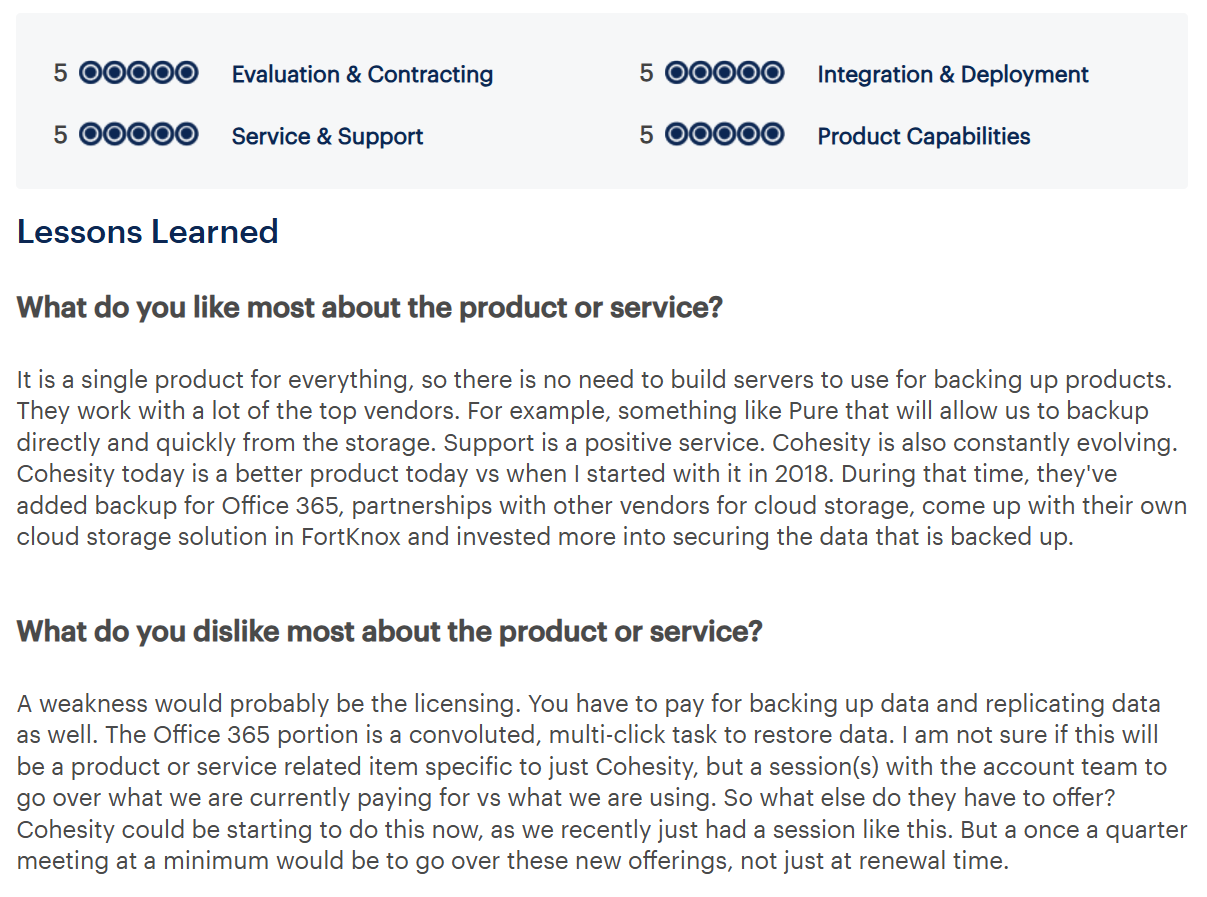
“You have to pay for backing up data and replicating data as well. The Office 365 portion is a convoluted, multi-click task to restore data." — IT Manager, Gartner Peer Insights
The pros and cons of Cohesity
Cohesity does what it was designed to do well. If you're consolidating fragmented backup tools in a hybrid environment, replacing tape with something modern, or protecting a large VM fleet with predictable workloads, it's a platform that earns the ratings it gets.
The Helios console is genuinely useful, the deduplication is effective, and the ransomware recovery story at the hospital speaks for itself.
Where reviewers flag it is the same place we see it. Cloud-first infrastructure works differently from on-prem infrastructure. Resources spin up across accounts and regions without anyone notifying the backup team. Storage costs grow silently.
Recovery requests tend to be specific (a database table, a particular file, a narrow compliance window) rather than wholesale VM restores. Cohesity's self-managed architecture is built around a level of infrastructure stability and manual oversight that cloud-first environments are designed to move away from.
The review data lines up with this. The positive reviews come overwhelmingly from hybrid and on-prem teams. The critical reviews come from teams whose environments operate under assumptions different from those Cohesity was designed for.
Is Cohesity right for you?
Who will get the most value?
- Hybrid environments where the majority of workloads run on-prem or in private data centers.
- VM-heavy estates with predictable workloads and stable infrastructure.
- Organizations replacing legacy backup tools (tape, NAS, older appliance-based systems) and consolidating onto a single platform.
- Teams with dedicated backup administrators who can manage cluster operations and ongoing policy maintenance.
Who should look elsewhere:
- Cloud-first companies running multi-account, multi-region AWS, Azure, or GCP environments at scale.
- Teams that need to recover individual files, database records, or table-level data without restoring full environments.
- Organizations where backup storage costs are already a concern and growing with data volume.
- Environments where new resources are deployed frequently and need automated backup discovery and classification.
- Teams that want to use backup data for analytics, compliance reporting, or AI workloads without running ETL pipelines.
What cloud-first teams actually need from a backup platform
Cloud-first infrastructure has a different backup problem than on-prem. Resources spin up continuously across accounts and regions without notifying anyone.
Ownership is fragmented across teams. New workloads go unprotected because static policies weren't built to track infrastructure that never stops changing.
Most teams don't immediately reach for a purpose-built cloud backup platform. They start with native tools like AWS Backup and Azure Backup because they're already there. Over time, fragmented visibility, all-or-nothing restores, and rising snapshot costs make it clear those tools weren't built for multi-account environments at scale either. On the Microsoft side, our comparison of the best Azure backup solution options covers where that ceiling sits.
That's the gap we built Eon to close.
Eon is the first backup autopilot for the age of cloud infrastructure. It connects to AWS, Azure, and GCP via secure, read-only APIs, with no agents, appliances, or clusters to manage.
Eon deploys via AWS Marketplace on a consumption-based billing model so that teams can start in minutes and scale spend with data, without the multi-year contracts and capacity commitments that Cohesity requires.
Four things work together to address the gaps cloud-first teams hit with Cohesity and native tools:
- Automated Cloud Backup Posture Management (CBPM). Eon created this category. CBPM continuously discovers new resources as they spin up, classifies them by data type, and assigns backup policies without manual tagging. Coverage gaps and policy drift surface automatically.
- Granular recovery with global search. File, record, and table-level restores with search across cloud providers. No rehydrating snapshots or spinning up full environments to find a single database record.
Backup-as-a-data-lake with Zero-ETL access. Backup data is stored in open formats (Apache Iceberg, Parquet) and is queryable directly through BigQuery, Snowflake, Databricks, Redshift, Athena, Trino, and Presto. No restore, no proprietary AI layer in the middle, no need to work inside a vendor's ecosystem. Compliance investigations, analytics, and ML workloads run on backup data using the tools your teams already use.
Cohesity's Gaia approach indexes backup data through a Cohesity-hosted RAG layer for natural-language search, primarily oriented toward unstructured content. Eon takes the opposite approach: open formats and standard query engines, so backup data behaves like any other table in your data stack.
- Immutable, logically air-gapped vaults by default. Every Eon deployment protects backups with immutable storage and logical air-gapping as the standard posture, not a premium add-on.
For managed databases such as RDS and Cloud SQL, where there are no files to scan, Eon analyzes the logical content of database backups (row counts, cardinality shifts, schema changes) to identify clean recovery points. When ransomware hits, recovery is surgical rather than a full rollback.
Global deduplication across cloud workloads, combined with incremental backups, reduces storage costs by 30 to 50 percent compared with hyperscaler-native tools, because Eon charges you for the data you actually need to store, not the full footprint under management.
Cohesity vs native cloud backup tools vs Eon
Most cloud-first teams pass through two decision points before landing on a purpose-built platform. Understanding where each option breaks down explains why.
| | Cohesity | Native Cloud Tools | Eon |
|---|---|---|---|
| Setup | Moderate to complex (cluster deployment) | Simple (console-based) | Agentless SaaS (API-based, no clusters) |
| Cost at scale | High (per-TB capacity licensing + cluster overhead) | Low initially, grows with snapshots | 30-50% lower through global dedup + incremental backups |
| Recovery | Structured full-environment workflows | Basic snapshot-level restore | Granular (file, record, table level) |
| Visibility | Centralized through Helios | Fragmented across accounts | Automated CBPM across clouds |
| Posture mgmt | Manual policy assignment | Per-service configuration | Automated CBPM (Eon-created category) |
| Backup data access | Restore required | Restore required | Zero-ETL, queryable in place |
Native tools are the default starting point, but can create blind spots as environments grow. On-prem platforms like Cohesity consolidate management but can add infrastructure overhead in cloud-native deployments. Neither was originally designed for multi-account, multi-region cloud environments at scale.
Final verdict
Cohesity earns its ratings for the environment it was built for. Teams running large on-prem or hybrid estates with predictable workloads consistently rate it well, and the review data backs that up.
Cohesity's recent merger with Veritas reinforces that center of gravity. Veritas's customer base skews heavily toward enterprise on-prem and hybrid environments, and the combined platform inherits those assumptions.
Cloud-first infrastructure creates a different problem. Resources change constantly, ownership is fragmented, and recovery requests are specific. In these environments, cluster-based architecture and manual policy assignment create friction that compounds as the estate grows.
If your infrastructure lives in the cloud, your backup platform should too. Find out what's actually protected across your clouds, where the gaps are, and how fast you can recover the right data. See Eon in action.
Frequently asked questions
Is Cohesity a good backup solution?
Yes, Cohesity is a reliable backup platform for enterprise environments running hybrid or on-prem infrastructure. It performs well with large VM fleets and stable workloads, with strong marks for centralized management and deduplication.
What are the main disadvantages of Cohesity?
The main disadvantages are escalating costs at scale (especially in cloud deployments, where per-TB capacity licensing scales with data growth regardless of how efficiently you store it), a complex initial setup without vendor-provided training, recovery workflows that favor full restores over granular precision, and limited automated discovery of new cloud resources.
How does Cohesity compare to AWS Backup?
Cohesity centralizes management and policy enforcement across workloads, while AWS Backup offers a simpler setup with less visibility and no granular recovery. Both leave gaps in cost control and posture management at multi-account scale.
Is Cohesity expensive?
Yes, Cohesity can become expensive as data grows. Per-TB capacity licensing means you pay for data under management regardless of storage efficiency. Combined with cluster compute costs in cloud deployments and add-on features, the cost model compounds across multiple dimensions. See our Cohesity backup pricing breakdown for what each of those dimensions adds.
Does Cohesity work well for cloud-native environments?
Cohesity supports AWS, Azure, and GCP, but its cluster-based architecture adds infrastructure overhead in cloud deployments. Cloud-first teams with multi-account, multi-region environments often report friction around cost growth, limited automated resource discovery, and recovery precision.
What is a good alternative to Cohesity for cloud environments?
For cloud-first teams, Eon is purpose-built for the environment that Cohesity wasn't designed for. It created the Cloud Backup Posture Management (CBPM) category, delivers granular recovery at the file, record, and table levels, and makes backup data queryable without restore.
Does Cohesity offer file-level or record-level restore?
Cohesity offers file- and object-level restores across many workloads and supports database-level recovery for SQL Server and Exchange. Teams needing record-level or table-level recovery across cloud-native databases may find platforms like Eon more streamlined.
How long does Cohesity take to set up?
Setup timelines vary, but multiple reviewers describe the initial deployment as requiring careful planning and dedicated resources. Organizations with complex compliance requirements or highly segmented networks may face a longer onboarding period. The lack of company-sponsored user training adds to the learning curve.