

Following a busy June that included Google Workspace backup and recovery, network exposure classification, and more, the momentum continued into July with the Summer of Shipping. Apparently no one told the Eon engineering team it was summer.
We introduced protection for MongoDB Atlas, Oracle on Amazon RDS, Amazon Keyspaces, and Azure Files, along with faster EC2 recovery through Instant Restore. We also made recovery easier to execute and monitor with bulk restore and live job steps, while expanding cross-cloud database protection across AWS, Google Cloud, and Microsoft Azure.
Together, these releases bring more of the critical resources enterprises rely on under one centralized, policy-driven platform.
MongoDB Atlas Backup and Recovery
Eon now supports cloud-native backup and recovery for MongoDB Atlas.
Using continuous change data capture, Eon allows teams to recover a specific collection, document, dataset, or point in time without restoring the entire database. This provides the recovery precision organizations need as AI agents, automated workflows, and cyber threats create new risks for production data.
MongoDB Atlas backups are stored in immutable, logically isolated storage and monitored for ransomware indicators such as abnormal encryption, schema changes, and mass deletion. Backup data is also maintained in open file formats, making historical MongoDB data accessible for recovery, security investigations, analytics, and AI workflows.
Learn more: https://www.eon.io/blog/mongodb-atlas-backup-and-recovery
Oracle Data Protection on Amazon RDS
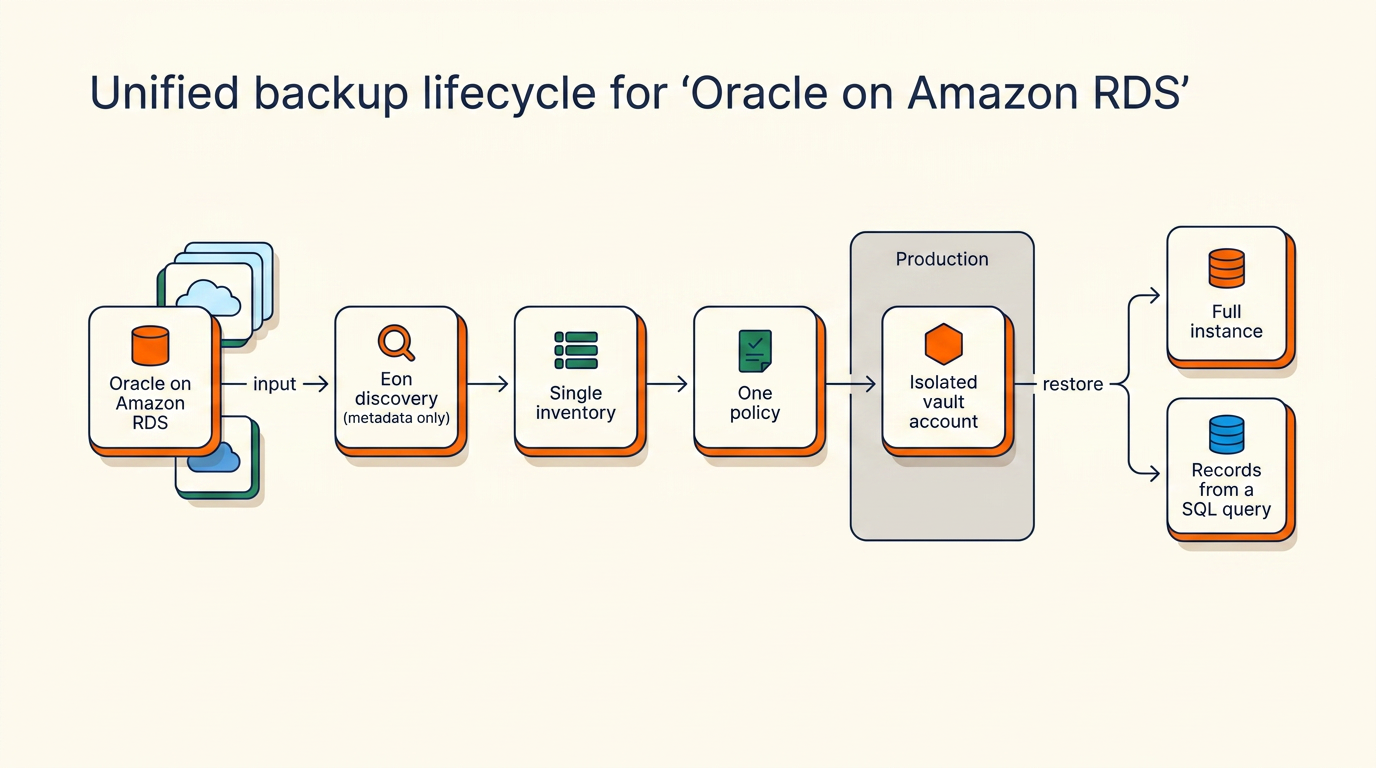
Eon also supports backup and recovery for Oracle databases running on Amazon RDS.
Organizations can protect Oracle RDS instances using the same automated, policy-driven backup workflows they use across the rest of their cloud estate—without relying on manual scripts, disconnected snapshots, or separate operational processes.
Teams can centrally discover Oracle RDS resources, apply protection policies, monitor coverage, and initiate recovery through the Eon platform.
Learn more: https://www.eon.io/blog/eon-backup-and-recovery-for-oracle-on-amazon-rds
Amazon Keyspaces Data Protection
Get end-to-end data protection for Amazon Keyspaces for Apache Cassandra with Eon.
This new integration delivers agentless backup, point-in-time recovery, and single-click restore for Keyspaces tables so teams can protect business-critical Cassandra workloads without building and maintaining custom backup infrastructure.
The release also marks an important step in Eon’s continued collaboration with AWS to provide expanded, enterprise-ready data protection.
Learn more: https://www.eon.io/blog/amazon-keyspaces-data-protection-with-eon
EC2 Instant Restore
Eon Instant Restore now helps organizations recover Amazon EC2 instances in minutes instead of hours.
Rather than waiting for every volume to be fully hydrated before an instance can start, Instant Restore boots the recovered EC2 instance immediately. Applications and users can begin accessing the instance while the remaining data continues hydrating in the background.
This significantly reduces recovery time for large instances and helps teams restore critical services faster following an outage, cyber incident, or operational failure.
Learn more: https://www.eon.io/blog/introducing-ec2-instant-restore
Azure Files Data Protection
Centrally manage backup and recovery for Azure Files with Eon. We automatically discover Azure Files shares, configure and schedule backup policies, monitor protection, and initiate restores through a centralized interface. Snapshots remain within the customer’s Azure account and are managed through Azure Recovery Services Vault, while Eon provides a consistent operational experience across the rest of the customer’s cloud environment.
Recover Multiple Resources with Bulk Restore
Bulk restore allows teams to recover multiple resources through a single operation instead of initiating and managing each restore individually.
Users can select a snapshot and restore template for each resource, then submit the entire recovery operation at once. Eon automatically creates the individual restore jobs and groups them under a shared bulk-restore operation, making it easier to monitor and coordinate larger recovery events. This is particularly useful for application-level recovery, disaster-recovery testing, and incidents affecting multiple dependent resources.
Follow Restores in Real Time with Job Steps
Restore jobs now include a live Steps breakdown within the job details panel.
Users can see exactly what Eon is doing throughout the recovery process, including:
- The current status and duration of each restore step.
- A live data-restoration progress bar.
- An estimated completion time.
- Details about resources created in the customer’s cloud account.
This provides greater transparency during recovery and makes it easier for infrastructure and application teams to understand when restored resources will be ready.
Expanded Cross-Cloud Database Protection
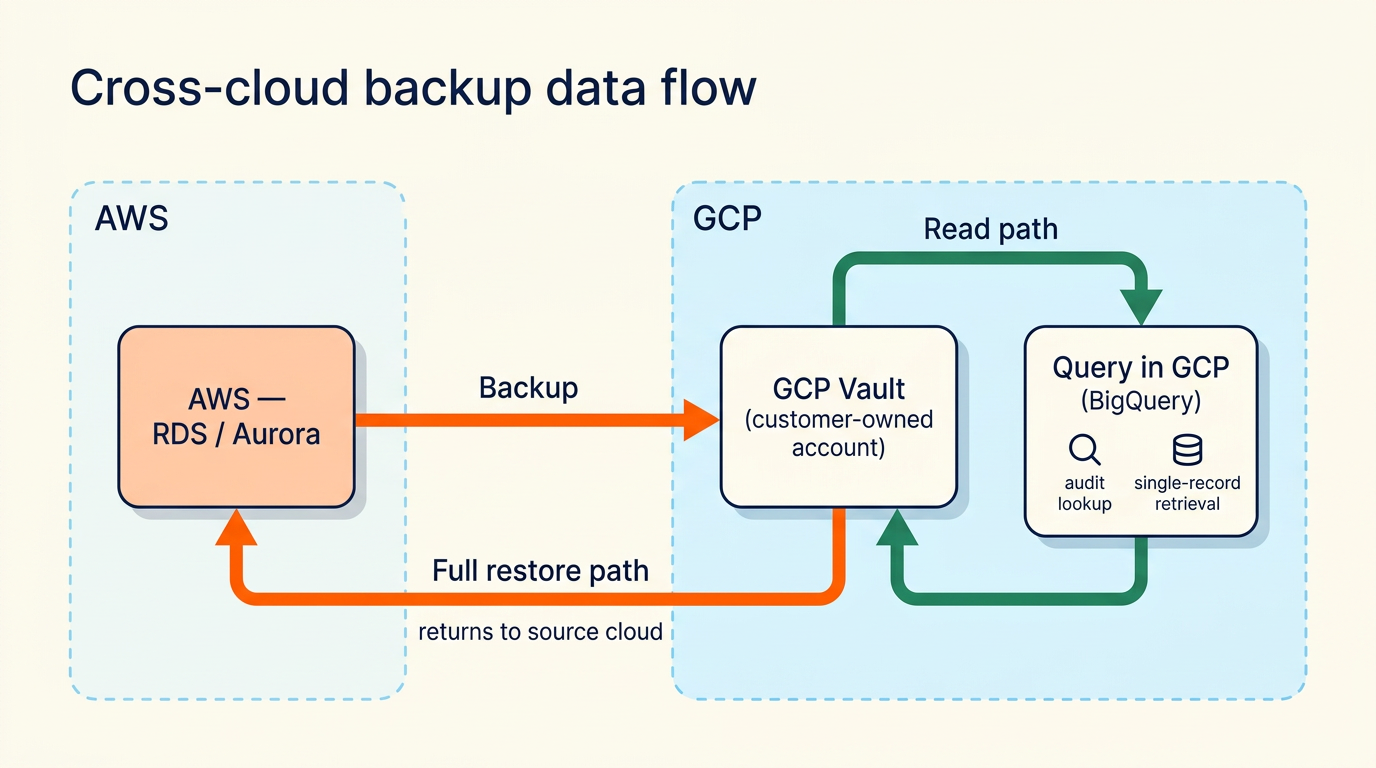
Eon has expanded support for cross-cloud relational database backup and recovery. Organizations can now back up a database into an Eon vault hosted in a different cloud, while retaining the ability to restore the database back into its original cloud environment.
Current support now includes:
- Amazon RDS and Aurora databases backed up to a Google Cloud vault.
- Google Cloud SQL databases backed up to an AWS vault.
- Microsoft SQL Server and Azure Database for PostgreSQL Flexible Server backed up to AWS or Google Cloud vaults.
By separating protected data from the production cloud environment, organizations can strengthen resilience against cloud-level outages, account compromise, ransomware, and other incidents that could affect both production systems and native backups.
Learn more: https://www.eon.io/blog/cross-cloud-backup-read-path
Learn More
We are continuing to expand the resources organizations can protect, recover, and put to work through a single cloud data platform. Request a demo to see the latest capabilities in action, or follow Eon on LinkedIn to keep up with the rest of the Summer of Shipping and beyond.