

Choosing wrong between Cohesity and Veeam means years of lock-in or runaway licensing, so we cut to the seven differences that decide it, plus where cloud-first teams outgrow both. For the Veeam half of that decision on its own, see our Veeam review.
Cohesity vs Veeam: What's the difference?
The main difference between Cohesity and Veeam is architecture and licensing philosophy. Cohesity runs a scale-out platform that consolidates backup, file and object services, and security features under one system, usually on certified appliances or as a managed service. Before choosing, set your targets with our guide to RTO vs RPO.
Veeam runs as software you install on hardware of your choice, licensed per workload instance rather than by stored capacity.
Choose Cohesity if you want consolidated data protection plus file and object services across a large hybrid estate, value scale-out architecture and AI-driven threat detection, or already run NetBackup and want a single-vendor roadmap.
Choose Veeam if you want hardware and hypervisor flexibility with no lock-in, predictable instance-based licensing, wide workload coverage including SaaS and Kubernetes, and strong cross-platform recovery. What that works out to per workload is in our Veeam cost breakdown.
| Factor | Cohesity | Veeam |
|---|---|---|
| Best for | Large hybrid enterprises wanting consolidation and AI-driven security | Teams wanting flexibility, no lock-in, and predictable licensing |
| Cloud / SaaS coverage | AWS, Azure, GCP, plus M365 and major SaaS apps | AWS, Azure, GCP, M365, Salesforce, Entra ID |
| Architecture | Scale-out platform, certified appliances or managed service, runs on Red Hat Linux | Software-defined, hardware agnostic across 70+ vendors, optional Software Appliance |
| Licensing model | Subscription, typically capacity-based by terabyte or petabyte, workload, or appliance | Per-workload instance licensing, decoupled from stored capacity |
| Ransomware approach | Immutable snapshots, AI-based anomaly detection, FortKnox cybervault, partner-led incident response | Recon Scanner, Threat Hunter, clean-room Secure Restore, in-house Cyber Secure response |
What is Cohesity?
Cohesity is a data protection and management platform. In December 2024 it completed its acquisition of the Veritas NetBackup business, bringing the DataProtect and NetBackup product lines under one company.
It runs a scale-out architecture and now ships two backup engines, its own DataProtect and the inherited NetBackup, alongside FortKnox cyber vaulting, DataHawk, SmartFiles, and SiteContinuity, through one interface running on Red Hat Linux.
Cohesity is available as a managed service, self-managed on certified platforms such as VMware, Nutanix, and Windows Hyper-V, or through a partner.
What is Veeam?
Veeam is a software-defined data resilience platform. It installs on hardware of your choice rather than dedicated appliances, licenses per workload instance, and writes self-describing backup files that restore without the original infrastructure.
In Veeam Data Platform v13, released in November 2025, Veeam added a hardened Linux Software Appliance, a Universal Hypervisor Integration API, Recon Scanner 3.0, and a Veeam Intelligence assistant. It protects physical, virtual, cloud, SaaS, and Kubernetes workloads from a single platform.
Cohesity vs Veeam: Feature-by-feature comparison
Both platforms protect enterprise data well, so the differences live in the details. Here are the seven that change the outcome, with where each one leads and where cloud-first teams find the model strained.
Company structure and backup engines
Cohesity offers the broadest portfolio of the two after the Veritas deal, now running two distinct backup engines, the cloud-era DataProtect and the decades-old NetBackup, under one interface.
That range comes with overlap and a learning curve: NetBackup carries 20-plus years of history across its Veritas, Symantec, and now Cohesity ownership, and remains difficult to set up and administer without deep platform expertise. Buyers also have to track which engine gets long-term roadmap investment as Cohesity converges the two.
Veeam offers a single unified platform with one engine, which keeps the mental model simpler. Its recent moves are additive rather than structural, including the v13 release and the $1.725 billion Securiti AI acquisition in October 2025. Teams adopt one product rather than choosing between two engines under one badge.
Winner: Tie. Cohesity wins on scope and consolidation, Veeam wins on a simpler single-engine model.
Licensing and cost model
Cohesity uses a subscription model structured around capacity, measured in terabytes or petabytes, plus workloads or appliances. Consolidating backup, files, security, and recovery into one platform can retire several point products and their separate costs, which appeals to teams collapsing many tools into one.
Veeam uses per-workload instance licensing that stays the same as the data behind each workload grows, with no extra charge for backup copies, longer retention, or replication.
Winner: Veeam for predictable scaling, though Cohesity can win when it replaces several products at once.
Architecture and deployment
Cohesity is a scale-out platform you run on certified systems, buy as a managed service, or get through a partner. That coupling delivers consistent performance, and it also limits hardware choice and stores backups in a proprietary format tied to the platform.
Veeam stays hardware agnostic across more than 70 storage and server vendors and added a hardened Linux Software Appliance and a Universal Hypervisor Integration API in v13, so any hypervisor vendor can integrate natively.
Its self-describing backup files restore without the original infrastructure, which helps teams migrating off VMware after Broadcom's licensing changes.
Winner: Veeam for hardware and hypervisor freedom with no lock-in.
Cyber resilience and ransomware recovery
Cohesity leans on immutable backup snapshots, AI-based anomaly detection, the FortKnox managed cyber vault, and DataHawk for threat scanning and classification, with incident response through Google Threat Intelligence and Mandiant.
Veeam built Recon Scanner 3.0, powered by Coveware, into the platform for real-time threat visibility, pairs it with a YARA-based Threat Hunter and a clean-room Secure Restore that scans restore points during recovery, makes backups immutable by default, and runs an in-house Cyber Secure incident response program rather than relying on partners.
Winner: Tie. Veeam leads on inline detection and clean-room restore; Cohesity leads on immutable vaulting and recovery at scale.
Recovery speed and granularity
Cohesity offers rapid recovery at scale and instant VM restore, with recovery orchestration centered on its platform. It recovers in the units it was built around, which are images, volumes, and VMs.
Veeam targets near-zero data loss with continuous data protection, instant recovery for VMs, physical machines, and NAS, and added instant recovery directly into Microsoft Azure with clean-room validation in v13. Its cross-platform recovery can bring a workload back even when the original hypervisor is gone.
Winner: Veeam for recovery flexibility and cross-platform options.
Cloud, SaaS, and Kubernetes coverage
Cohesity protects AWS, Azure, and Google Cloud across its DataProtect and NetBackup workloads, and has deepened its Google Cloud integration, including FortKnox cyber vaulting on Google Cloud.
Veeam carries the broader modern workload list, protecting AWS, Azure, and Google Cloud, Microsoft 365 and Entra ID, Salesforce, Kubernetes through Kasten, and native Red Hat OpenShift Virtualization backup on its 2026 roadmap, building on existing Kasten support.
Winner: Veeam for the wider modern workload coverage.
AI readiness and backup data as an asset
Cohesity introduced Gaia, which runs retrieval-augmented generation directly on backup data using NVIDIA AI Enterprise, with integrations to Microsoft Copilot, Glean, and Google Gemini. Its RAG-on-backup capability is further along than most rivals.
Veeam added a Veeam Intelligence assistant and acquired Securiti AI for $1.725 billion, positioning toward a unified data and AI platform, though that capability is still being assembled.
Winner: Cohesity. Gaia's RAG-on-backup is further along than Veeam's in-progress Securiti integration.
What real users say
In practice, the two land close, with Cohesity rated slightly higher and Veeam reviewed in far greater volume.
Cohesity
Pros
- Fast deduplication and restore performance. Kalaiarasan M., a specialist at HCLSoftware, noted on PeerSpot that "the deduplication in Cohesity DataProtect is very fast."
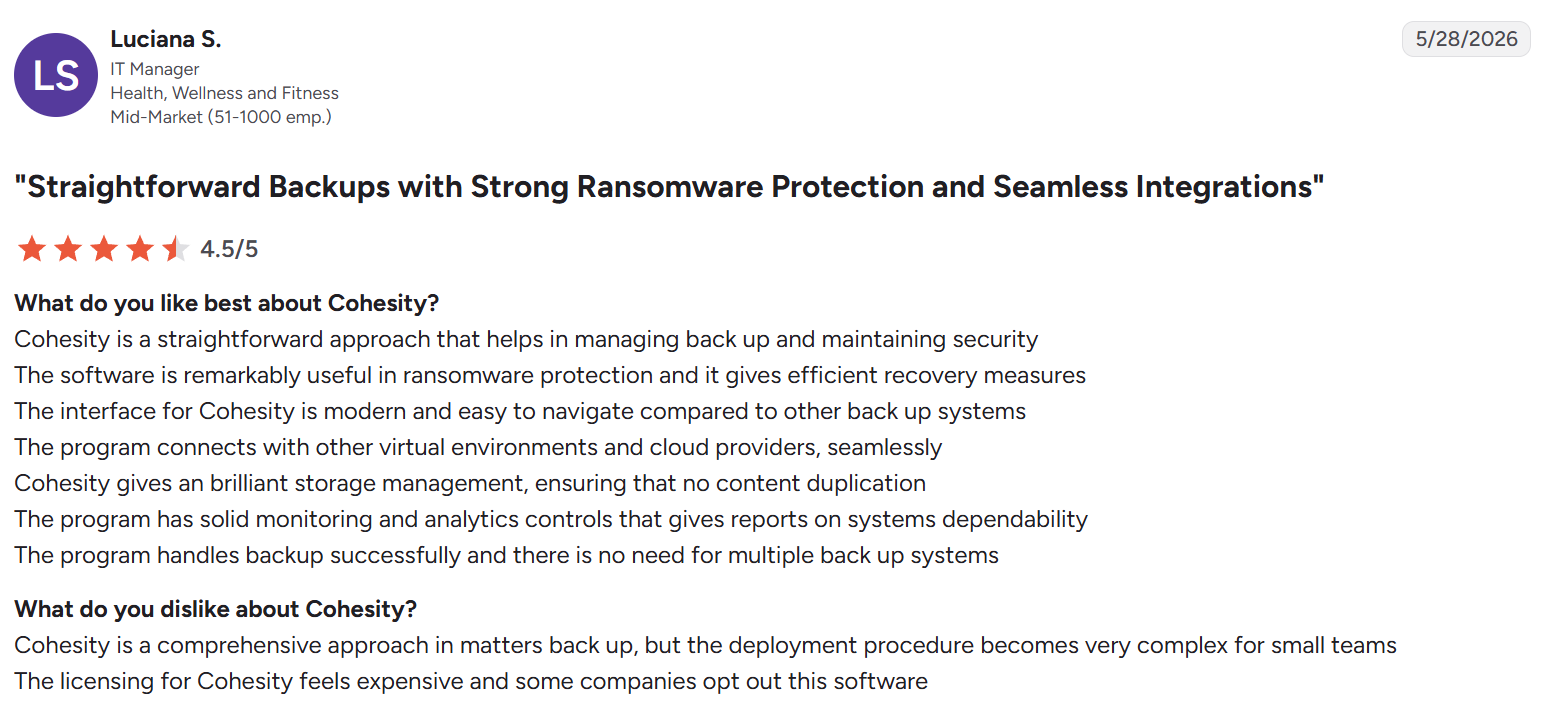
- Simple to stand up and run. Luciana S., an IT manager, wrote on G2 that Cohesity is "modern and easy to navigate compared to other backup systems."
- Consolidates backup into one system. Stefan M., a CTO at fgnext, described it as "a converged solution that simplifies backup."
Cons
- Recovery automation has gaps. A senior product manager in IT services wrote on Gartner Peer Insights that Cohesity's "Active Directory restoration could be more robust in terms of automation and playbooks."
- Pricing draws criticism. An IT manager in manufacturing said, “You have to pay for backing up data and replicating data as well.”
Read our more detailed Cohesity review here
Veeam
Pros
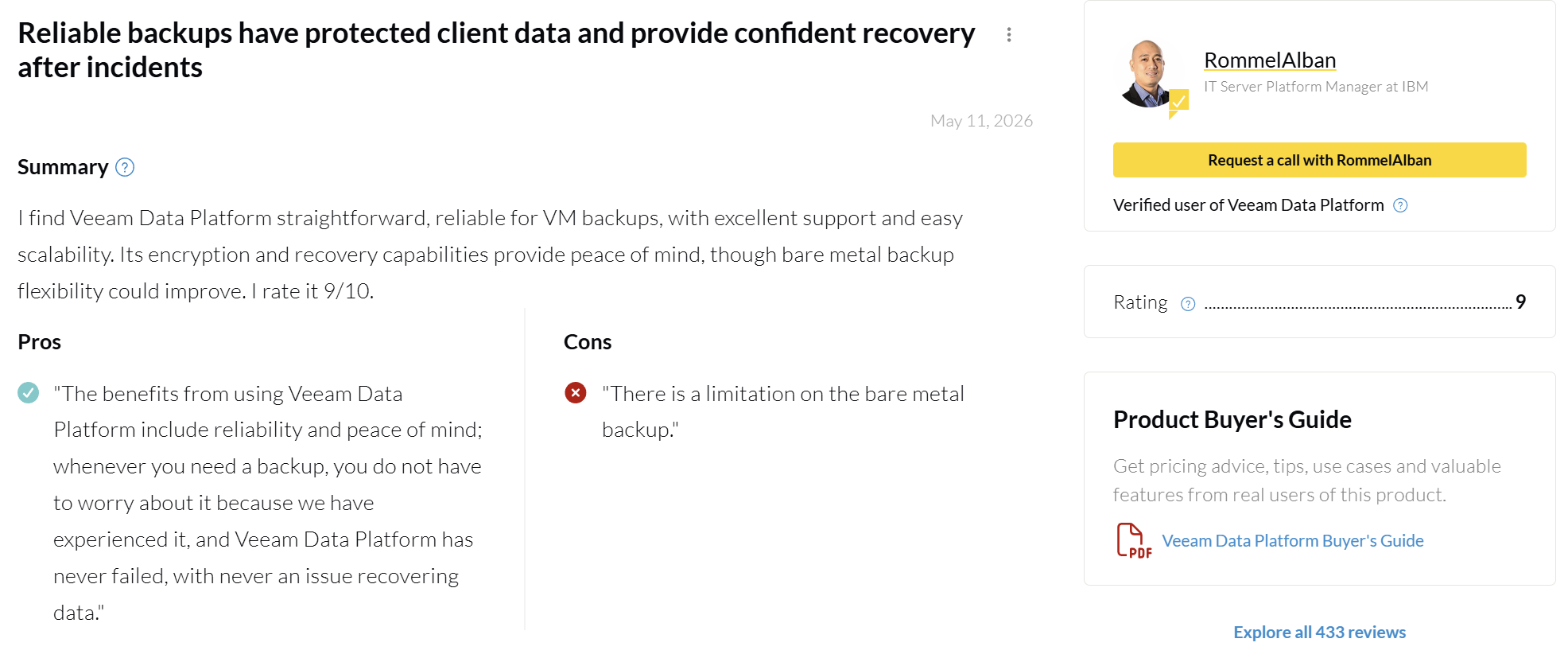
- Dependable recovery over time. Rommel Alban, an IT server platform manager at IBM, wrote on PeerSpot that Veeam "is reliable for VM backups, with excellent support and easy scalability."
- Flexible hybrid deployment. A senior production analyst at a logistics company told PeerSpot that its "hybrid deployment options is very simple, efficient, and user-friendly."
- Quick to set up. Michael Schwarzer, a managing director at INT/box, noted that users can "back up most environments within minutes."
Cons
- Cloud-native depth and automation lag. Niyajuddin T., an infrastructure team lead at Digitaltrack, wrote that Veeam could use "deeper cloud-native features, more advanced analytics, and enhanced automation."
- Support response can disappoint. Jitendra Sadaye, an associate technical specialist, cited "difficulties due to response time and quality of support."
How to make your choice
Cohesity and Veeam both protect enterprise data well, so the decision turns on architecture, cost model, and what you want from backup data later. Teams searching Veeam vs Cohesity usually arrive with the same three questions: what it costs at their scale, what it recovers, and what happens to the backup data afterward. The same three axes decide the Commvault vs Veeam comparison, with broader workload coverage on the other side.
Cohesity is the better fit if:
- You want to consolidate backup, file and object services, security, and disaster recovery into one scale-out platform.
- You value AI-driven threat detection and an integrated cyber vault.
- You already run NetBackup and prefer a single-vendor roadmap.
Veeam is the better fit if:
- You want hardware and hypervisor freedom with no lock-in.
- You need predictable instance-based licensing as data grows.
- You need broad coverage across cloud, SaaS, and Kubernetes, plus cross-platform recovery.
A cloud-native alternative: Eon
Teams shortlisting Cohesity and Veeam are weighing two platforms with data center roots. Cloud-first teams running everything on public cloud have a third option built for that profile.
Eon is a fully SaaS-managed backup platform for teams running AWS, Azure, and Google Cloud, with no appliances, no worker instances, and no per-cloud license stacking.
Its Autonomous Cloud Backup Posture Management discovers cloud resources across accounts and regions, classifies data by risk and compliance context, and applies backup policies based on data characteristics rather than tags, which keeps coverage aligned as environments change.
Eon supports granular recovery at the file, object, and database-record levels. A recovery process that took SoFi a full day now finishes in minutes. Eon also stores backups in open formats (Parquet, Iceberg, and Delta Lake), turning backup history into a governed live data lake for analytics, ML, and AI without restore-first workflows.
Restores include no data retrieval or egress fees, which adds up because backups parked in tiered cloud object storage typically carry retrieval and egress costs on top of storage.
Storage savings of 30 to 50% come from incremental-forever backups and cloud-native deduplication. NETGEAR cut backup storage costs by 35% after moving to Eon from a legacy provider, and Cost Explorer gave its team instant visibility into spend by resource and application, replacing the manual reporting it had relied on before.
Ransomware resilience is built into the backup workflow. Eon stores data in immutable, logically air-gapped vaults with anomaly, ransomware, and malware detection tied to backup activity, and surfaces clean recovery points for rollback across compute, object storage, and databases.
Struggling to recover a single file across multi-cloud backups without a full restore? Book a demo and see how Eon recovers at the file, object, and record level across AWS, Azure, and GCP.
Frequently asked questions
Is Cohesity better than Veeam?
Neither Cohesity nor Veeam is universally better, because they optimize for different priorities. Cohesity fits large hybrid estates that want consolidation and AI-driven security on a scale-out platform, while Veeam fits teams that want hardware freedom, predictable licensing, and broad workload coverage. Teams who add a third name to that shortlist usually land on Rubrik, which we cover in Cohesity vs Rubrik. If the shortlist is Cohesity vs Rubrik vs Veeam rather than a straight two-way call, that comparison covers where Rubrik's security-led model differs from both.
Is Cohesity the same as NetBackup now?
No, but NetBackup is now a Cohesity product. Cohesity sells two distinct backup engines, its own DataProtect and the acquired Veritas NetBackup, under one interface, and supports both while it works toward a converged platform.
How do Cohesity and Veeam handle ransomware differently?
The main difference is timing and method. Veeam emphasizes real-time threat detection during backup and recovery with clean-room Secure Restore and in-house incident response, while Cohesity emphasizes immutable snapshots, AI-based anomaly detection, and partner-led incident response through Google Threat Intelligence and Mandiant.
Which is more cost-effective, Cohesity or Veeam?
The cost-effective choice depends on data growth. Cohesity's capacity-based subscription can rise as protected data grows, while Veeam's per-workload instance licensing stays flat as data behind each workload increases, so fast-growing estates often favor instance pricing. Our Cohesity pricing breakdown shows how that capacity-based subscription is quoted across deployment models.
Are Cohesity and Veeam good for cloud-first companies?
Both work in the cloud, but both started in the data center, so cloud-first companies running multi-petabyte estates across several providers often hit gaps in cost, visibility, and granular recovery. Cloud-native platforms such as Eon are built for that profile, classifying cloud resources automatically and making backups queryable without a full restore. The wider field of Cohesity alternatives covers the rest of that shortlist.