


Data protection has always run at human speed. An admin sets a policy, tests a restore once a year, and trusts the recovery plan to hold if it is ever needed. That cadence made sense when the threat also moved at human speed.
Agentic AI ended that assumption on both sides at once. Engineers now ship more code, faster, spinning up databases and buckets that no one remembers to tag. Attackers now automate reconnaissance, exploit generation, and lateral movement, compressing what once took days into hours. Frontier models like Mythos have already been shown to find zero-days and build working exploits on their own. Ransomware increasingly completes at machine speed, in minutes rather than days.
The backup is no longer the safe corner of that story. It is the first target. In a Sophos survey of ransomware-hit organizations, 94% saw attackers try to compromise their backups and 30% had backups destroyed outright. Backup repositories are targeted in roughly 96% of attacks and compromised about 76% of the time, and backup integrity is the single dominant recovery variable: organizations with intact backups recover within a week 46% of the time, versus 25% for those whose backups were hit. CrowdStrike found that 48% of organizations now name AI-automated attack chains their greatest ransomware threat, 85% say traditional detection is becoming obsolete, and fewer than a quarter recover within 24 hours.
A discipline that reviews, coordinates, and approves at human pace cannot close that gap. Resilience has to become autonomous across the full data lifecycle, with humans reserved for the decisions that cannot be undone. This ships today, not on a roadmap: Eon, the cloud-native data backup company, has designed its architecture so each stage of the lifecycle is agent-drivable right now.
You cannot protect an estate you discover once a quarter
Most organizations still discover their cloud estate the way they audit it: periodically, manually, and after the fact, while AI-assisted engineering spins up new databases and buckets daily that no inventory captures. Continuous, automatic discovery is the only visibility model that keeps pace with how infrastructure is now created.
Eon maps a multi-cloud estate without ever reading resource data. Installation is a single CloudFormation template that grants read-only IAM permissions, after which Eon runs its first discovery across the account. Discovery is metadata-only. Eon reads resource names, tags, and existing snapshots; the actual resource data is never read or transferred during discovery.
That scan runs continuously, catching new and updated resources as they appear, across AWS, Azure, and Google Cloud from a single platform with no software agents or appliances deployed into your workloads. One IAM role, no client software, no tagging prerequisite. An agent can query that live map instead of a stale spreadsheet.
Policy has to follow the data, not the tags
Eon classifies each resource by data class, environment, and application, drawing on its properties, metadata, and contents, then attaches backup policy to the classification rather than to the individual resource, so protection follows the data instead of manual tags that drift the moment a team ships faster than it documents. A new PII-bearing database inherits the right policy the moment it is classified, without anyone tagging it.
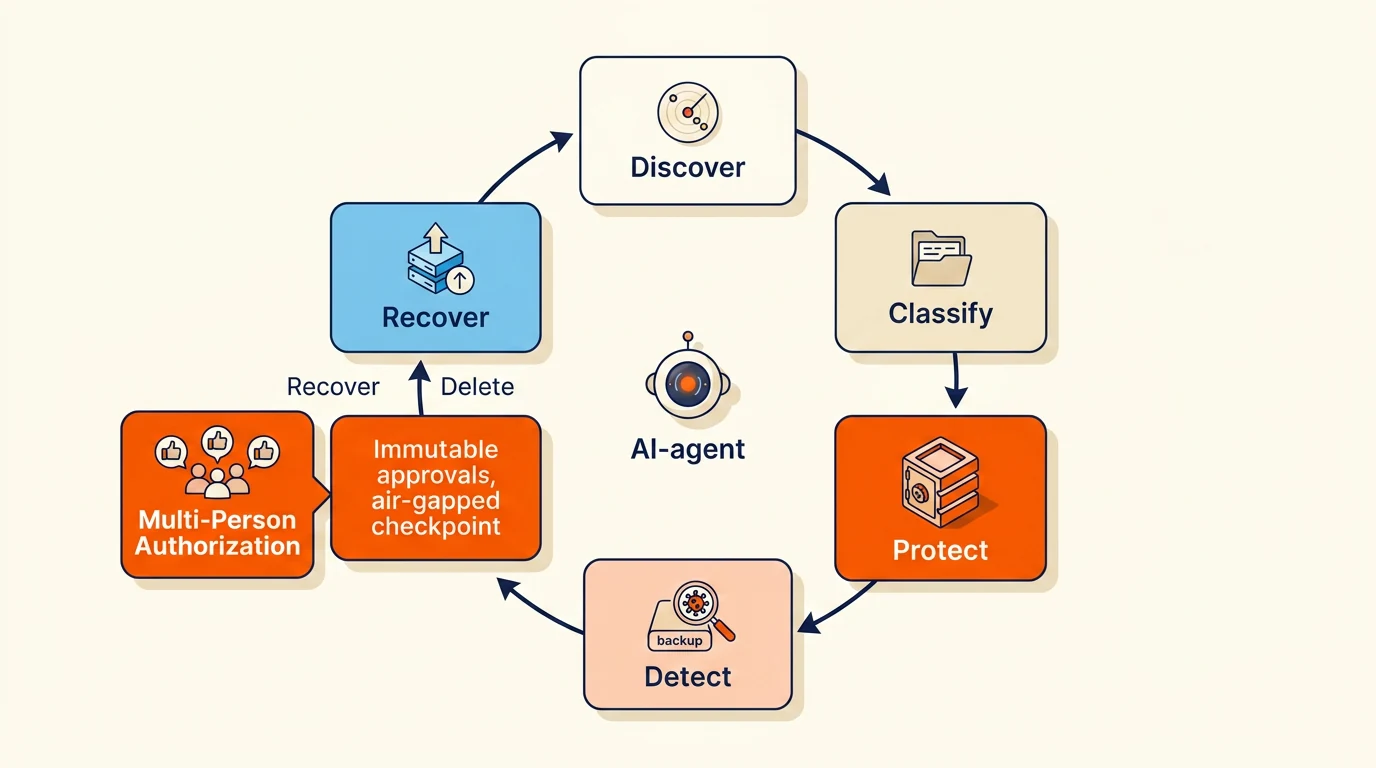
Cloud Backup Posture Management (CBPM) is the discipline this belongs to: an autonomous control layer that runs a continuous loop of discover, classify (PII, PHI, financial; prod versus dev; no manual tagging), apply policy by classification, monitor for drift, and repeat. CBPM changes the operative question from “Is this resource backed up?” to “Is it backed up correctly, continuously compliant, and actually restorable?” Eon’s 2025 report found that only 5% of organizations have automated their backup posture. Our primer on cloud backup posture management walks through that loop step by step.
Classification is also the first place the trust boundary shows up. If a human overrides a classification, Eon stops auto-updating it, because the override changes which backup policies, posture controls, and access controls apply. The machine keeps the estate current; the human owns the deliberate exception.
Recovery has to live outside the blast radius
If an attacker who owns your production credentials can also reach your backups, you do not have a recovery plan; you have one large blast radius. Recovery only counts as insurance when it lives somewhere those credentials cannot follow.
Eon keeps recovery on an independent plane: each customer’s vault lives in a dedicated vault account inside a separate Eon tenant, logically air-gapped from that customer’s production and internal environments. Most backup platforms, by contrast, sit inside the same blast radius they are meant to protect, with shared control planes, long-lived credentials, and persistent access. With Eon-managed keys, the vault is locked down from any cloud account you own, so an attacker who compromises your accounts cannot reach the key. Eon’s public Terraform provider reflects the same separation, exposing distinct source_account, restore_account, and vault resources rather than a single-account design.
Isolation only earns its keep if recovery stays surgical. Eon restores files, objects, rows, databases, or full workloads without forcing a full-snapshot restore, with point-in-time recovery down to the individual file or object. An agent can request exactly the rows that changed, not the whole database.
Immutability and cleanliness are two different guarantees
Eon makes the backup itself the detection surface. A WORM object lock proves a recovery point is intact, unaltered, and undeletable. It says nothing about whether the data inside is infected. An immutable snapshot of an encrypted database is still an encrypted database.
Eon answers that second question, whether the recovery point is clean, at the logical layer. Rather than scanning a disk image or a live host, Eon analyzes each snapshot’s logical contents: files, blobs, rows, and schemas. Logical-content analysis is what lets Eon catch encryption inside managed-database backups (RDS, Postgres, MySQL, MSSQL) where entropy and signature tools are structurally blind, because there is no filesystem to scan. At the VM, object, and file layer, signals include suspicious entropy shifts, known-malicious extensions, unusual folder-behavior patterns, ransomware notes, and recognized threat indicators. At the database layer, they include row-count drops, schema changes, and cardinality shifts. Eon extended this detection to cloud databases in March 2026.
The analysis runs inside the logically air-gapped vault, on data Eon already holds, adding no agents and no new attack surface to production. Multiple weighted signals converge into a confidence score that separates clean recovery points from compromised ones, and granular recovery then restores only what the verdict says changed. Underneath it all, Eon retains a protected resource’s latest clean snapshot indefinitely, even after its retention period would otherwise expire, so a verified-clean recovery point that predates the attack is always available. The whole package maps to the NIST CSF functions of Identify, Protect, Detect, Respond, and Recover, which is the framing most security leaders already plan against.
Detection at machine speed is wasted on response at human speed
In May 2026, Eon shipped the piece that closes the loop: Eon now exposes its capabilities to AI agents through the Model Context Protocol (MCP), with pre-built skills for Claude Code, Codex, and Cursor. Detection that a human still has to read, interpret, and act on would otherwise fall back to human speed. Through MCP, an agent can query backup inventory and snapshots, discover connected accounts and policies, and trigger and monitor backup jobs in natural language. The same capabilities reach agents on Google Gemini Enterprise through A2A.
Those primitives compose into a full ransomware loop, driven from Claude: read posture across the estate, investigate the affected resources against the detection verdicts, and remediate by restoring the last clean point. The agentic-recovery category is filling up quickly, so the differentiation is architectural: detection that lives on the backup, logical analysis that reaches inside managed databases, and cross-cloud coverage from a single read-only role. This loop is built from the primitives described in Eon’s May 2026 product update.
The agent reasons; a human authorizes
Eon’s trust model lets the agent do the reasoning and reserves the human for the one step that cannot be reversed. Autonomy without that stopping point is how an AI coding agent deletes a production environment while operating with valid credentials and legitimate API calls.
Eon enforces that with Multi-Person Authorization. Action Approvals require one or more designated approvers before critical or sensitive backup, recovery, and administrative actions execute: an explicit human verification layer between the agent’s plan and the irreversible action. The agent can investigate an incident, correlate signals, and stage a remediation across the estate in seconds; the destructive restore or deletion waits for a person to approve it. Because recovery runs on an independent resilience plane, that authorization holds even when production itself is compromised.
Data protection ran at human speed because both sides of the equation did. That era is over, and it is not coming back. The organizations that stay resilient will not be the ones with the most frequent backups or the largest security teams; they will be the ones whose entire loop of discovery, classification, protection, detection, and recovery runs continuously at machine speed, with human judgment reserved for the few decisions that cannot be undone. The question to ask of any data protection strategy in 2026 is no longer “are we backed up?” It is “how much of this loop still waits on a person?”
At Eon, we built our architecture around that question. See how Eon approaches recovery from AI-driven threats.
FAQ
What is autonomous data resilience?
Autonomous data resilience is data protection that runs the full lifecycle of discovery, classification, backup, and ransomware detection and recovery at machine speed, with AI agents driving the routine work and humans reserved for irreversible decisions. It replaces the annual “set it and hope” backup posture with a continuous loop that can respond as fast as AI-accelerated attacks move.
What is Cloud Backup Posture Management (CBPM)?
Cloud Backup Posture Management (CBPM) is an autonomous control layer that continuously discovers cloud resources, classifies them (PII, PHI, financial; prod versus dev) without manual tagging, applies backup policy by classification, and monitors for drift. Eon’s 2025 report found that only 5% of organizations have automated their backup posture.
How does Eon detect ransomware inside backups?
Eon makes the backup itself the detection surface, analyzing each snapshot’s logical contents (files, blobs, rows, and schemas) inside a logically air-gapped vault rather than scanning a live host. Weighted signals converge into a confidence score that separates clean recovery points from compromised ones, so Eon can catch encryption even inside managed-database backups (RDS, Postgres, MySQL, MSSQL) where entropy and signature tools are blind.
Do AI agents need human approval before recovering or deleting data?
Yes. In Eon’s agentic data protection model, an AI agent can query posture, investigate an incident, and stage a remediation through the Model Context Protocol (MCP), but Multi-Person Authorization requires one or more designated approvers before critical or irreversible backup, recovery, or administrative actions execute.