

One keeps services live when infrastructure fails, while the other gets you back when the data is compromised, deleted, or gone. Confusing disaster recovery and high availability is how teams discover the gap at the worst possible time.
Disaster recovery vs high availability: Quick answer
HA prevents small failures from becoming outages. DR gives teams a path back when the running environment or data is compromised.
Teams confuse the two because HA is treated as proof that recovery is covered. It’s not. HA can absorb expected infrastructure faults, but it doesn’t prove that backups are clean, visible, policy-aligned, or restorable.
Business continuity is the broader plan. HA and DR are two parts of that plan: one keeps services available during expected faults, and the other restores systems after larger incidents. For where the line between business continuity and disaster recovery actually falls, see the full comparison.
Disaster recovery vs high availability: At a glance
| | High availability | Disaster recovery |
|---|---|---|
| What it does | Keeps a workload available during expected faults | Restores systems and data after a larger incident |
| Primary goal | Keep services live | Restore systems and data |
| Failure scope | Localized failures | Broader disruption |
| Recovery method | Failover, redundancy, and traffic shifting | Restore steps, recovery targets, and runbooks |
| Data risk | Can replicate deletion, corruption, or encryption to healthy nodes | Recovers from clean restore points |
| Common example | Load balancer routes traffic to healthy nodes | Restore from clean backup after deletion or encryption |
What is high availability?
High availability is an architecture pattern that keeps a workload available during expected infrastructure faults. It uses redundancy, failover, health checks, and traffic shifting so a failed instance, node, or zone does not become a user-facing outage. The goal is to reduce interruption, not to rebuild from major loss. Neither pattern helps much when the provider itself goes down, which is the case a cloud outage plan has to cover.
For example, if one application node fails, a load balancer can route traffic to healthy nodes while the failed node is replaced.
What is disaster recovery?
Disaster recovery is an approach that restores systems and data after incidents that HA alone cannot solve. Examples include a region-wide outage, ransomware event, accidental deletion, corruption, or a major misconfiguration.
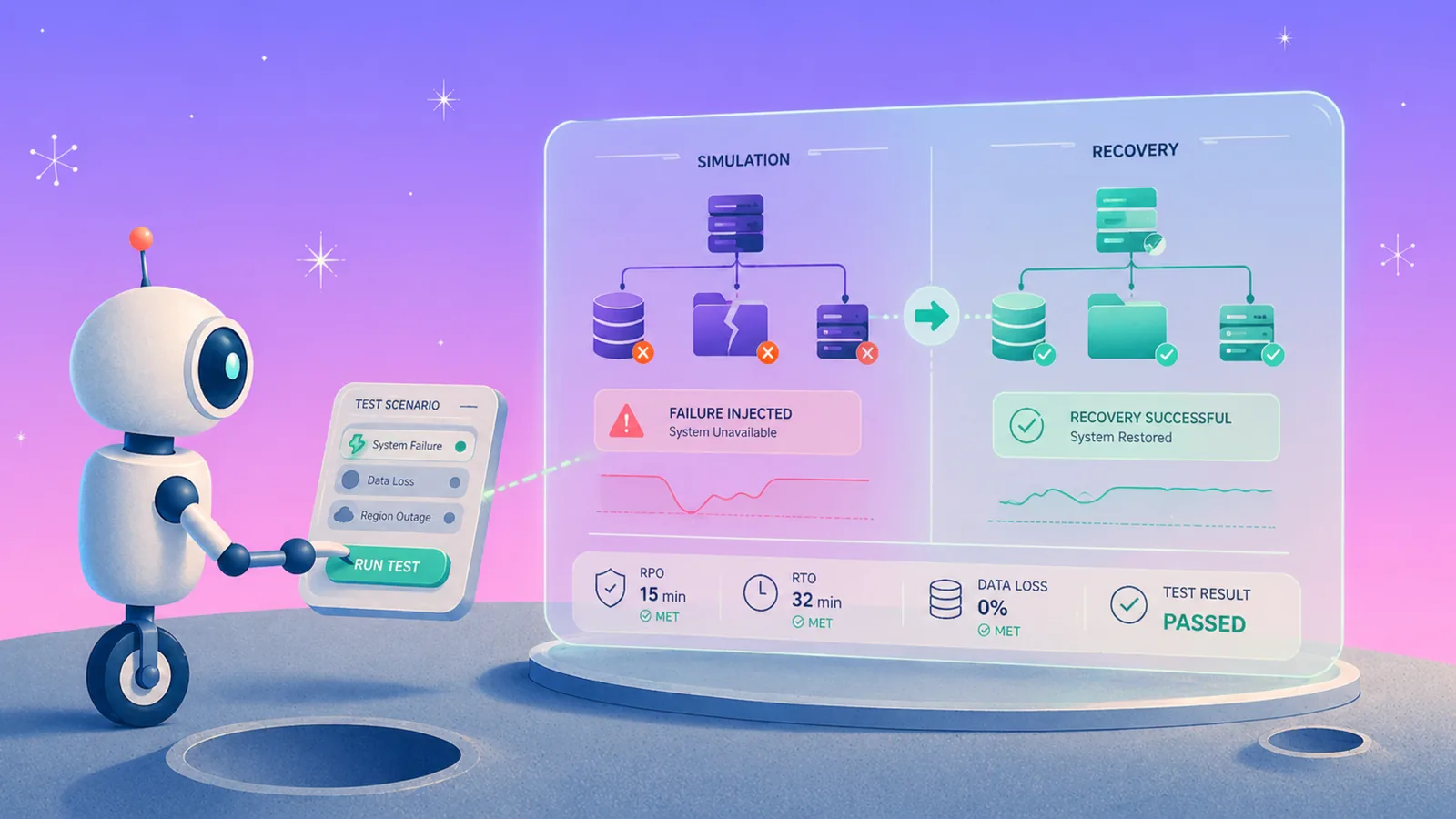
DR is about getting back to a usable state (not just staying online) through restore planning, tested recovery steps, and defined recovery targets.
For example, after ransomware encrypts production data, DR uses clean restore points and runbooks to bring the workload back safely.
Key differences between high availability and disaster recovery
High availability and disaster recovery differ most in failure scope, recovery method, and what they protect against. Put the other way round, high availability vs disaster recovery is a question about which failure you are protecting against rather than which approach is better: HA vs DR is a pairing, not a choice.
Failure scope
HA targets failures inside the running environment: a failed instance, unhealthy node, unavailable zone, or similar component-level fault. DR targets incidents that compromise the environment, the data, or the ability to recover safely.
A failed node is an HA problem. Encrypted, deleted, or corrupted production data is a DR problem.
Recovery method
HA keeps services running by shifting work to healthy components. DR brings systems back by recovering data, infrastructure state, or both.
If a node fails, HA reroutes traffic. If source data is compromised, DR restores a known-good state.
Data integrity risk
Replication doesn't verify what it copies. Poisoned data, whether encrypted by ransomware, silently corrupted, or accidentally deleted, moves to healthy nodes exactly the same way clean data does.
That’s why uptime and data integrity are not the same thing.
Testing cadence and ownership
High availability and disaster recovery fail differently inside organizations. HA has clear owners because uptime SLAs are visible every day. DR ownership is easier to blur because restore failures stay hidden until a test, audit, corruption event, or outage exposes them.
Treat failover tests and restore tests as separate controls. A failover drill can pass while backups remain untested, unsearchable, or unusable.
Planning requirements
HA planning centers on redundancy, failover paths, and dependency design. DR planning adds restore runbooks, recovery owners, restore permissions, and target definitions such as RPO and RTO.
That extra planning is important because recovery depends on usable backups, visible coverage, and policies that still match the workload.
Why most teams need both
High availability is not enough when the incident affects data integrity, recovery confidence, or an entire operating environment. By the time the team notices something is wrong, the compromised state may already exist across every healthy node. Availability stays intact. Recoverability is already gone.
Uptime and recoverability need separate controls and separate tests. HA keeps services live; it cannot tell you whether your last clean backup is usable, current, or even exists.
Ransomware makes the gap obvious. Failing over to another copy of compromised data does not solve the problem. Teams need a trusted clean recovery point, tested restore steps, and enough visibility to know what was protected before the incident started.
How to decide what your team needs
Use high availability when the main risk is infrastructure failure inside a running environment: failed nodes, unhealthy instances, zone issues, or routine component faults.
Use disaster recovery when the main risk is loss of a usable state: deletion, corruption, ransomware, major misconfiguration, region-wide outage, or failed restore path.
Use both when the business needs uptime and recoverability. Test them separately because a passing failover drill says nothing about whether backups are current, recoverable, or aligned to policy.
Closing the gap between uptime and recovery readiness
HA can keep an application online, but it cannot prove every critical dataset has a clean, policy-aligned restore point. That's what Eon is built around: backup posture, granular recovery, and usable backup data at cloud scale.
Cloud Backup Posture Management (CBPM) is the core mechanism. Eon continuously discovers and classifies cloud resources, applies protection based on data type and business risk rather than tags, and surfaces coverage gaps across accounts and regions as environments change.
Backups land in immutable, logically air-gapped vaults by default, so a compromised production environment can't reach into the backup layer. That's what makes "clean recovery point" the foundation for ransomware rollback.
Granular recovery is the layer that makes those clean points usable. Teams can restore a specific file, object, table, or record instead of rehydrating a full environment. Eon also makes backup data searchable and queryable without a full restore first: useful for audits, investigations, and increasingly for analytics and AI workflows.
Customer results show why precision matters. SoFi cut recovery from a full day to under five minutes across a five-region AWS environment. NETGEAR reduced backup storage costs by 35% and cut recovery for a 10TB SQL Server database by 88%, from 24 hours to under three.
Sigdo Koppers also cut restore time for a critical financial server from about two days to a couple of hours during its Google Cloud migration.
Eon isn't a replacement for failover design, runbooks, or incident communications. It strengthens the recovery layer those plans depend on: coverage visibility, clean recovery points, granular restore, and queryable backup data.
Final take
Treating uptime as proof of resilience is how teams discover the gap at the worst possible time. The running environment can look healthy right up until the moment clean data doesn't exist, coverage has drifted, or a restore fails. Strong recovery readiness requires both controls working, and evidence that the backup side actually holds up.
If your environment spans multiple accounts, regions, or cloud providers, that evidence gets harder to maintain manually. Book a demo and see how Eon helps teams close that gap.
Frequently asked questions
What is the difference between disaster recovery and high availability?
The difference between disaster recovery and high availability is the failure scope and recovery method. High availability handles localized failures, while disaster recovery restores systems and data after broader disruption.
Can high availability replace disaster recovery?
No, high availability cannot replace disaster recovery. HA can reduce downtime during localized failures, but it doesn’t address deletion, corruption, ransomware, or region-wide disruption.
Do most teams need both high availability and disaster recovery?
Yes, most teams need both high availability and disaster recovery because they solve different risks. HA supports continuity, while DR supports recovery after broader incidents.
What metrics matter for disaster recovery planning?
The main metrics for disaster recovery planning are RPO and RTO. RPO defines acceptable data loss. RTO defines acceptable downtime.
How can Eon help with recovery readiness?
Eon helps with recovery readiness by showing backup posture, policy drift, and restore options across cloud environments. It connects to AWS, Azure, and Google Cloud through cloud-native APIs with no agents, appliances, or clusters, so onboarding and discovery don't require running components inside customer environments.