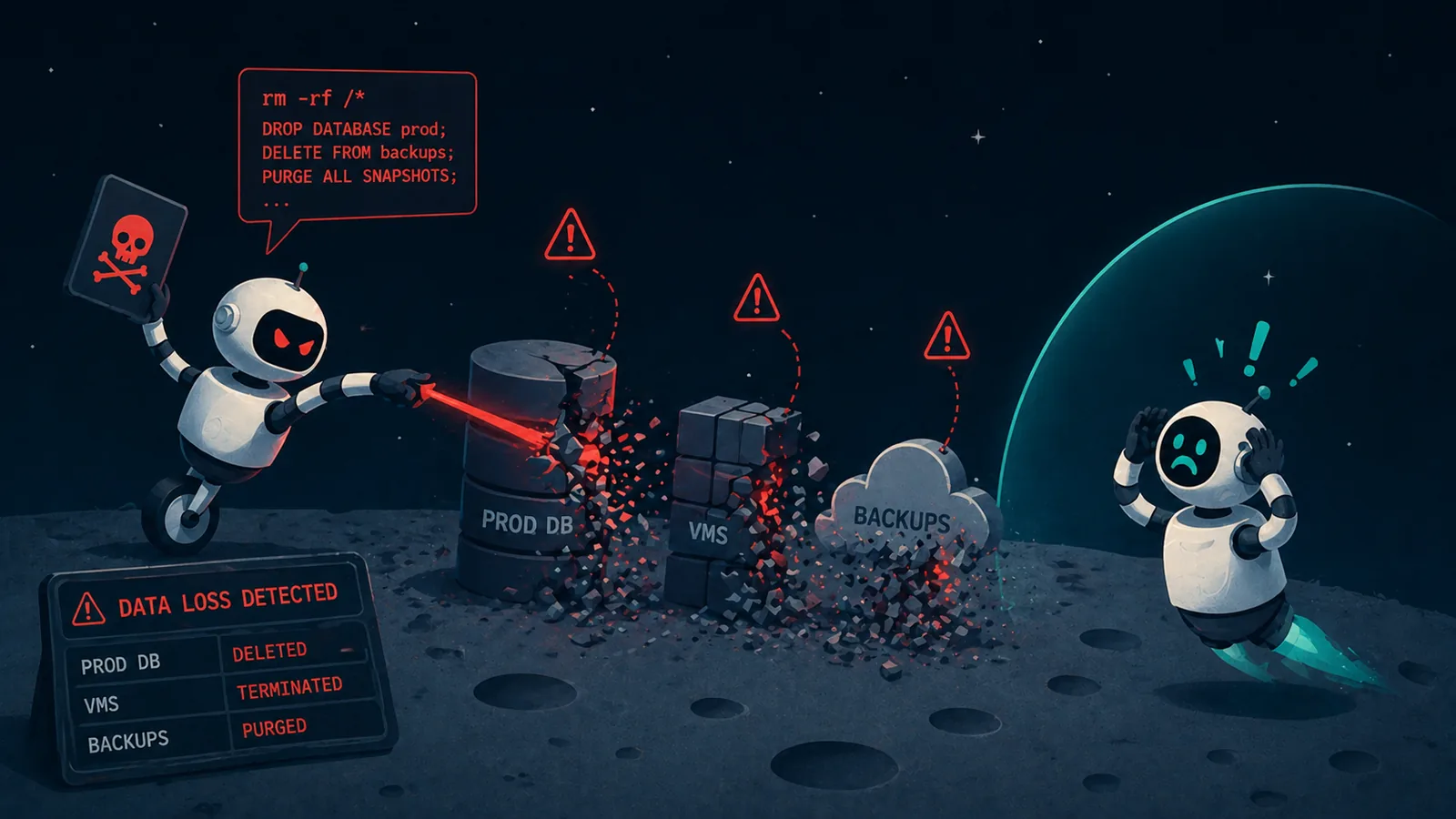


Most DR plans pass internal review and then fail their first real test. The disaster recovery audit checklist is what surfaces the gap before an incident does, and the items below are the ones most crucial for cloud-first environments. A disaster recovery checklist that only lists systems will not catch that gap; the disaster recovery plan checklist here asks for evidence at every point.
Why the audit matters more than the plan
An unaudited DR plan is closer to a draft than a tested system. Most teams discover the gap the same way: new resources spun up without a backup policy, recovery times that have drifted past the documented RTO, or backup credentials shared with production.
Cloud environments change faster than the documents describing them, so a plan that worked 18 months ago rarely works today without verification.
Eon's 2026 survey of 583 cloud IT leaders found that 78% had at least one recovery failure in the past year, and 38% had three or more. Cloud providers operate on a shared responsibility model where the customer owns data protection and recovery. The audit is how you find out which side of that line your gaps sit on.
The 13-point disaster recovery audit checklist
These points cover the conditions that are vital for cloud-first DR plans. Each one maps to a recovery failure mode we have seen surface in real audits.
1. Coverage map across every account, region, and provider
Start by mapping every cloud resource across every account, region, and provider. Databases, VMs, object storage buckets, Kubernetes clusters, and managed services holding production data all need to appear on the map.
For each resource, the audit answers three questions:
- Is it backed up?
- When was the last successful backup?
- Does the backup policy match the resource's criticality?
The resources that fail this check are almost never the obvious ones. Production databases get backed up. The gaps show up in newer accounts spun up for a project, secondary regions added for latency, DynamoDB tables created outside the main IaC pipeline, and S3 buckets holding logs or exports that became the system of record for something.
A coverage map only works if it pulls from the cloud API directly rather than a spreadsheet of what someone remembered to tag.
2. Backup policy drift monitoring
Coverage mapping catches gaps at a point in time. Drift monitoring catches them continuously, which is important because the policy that was correct last month may not cover what is running today. The audit confirms the team has live visibility into backup policy drift across the cloud estate. Drift is easier to spot when the baseline is written down, which is what a documented backup policy gives an auditor.
Eon’s cloud backup posture management (CBPM) addresses this by continuously discovering new resources, classifying them by data type, and automatically applying the appropriate backup policy.
The audit checks whether the team gets alerted when retention rules change, when new resources skip backup policies, or when backup jobs start failing silently. Without alerts, drift compounds quietly until an incident exposes them.
3. Workload tiering by business impact
The audit verifies that workloads are classified by tier and that each tier has a documented owner.
- Tier 1 covers mission-critical systems where downtime translates to revenue loss in minutes. Customer-facing applications, payment processing, and production databases.
- Tier 2 covers business-critical systems that tolerate hours of downtime. Internal tools, reporting, staging.
- Tier 3 covers operational systems that tolerate a day.
- Tier 4 covers non-critical systems where best-effort recovery is acceptable.
A DR plan without tiering tends to overspend on low-priority systems and underspend on the ones that matter to revenue. The audit confirms the tiers exist and that they reflect current business priorities.
4. RTO and RPO targets per tier
Every DR plan has RTO and RPO numbers documented somewhere. The real audit work is checking two conditions those numbers don't capture on their own. Both conditions get harder to hold as the estate grows, which is what separates enterprise-scale disaster recovery from a single-team plan.
The first is the signature behind each target. A 15-minute RTO set by IT means IT believes it's achievable. The same target signed off by the business owner whose product line incurs the downtime cost means the company has accepted 15 minutes as the floor and budgeted the recovery infrastructure accordingly.
The second is the gap between the documented target and the actual recovery time from the most recent test. A 15-minute RTO that takes 3 hours in practice means either the infrastructure can't deliver what the document promises, or the document needs revising to match what the infrastructure can do. The gap itself is the audit finding worth acting on.
Recovery targets should be tiered to business criticality. Typical ranges look like this:
| Tier | Typical RTO | Typical RPO |
|---|---|---|
| Tier 1 | Under 15 minutes | Under 5 minutes |
| Tier 2 | Under 4 hours | Under 1 hour |
| Tier 3 | Within a day | Within a day |
| Tier 4 | Best-effort | Best-effort |
5. Backup architecture isolation from production
Backup infrastructure needs its own identity boundary. The audit verifies that production credentials cannot reach the backup vault, even when compromised.
Specifically, the audit looks for backup data stored in a separate identity boundary, with immutability that prevents modification or deletion during retention.
Policy-based protection is easy for a compromised admin account to disable, which is why the audit checks for immutability enforced at the storage layer.
Eon’s logically air-gapped backup architecture is built around this principle. Backup data sits outside the production blast radius and uses different credentials, so ransomware compromising production cannot reach the recovery layer.
6. Recovery point validation
The audit verifies that recovery points have been tested for actual usability. Backup jobs can complete on schedule and still produce data that fails when someone tries to restore it.
In ransomware scenarios, particularly, this distinction is structural. Backups can complete successfully while containing already-encrypted data.
The audit checks for workload-aware detection that analyzes backup contents for anomalies. Eon's ransomware detection reads file entropy and ransomware signatures in file and object backups, and the logical contents of database backups (row counts, schemas, and cardinality), flagging the last known good recovery point so operators always restore from a verified, clean state.
7. Granular recovery paths tested
The audit confirms that granular restore paths work end-to-end. File-level, record-level, and table-level recovery should be rehearsed before an incident, with measured times documented.
Most real disasters are resolved with partial restores: a corrupted table, an accidentally deleted bucket, or a handful of ransomware-encrypted files. Full-environment restores take longer and risk reintroducing problems.
NETGEAR cut recovery time for a mission-critical 10TB SQL Server database from 24 hours to under 3 hours with Eon's cloud-native recovery architecture. The audit verifies that the capability exists in the recovery toolset.
8. Testing cadence and realistic scenarios
The audit verifies that DR testing happens at least quarterly for Tier 1 workloads, and that tests cover the full range of realistic scenarios, including the messy ones teams tend to skip.
Realistic scenarios include simulated backup admin compromise, full-environment restore to an isolated environment, end-to-end runbook execution by someone who did not author the runbook, and recovery time measurement against the documented RTO for each Tier 1 workload.
A DR plan that has not been tested in 12 months is functionally untested. The audit measures the date of the most recent test for each Tier 1 workload and flags any that have lapsed.
9. Documented runbooks for the most likely scenarios
Generic DR documents collapse under real incident pressure. The audit checks for scenario-specific runbooks alongside the generic plan, with one runbook for each likely failure mode.
Specific runbooks should exist for restoring a compromised RDS database, rebuilding an S3 bucket after policy manipulation, recovering a Kubernetes cluster when the cluster configuration is suspect, and rotating every credential when the production identity is compromised.
Each runbook should be executable by someone who did not write it. The audit tests this directly by handing a runbook to a different operator and watching them follow it.
10. Incident command and named ownership
The audit confirms that named individuals own each role in the incident response structure. Generic team-level ownership ("the infrastructure team will respond") breaks down within the first 12 hours of a real incident. Preparing that evidence once rather than per audit is the first of five ways to cut backup compliance costs.
The audit confirms named owners exist for incident command, recovery execution, communications, legal, and executive liaison, each with a documented primary and backup, and off-hours contact details.
11. Communication plans with pre-drafted templates
The audit verifies that communication templates exist for the most likely scenarios. Customer notification emails, regulator filings, employee updates, and executive briefings should be pre-drafted before any incident.
Templates should cover both internal audiences (executive team, board, legal, HR) and external ones (customers, regulators, cyber insurance, and incident response retainers).
12. Compliance evidence for SOC 2, HIPAA, GDPR
The audit confirms that DR controls produce the evidence required for the organization’s compliance frameworks. SOC 2 expects documented testing and review cadence. HIPAA expects evidence of contingency planning. GDPR expects evidence of data restoration capability. What the healthcare side of that looks like in practice is covered in our guide to HIPAA compliant disaster recovery.
For each applicable framework, the audit verifies that test results, runbook reviews, and recovery time measurements are captured in a format auditors will accept. Eon's global search lets teams pull audit evidence directly from backup data (specific files, records, or snapshots) without restoring full environments first.
CISA’s #StopRansomware guide recommends pre-incident validation of restore paths and recovery point integrity, which maps directly to the evidence requirements.
The audit also confirms that data residency requirements are met. Backups crossing regional boundaries can create compliance exposure depending on the framework.
13. Recovery cost validation against budget
The audit checks that the cost of executing the DR plan has been measured against current cloud spend and documented.
Cloud DR costs include compute and storage for standby environments, replication bandwidth, recovery testing infrastructure, and the operational overhead of maintaining the plan. Hot site disaster recovery sits at the top of that cost curve, which is why it is usually reserved for Tier 0 workloads.
Many organizations discover during an audit that the DR plan is more expensive than documented because costs have drifted as the environment has grown. The audit captures actual current costs and compares them to the documented budget.
The audit also identifies cost reduction opportunities. Cloud-native backup platforms typically deliver 30-50% in storage cost reduction compared to hyperscaler-native backup through deduplication, compression, and incremental snapshots.
Eon's Cost Explorer shows backup spend broken down by workload and policy, so the audit has actual numbers to work from rather than estimates.
Common disaster recovery audit mistakes
Three patterns show up in almost every audit we review that missed real gaps:
- Auditing documents instead of infrastructure. The plan says backups run every 4 hours; the audit needs to verify they actually do. Plans routinely pass document review while real coverage gaps go undetected in production.
- Skipping the granular restore test. Most audits test a full-environment restore and stop there. The real recovery scenario is usually one corrupted table or a handful of deleted files, and a full-environment test does not validate that path.
- Treating the audit as annual instead of continuous. Cloud environments change weekly. An annual audit captures a snapshot that is outdated within a month, and the items that matter most (coverage, drift, testing cadence) need continuous monitoring that runs alongside the environment itself.
What separates a strong audit from a checkbox audit
The difference between a useful DR audit and a compliance-only audit comes down to one question:
Does the audit measure what would happen during a real incident, or only what the documents say should happen?
Compliance-only audits review the plan documents and check boxes. Strong audits run real recovery scenarios, time the recovery in practice, and verify that the named operators execute the documented runbooks.
Here’s a practical test: could someone who didn't write the plan execute it under incident pressure, with recovery times that match what the document promises? If the answer isn't clearly yes, the audit has more work to do.
What an audit cannot fix on its own
Most items on this checklist describe ongoing conditions. Coverage drift, policy gaps, and recovery point validity slip back into the same state within weeks of an audit's closure, because the cloud environment keeps changing while the audit findings remain static.
Eon closes that loop. CBPM continuously discovers resources across accounts and regions, automatically applies backup policies, and surfaces drift as same-day alerts. Workload-aware ransomware detection flags clean recovery points without manual validation.
Granular restore paths run across AWS, Azure, and Google Cloud without rehydrating full environments, so the recovery capability the audit verified actually delivers when needed.
Backup data is also directly searchable and queryable for compliance requests, investigations, and audit evidence, so the recovery layer does more than sit idle between tests.
Find the gaps before an incident does
A recovery audit is only as useful as the recovery infrastructure it audits. Book a demo to see how Eon delivers logically air-gapped backups, workload-aware ransomware detection, CBPM coverage visibility, and granular recovery across AWS, Azure, and Google Cloud.
Frequently asked questions
What is a disaster recovery audit checklist?
A disaster recovery audit checklist is a structured set of items used to evaluate whether a DR plan would hold up during a real incident. It covers coverage, RTO/RPO targets, recovery testing, runbooks, communication plans, and compliance evidence.
How often should you run a disaster recovery audit?
You should run a disaster recovery audit at least annually, with quarterly testing of Tier 1 workloads. Major infrastructure changes, new compliance requirements, and post-incident reviews should also trigger an audit.
What is the difference between a DR audit and a DR test?
The difference between a DR audit and a DR test is that a DR audit systematically evaluates the plan, controls, and evidence, while a DR test exercises a specific recovery scenario end-to-end. The audit confirms the documentation and structure work; the test confirms that the recovery itself works.
What should a cloud disaster recovery audit cover?
A cloud disaster recovery audit should cover coverage across accounts and regions, workload tiering, RTO/RPO targets per tier, backup architecture isolation, recovery point validation, granular recovery paths, runbooks, incident command, and compliance evidence.
How do you audit RTO and RPO compliance?
You audit RTO and RPO compliance by measuring actual recovery times and data loss in tested scenarios, then comparing against documented targets. Targets that exceed measured performance need either better recovery infrastructure or revised business expectations. A target that was never derived from business impact fails that comparison by construction, which is a reason to revisit the recovery time objective targets themselves.
What compliance frameworks require disaster recovery audits?
Compliance frameworks requiring disaster recovery audits include SOC 2, HIPAA, ISO 27001, and PCI DSS. Each framework specifies different evidence requirements, but all expect documented testing, review cadence, and recovery time measurements. The HIPAA evidence specifically is broken down in our guide to the hipaa data backup plan.
Who should perform the disaster recovery audit?
The disaster recovery audit should be performed by someone independent of the team that wrote the plan, ideally with hands-on cloud recovery experience. Internal audit teams, third-party assessors, or an infrastructure leader from outside the DR team all work.