

Rubrik vs Cohesity vs Eon: At a glance
Rubrik and Cohesity are proven options for hybrid and mixed estates. They make sense when on-prem, SaaS, and legacy workload coverage still drive the backup strategy. Whether you come at it as Rubrik vs Cohesity or Cohesity vs Rubrik, the comparison turns on the same question: which operating model your team can sustain as more of the estate moves to the cloud. The same question drives Rubrik vs Veeam for cloud backup, with a different second vendor on the other side of it.
For cloud-first teams, the operating model question is different. Eon combines CBPM, granular recovery, Cost Explorer, ransomware-ready restores, and backup data access without restore.
| | Rubrik | Cohesity | Eon |
|---|---|---|---|
| Deployment model | SaaS + regional compute | SaaS + cluster-based roots | Agentless SaaS |
| Backup posture and policy control | Policy-based, compute-dependent | Broad, manual setup | Automated (CBPM) |
| Recovery precision | Strong hybrid, restore-first | File/object recovery | Granular (file/record/table) |
| Immutability | Immutable snapshots | Immutable snapshots | Logically air-gapped, immutable backups |
| Ransomware recovery | Advanced detection and recovery assembled from licensed add-ons and customer-run compute | Deeper ransomware response requires additional licensing and operational setup | Built-in detection, clean recovery points, and granular recovery |
| Backup data utility | Search-first recovery workflows | Search and export workflows | Zero-ETL data lake: search, SQL query, analytics, and AI without restore |
| Cost attribution | Hard to isolate by workload | Limited attribution | Cost Explorer with account → service → resource visibility |
Choose Rubrik if you run a hybrid estate with meaningful on-prem infrastructure, need broad SaaS or legacy workload coverage, and can support customer-managed backup infrastructure in the cloud. Cloud-first teams that cannot staff that usually end up comparing BaaS platforms instead.
Choose Cohesity if your primary goal is to consolidate multiple backup tools into a single platform across a large, mixed environment.
Choose Eon if you run cloud-first infrastructure and need CBPM, granular recovery, Cost Explorer, ransomware-ready restores, and searchable backup data.
Meet the contenders
Rubrik: Hybrid backup built for on-prem roots
Rubrik fits best in hybrid environments where on-prem and SaaS coverage still matter. In cloud environments, its model often introduces customer-managed compute and restore-first workflows as scale increases.
Rubrik's granular file recovery for AWS depends on Exocompute (EKS-based compute in the customer environment for indexing and recovery tasks), which adds Kubernetes and networking overhead and is commonly deployed in dedicated VPCs per region.
Cohesity: Consolidation-first, cluster-based backup for mixed estates
Cohesity is strongest when the goal is to replace multiple backup tools with a single platform across mixed estates. It covers broad environments well, but its operating model still reflects its cluster-based roots, even as its SaaS offering (DataProtect as a Service) reduces some of that overhead in cloud deployments.
For mixed estates, the model works. For cloud-first environments, it means inherited cluster infrastructure and less automation than a SaaS-managed alternative.
Eon: Cloud backup posture, recovery, cost clarity, and data access
Eon is built for cloud-first teams running large AWS, Azure, and Google Cloud environments. It combines CBPM, logically air-gapped, immutable backups, granular recovery, Cost Explorer, and direct access to backup data on a single platform.
Eon was founded by the team that built CloudEndure (acquired by Amazon) and AWS's native migration and DR services. That cloud background shapes its focus on posture, recovery, cost, and protected data.
Teams can use Eon to prove coverage, restore files, objects, tables, or records, trace spend by resource, and query or reuse backup data (as a data lake) for audits, investigations, analytics, and AI without ETL.
The key differences show up after backups exist: posture proof, drift detection, granular recovery, cost attribution, and backup data that's searchable, queryable, and ready to use.
Eon vs Rubrik vs Cohesity: Feature breakdown
For cloud-first teams, the real differences are posture, recovery, cost attribution, and backup data access.
Backup posture and policy control
Rubrik: Has mature policy-based management, but cloud consistency can depend on deployed components, workload coverage, and manual oversight as accounts and regions grow.
Cohesity: Supports broad policy control across mixed estates, but cloud posture can still require static policies and ongoing manual effort as infrastructure changes.
Eon: Eon’s CBPM discovers resources, classifies data by risk, applies protection policies, and flags coverage gaps.
Best fit: Eon — strongest for automated cloud backup posture across changing environments.
Ransomware recovery
Rubrik: Offers ransomware features, but advanced scanning can require additional licensed components and customer-side compute. Coverage can vary by workload and configuration. Coverage gaps of that shape are the usual reason cloud backup ransomware succeeds against an otherwise well-run estate.
Cohesity: Supports immutability, but deeper detection and response workflows may require additional licensing and operational setup, depending on the environment.
Eon: Builds ransomware detection into the backup workflow. It combines logically air-gapped immutable backups, backup-change signals, clean recovery points, and granular recovery for cloud workloads.
Best fit: Eon — best for cloud-first teams that need clean recovery points and granular ransomware recovery without making add-ons the default.
Backup data utility and data lake access
Rubrik: Helps teams find recovery points, but deeper analysis usually depends on restore workflows. That makes backup data useful for recovery, but harder to use for audits, investigations, analytics, or AI.
Cohesity: Supports search and export workflows across backup data. For cloud-first teams, export still adds a step when the goal is to inspect or analyze protected data directly.
Eon: Converts supported backups into a queryable data lake without ETL or restore. Teams can search across files, objects, and database contents to find the right record or point in time in seconds, run SQL queries directly on backup data, and pull results for audits, investigations, analytics, or AI without a restore job. That makes backup data AI-ready by default: usable for vector-DB injection, MCP-connected agents, and natural-language queries on historical data without a separate pipeline.
Backup data is stored in open formats (Parquet, Delta Lake, Iceberg), so it plugs into the tools teams already use for BI, reporting, and ML. A compliance request or internal investigation doesn't have to start with a recovery workflow.
Best fit: Eon — for teams that need backup data usable for audits, investigations, analytics, and AI, without restore or ETL.
Deployment model
Rubrik: Supports cloud workloads, but some cloud workflows can require Exocompute or customer-side compute. That adds infrastructure to size, deploy, and operate.
Cohesity: Offers SaaS management, but many cloud deployments still reflect its cluster-based roots and supporting infrastructure model.
Eon: Runs as a fully SaaS-managed, agentless platform. Teams do not need to run backup clusters, regional compute, or agents to keep cloud infrastructure protected.
Best fit: Eon — the simplest cloud operating model.
Recovery capabilities
Rubrik: Has strong recovery depth across hybrid and legacy workloads, especially where broad environment coverage matters more than cloud-native simplicity. Practitioner accounts of that depth, and its costs, are gathered in Rubrik reviews.
Cohesity: Supports file and object recovery across mixed environments, with useful recovery coverage for large estates.
Eon: Supports granular cloud recovery at the file, object, table, and database-record level. Teams can restore changes without booting or rebuilding full environments, which matters more as AI coding agents drive faster, smaller incidents (dropped tables, corrupted schemas, runaway writes) that don't warrant a full restore.
Best fit: Tie — Eon for granular cloud recovery; Rubrik for deep hybrid recovery coverage.
Cost attribution and cloud backup spend
Rubrik: Costs can span capacity, licensed modules, and customer-managed compute. That can make spend harder to trace to a specific cloud account, workload, or resource. Our Rubrik pricing breakdown shows how those components are quoted per BETB.
Cohesity: Costs can expand with cluster footprint, duplicated storage, and licensed features. In cloud-heavy environments, attribution is less direct.
Eon: Includes Cost Explorer for spend by account, service, and resource so that teams can trace costs to a specific workload, policy, or resource. Teams can find high-cost resources, support chargeback, and see policy impact.
Eon can also reduce backup storage spend by 30–50% through incremental backups and global deduplication, depending on retention, change rates, and data growth.
Best fit: Eon — for cloud-first teams that need resource-level cost attribution and lower backup storage spend.
Hybrid and legacy workload support
Rubrik: Strongest fit for meaningful on-prem, SaaS, and legacy workload coverage.
Cohesity: Strong fit for large mixed estates that need tool consolidation.
Eon: Built for cloud-first workloads, not on-prem-heavy environments.
Best fit: Rubrik — strongest for hybrid and legacy coverage.
Platform breadth and consolidation
Rubrik: Broad coverage across hybrid, SaaS, and cloud workloads.
Cohesity:Strongest fit when the goal is consolidating many backup tools across a mixed estate.
Eon: More focused on cloud-first posture, recovery, cost attribution, and backup data utility.
Best fit: Cohesity — best for broad backup-tool consolidation.
What real users say
Here’s how each platform shows up in real-world use, based on customer feedback and documented outcomes. Our Cohesity reviews roundup collects the ratings and recurring complaints behind that picture.
Rubrik
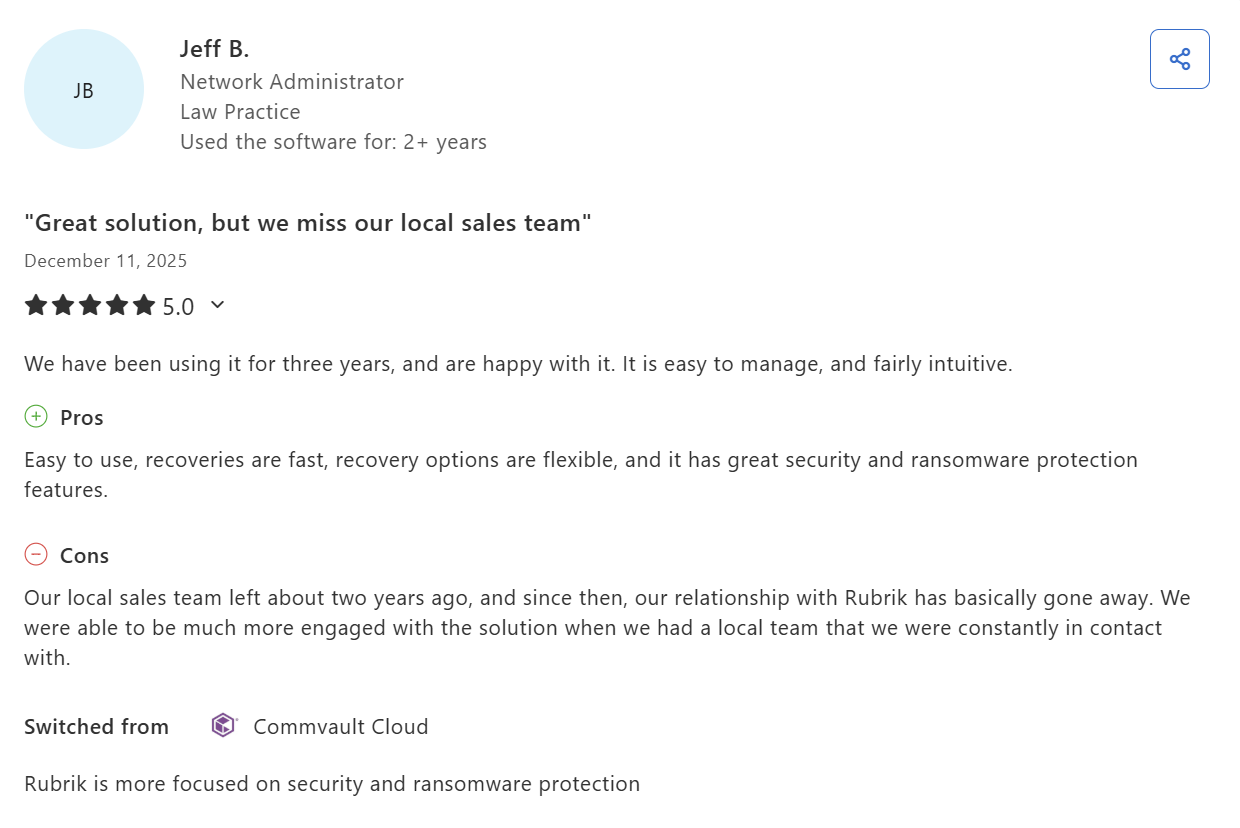
“It has great security and ransomware protection features.” — Jeff B., Network Administrator, Capterra
Cohesity
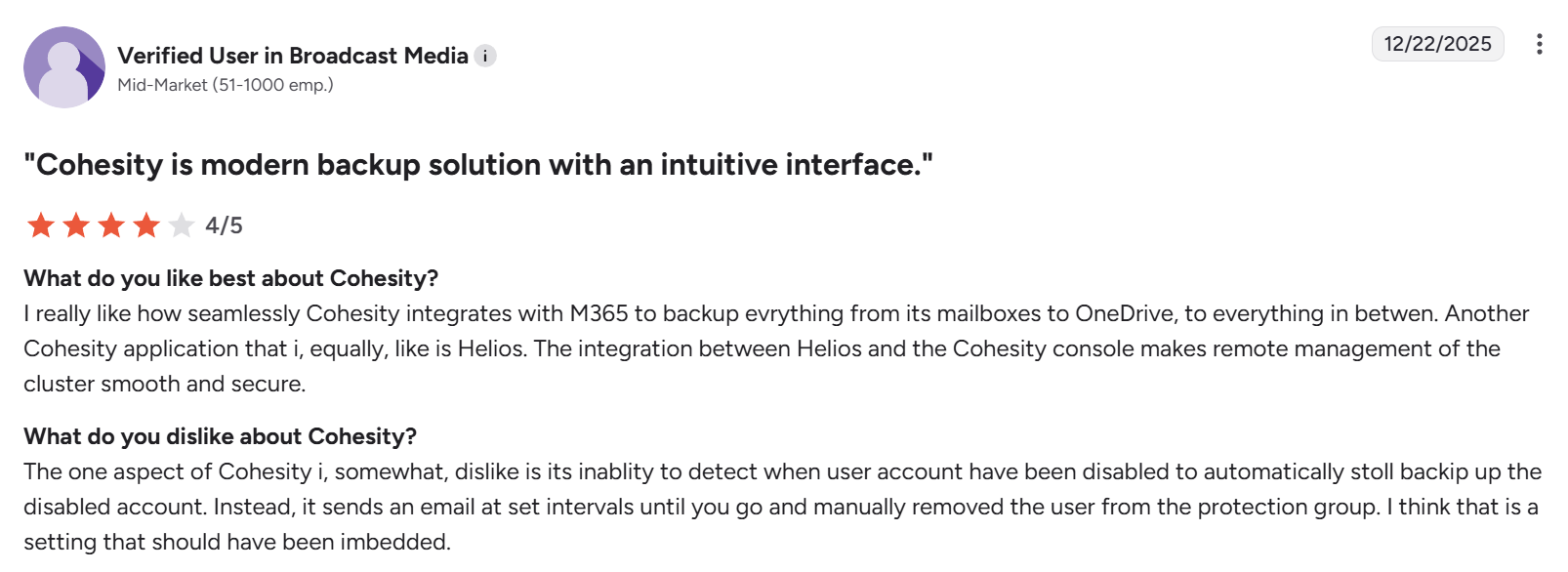
“The integration between Helios and the Cohesity console makes remote management of the cluster smooth and secure.” — User in Broadcast Media, G2
Eon
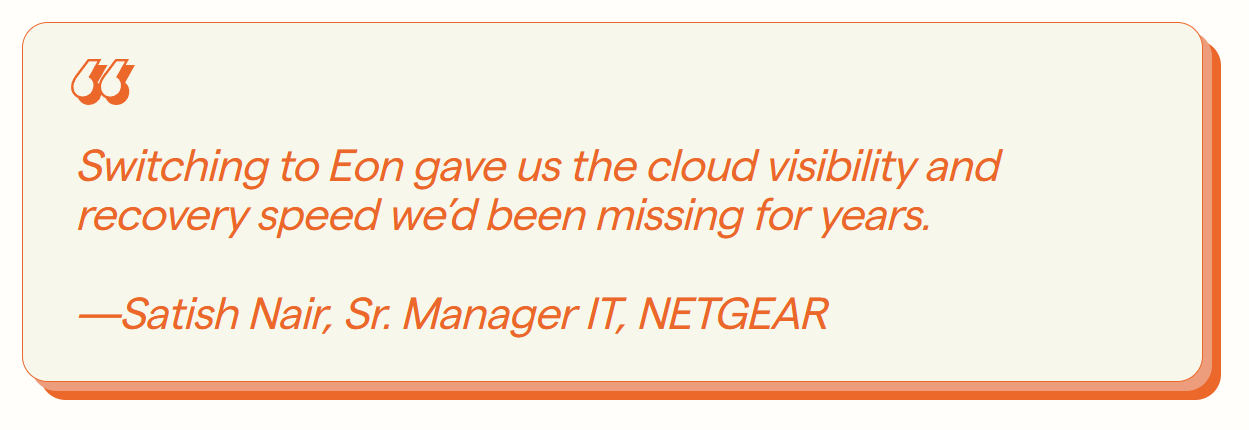
“With Eon in place, we’ve moved from a legacy backup model to a simplified, scalable, and cloud-first solution.” — Satish Nair, Sr. Manager IT, NETGEAR, Eon Case Study
"We save more with Eon than we spend, and recovery went from a day to minutes." — CJ Keefe, Director, Corporate Infrastructure, DevOps & SRE, SoFi, Eon Case Study
Which platform should you choose?
The right choice depends on which operating model your team can support. Rubrik and Cohesity are built for hybrid and mixed environments, while Eon is designed for cloud-first teams that want less infrastructure and more usable backup data.
Choose Rubrik if you:
- Run a hybrid estate with meaningful on-prem infrastructure
- Need broad SaaS or legacy workload coverage
- Can support customer-managed backup infrastructure
Choose Cohesity if you:
- Want to consolidate multiple backup tools into one platform
- Run a large mixed environment with on-prem workloads
- Prioritize breadth over cloud-native simplicity
Choose Eon if you:
- Run cloud-first infrastructure across AWS, Azure, or Google Cloud
- Need CBPM to prove coverage and surface policy drift
- Want ransomware-ready recovery from clean points
- Need granular recovery at the file, object, table, or record level
- Want Cost Explorer to trace spend by account, service, and resource
- Need backup data to be searchable, queryable, and reusable without restore
Final verdict
The right choice depends on where your infrastructure actually lives and where it's going.
Rubrik is strongest in hybrid environments, especially where on-prem, SaaS, and legacy workloads still need deep, reliable coverage. Teams that decide it is not the right fit can work through the field in our Rubrik alternatives roundup.
Cohesity is geared toward consolidation, bringing multiple backup tools and environments into a single platform across mixed estates.
Eon is built for cloud-first teams that need posture proof, drift detection, granular recovery, cost attribution, and usable backup data.
For teams still managing a meaningful hybrid estate, Rubrik and Cohesity are established options.
For cloud-first teams, the bar is higher: backup that proves its own coverage, restores at the record level, attributes spend by resource, and stays usable without a recovery job. That's the standard worth comparing against.
See how Eon fits cloud-first backup operations
If you’re evaluating cloud backup posture, ransomware recovery, granular restore, Cost Explorer, and backup-data access across AWS, Azure, or Google Cloud, a live walkthrough shows how Eon fits your environment.
Book a demo to see how Eon performs across your cloud environment.
Frequently asked questions
What is the main difference between Rubrik and Cohesity?
The main difference between Rubrik and Cohesity is how their cloud operating models extend from hybrid roots. Rubrik can introduce customer-managed compute and restore-first workflows for some cloud workflows, while Cohesity keeps a more cluster-based model for large mixed estates.
Is Rubrik or Cohesity better for cloud-native environments?
Neither Rubrik nor Cohesity is designed specifically for cloud-native environments. Both support cloud workloads, but their operating models remain rooted in hybrid architectures.
Is there a cloud-native alternative to Rubrik and Cohesity?
Yes. Eon is built for AWS, Azure, and Google Cloud environments with CBPM, logically air-gapped immutable backups, granular recovery, and backup data that's searchable and queryable without a full restore. For a wider view of the field, see our roundup of Cohesity alternatives.
How do Rubrik and Cohesity handle ransomware?
Rubrik and Cohesity offer ransomware features, but deeper detection and recovery workflows are typically assembled from licensed add-ons and, in Rubrik's case, customer-run compute. Eon builds detection into the backup workflow by default: logically air-gapped immutable backups, known-good recovery points, and granular recovery, without extra components.
How is Eon different from Rubrik and Cohesity?
Eon is built for cloud-first backup operations, not hybrid backup infrastructure. It combines CBPM, immutable air-gapped backups, granular recovery, Cost Explorer, and queryable backup data for audits, investigations, analytics, and AI.
Do Rubrik and Cohesity support multi-cloud environments?
Yes, Rubrik and Cohesity support multi-cloud environments across AWS, Azure, and Google Cloud. The difference is that this support often entails greater infrastructure and configuration overhead than a cloud-first, agentless model.