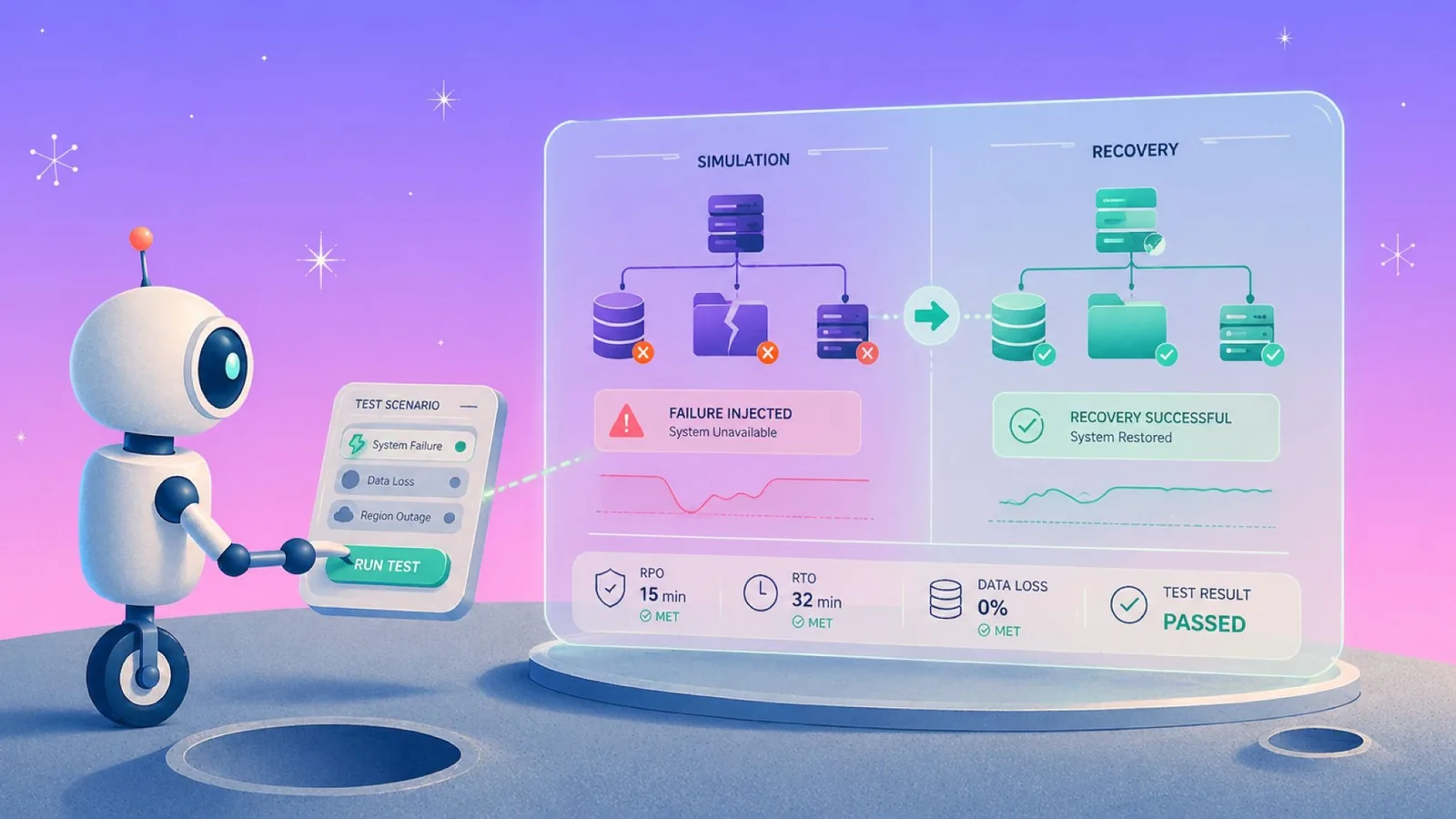


Continuous data protection promises a recovery point measured in seconds, yet cloud environments often deliver it through per-service features that cap retention and restore in bulk. Those caps are easier to reason about against the wider picture of cloud data protection, where CDP is one option among several.
Whether that promise holds in the cloud comes down to how granular your recovery is and how far your backups sit from production.
What is continuous data protection?
Continuous data protection (CDP) is a backup method that records every change as it happens, so you can restore to almost any moment in time. The goal is a recovery point objective near zero, the most data you can afford to lose, measured in time.
CDP comes in two forms that differ in how much data they can lose:
- True CDP writes every change the instant it happens, so the recovery point is effectively zero, though it costs more and strains the network.
- Near-CDP takes block-level backups every 30 seconds to 15 minutes and is what people usually mean by continuous data protection.
How does continuous data protection work?
Continuous data protection works by taking one full copy of your data, then recording every later change in an ordered log. Modern platforms use changed-block tracking, so only modified or new blocks get written after the first full copy, an approach often called incremental forever.
To recover, the system replays the log up to the moment you choose and rolls the data back to that state. Platforms periodically reconcile the change log to a fresh full backup, which keeps the chain from growing long enough to corrupt or slow a restore.
Two tradeoffs come with the model. Writing every change in near real time increases storage traffic, and a recovery copy that lives in one place can become a single point of failure if nothing protects the copy itself.
How does continuous data protection compare to other backup approaches?
On recovery point and restore precision, CDP sits between scheduled backup and live replication. Each approach trades how often it captures data against how precisely it can restore.
| Approach | How often it captures | Typical RPO | Restore granularity |
|---|---|---|---|
| Scheduled backup | Once or a few times a day | Hours of potential loss | Full resource |
| Snapshot | Point-in-time copy on a schedule | Minutes to hours | Usually full volume or instance |
| Replication | Continuous copy to a standby | Near zero | Full system |
| CDP and near-CDP | Continuous, or every few minutes | Seconds to minutes | Point in time, sometimes granular |
Where does continuous data protection live in the cloud today?
In the cloud, continuous data protection is built into individual services rather than offered as one system. Each major data service ships its own version of point-in-time recovery, and the boundaries between them matter once an application spans more than one service.
Amazon RDS and Aurora support continuous backup with point-in-time recovery to any second within the retention window, and a restore creates a brand-new database instance. The window caps at 35 days, and RDS restores reach up to the most recent five minutes of activity.
Amazon DynamoDB offers PITR with per-second granularity for any point in the preceding 35 days, and every restore lands in a new table. Amazon S3 keeps prior object versions through versioning, and its continuous backup restores reach up to the most recent 15 minutes.
Data warehouses follow the same pattern. Snowflake bundles its protection as Continuous Data Protection, combining Time Travel for querying and restoring recent history with Fail-safe for disaster recovery.
Each feature is per-service, retention-capped, and restores in bulk. That returns a whole table or bucket, not the exact record you lost.
Why does continuous data protection break down at cloud scale?
The per-service model holds up for one database. It strains across hundreds of accounts and several clouds, which is where many teams now operate. Four problems show up consistently.
Retention caps cut the recovery window short
Native point-in-time recovery in RDS, Aurora, and DynamoDB stops at 35 days. If a quiet deletion or a slow data-corruption bug surfaces after that window, the point-in-time history you needed is already gone.
Cost pressure makes the window even shorter in practice. In Eon's 2026 Cloud Data Infrastructure Report, 63% of respondents say high storage costs push them to retain or protect less data than they should.
As one site reliability lead described the tradeoff, their team caps S3 backup retention at six weeks, since, in their words, "if we need something earlier than that, tough luck.”
Coarse restore defeats the near-zero RPO promise
A perfect recovery point does not help much if recovery is coarse. Native PITR restores an entire new instance or table, so getting one row back means restoring the whole table to a new table, querying it, and copying the record across.
That gap shows up in recovery times. 60% of respondents in Eon's 2026 report need six or more hours for a full restore. A near-zero recovery point loses its value when the recovery time runs to hours for data you could describe in one sentence.
No single timeline across services, accounts, and clouds
Each service keeps its own recovery clock, so an application built on RDS, DynamoDB, and S3 has no shared point in time to roll back to. Coverage also drifts, because a new database or bucket can launch without point-in-time recovery turned on, and nothing flags it until a restore fails.
One VP of engineering described the same governance gap: a hundred new databases turned on every day, with no idea what data sits in them, leaving the team to "kind of hope that the teams are backing things up as they should be."
When recovery confidence outruns reality
The same report also flagged a confidence gap: 98% of executives are confident in their organization's recovery, yet 56% had three or more recovery failures in the past year.
Ransomware adds to the risk, since attackers increasingly target backups directly. In one recent case, an AI coding agent deleted a production database and its volume-level backups in seconds after a stray credential sent a delete call to production storage.
When backups share an account and credentials with production, they sit inside the same blast radius, and managed databases are easy to miss because file-level scanning skips them.
What does continuous data protection look like done right in the cloud?
In the cloud, continuous data protection earns its promise only when the setup closes the four gaps above. Five capabilities separate a setup that works from one that only looks protected.
Granular recovery
The unit of recovery should match the unit of damage: the exact record or file you lost, restored in minutes without rehydrating the environment.
Eon's granular recovery restores EC2 instances, volumes, folders, or files, recovers individual DynamoDB items, and recovers RDS, Aurora, or EC2-hosted database records straight from a SQL query, so you pull back only the affected data.
NETGEAR saw this at scale: after moving to Eon, it recovered a 10TB SQL Server database in under three hours instead of 24, an 88% cut in recovery time.
Continuous posture with CBPM
A resilient setup classifies and protects every resource the moment it is created, and surfaces policy drift before an incident exposes it.
Cloud Backup Posture Management (CBPM) discovers and classifies resources by data type, such as PII, financial, or production data, then applies retention and protection policy automatically without manual tagging.
Logically air-gapped, immutable backups
Ransomware and accidental deletes hit whatever copies they can reach. Isolation means a separate, immutable copy in an account that production credentials cannot alter or delete.
That isolation pairs with clean recovery point identification. Eon's ransomware protection marks where data starts to look compromised on a timeline, so you can see which restore points are safe before you recover.
Queryable backup data
Validating a backup or running analytics on it should not require a full restore. Ideally, you inspect schemas, sample records, and run SQL directly against backups, and the same data feeds analytics or AI without a separate copy step.
Database Explorer provides zero-ETL access to backup data in open formats, so one backup serves recovery and analysis from the same place.
Retention beyond native caps
Long-term retention should carry no per-service cap, priced by how data is stored rather than by appliances or per-API fees. Compliance and investigation windows can then run well past the 35-day ceiling.
Cloud-native deduplication lowers storage cost by up to 50%, so a longer recovery history does not mean a larger bill.
We built Eon around these five capabilities for AWS, Azure, Google Cloud, MongoDB Atlas, Microsoft 365, and Google Workspace, pulling posture, granular recovery, isolation, and query access into one workflow.
How should you choose a continuous data protection approach?
Start by tiering workloads by how much data loss and downtime each one can tolerate. A production transactional database and a dev instance carry different risk, and a single target for everything overprotects cheap data while leaving critical systems exposed.
Work through five questions as you evaluate options.
- Does the recovery point and recovery time target match each workload, rather than one blanket setting for all of them?
- Does the retention ceiling cover your longest compliance or investigation window, rather than only the native 35-day cap?
- Can you restore a single record, file, or table, rather than only a full instance?
- Are new resources protected automatically as they are created, instead of through manual tagging?
- Can you identify a clean recovery point after a ransomware event, and is that copy beyond the reach of production credentials?
See how far back you can really go
How far back can you restore a single record across every account and cloud you run today, and is that copy out of reach of production credentials? If the answer is fuzzy, that is the gap worth closing.
Book a demo and see how Eon handles granular recovery and continuous posture across your clouds.
Frequently asked questions
What is the difference between continuous data protection and traditional backup?
The difference between continuous data protection and traditional backup is capture frequency. CDP records every change as it happens or every few minutes, while traditional backup runs on a fixed schedule. That shrinks the recovery point objective to seconds, whereas a nightly backup can lose up to a full day of data between runs.
Does continuous data protection guarantee zero data loss?
No, continuous data protection does not guarantee zero data loss in most setups. Only true CDP, which writes every change instantly, approaches a zero recovery point, while near-CDP, the common form, keeps an RPO of roughly 30 seconds to 15 minutes.
Is AWS Backup continuous data protection?
AWS Backup is continuous data protection only in part. It offers continuous backup and point-in-time recovery for RDS, Aurora, and S3, capped at 35 days, and restores create new resources rather than recovering a single file or record on their own. How those native mechanisms fit together is covered in our guide to Amazon RDS backup.
What is a good RPO for continuous data protection?
A good RPO for continuous data protection depends on the workload. Transactional databases often target seconds to a few minutes, while analytics warehouses can tolerate hours, so match the recovery point to what each system can afford to lose.
Is continuous data protection the same as disaster recovery?
No, continuous data protection is not the same as disaster recovery. CDP is a method for capturing recoverable data continuously, while disaster recovery is the broader plan for restoring operations after an outage, and CDP supports a recovery plan without replacing it.
How does continuous data protection help with ransomware recovery?
Continuous data protection helps with ransomware recovery by keeping frequent recovery points, so you can roll back to a moment before encryption started. It helps most when those recovery points are immutable and logically air-gapped, and when the data is scanned to confirm which point is actually clean.