

If you are weighing Druva vs Rubrik for cloud infrastructure backup, a third option, Eon, does that job better, while both rivals keep clear wins on home turf. We evaluated vendor documentation, filings, and verified reviews to show where each earns its place.
Druva vs Rubrik vs Eon: TL;DR
Druva, Rubrik, and Eon solve different backup problems, so the right choice depends on where your critical data lives.
Choose Druva if your protection priorities are Microsoft 365, endpoints, and identity systems like Entra ID.
Choose Rubrik if you run a large on-prem footprint next to cloud workloads and want a single policy engine across both.
Choose Eon if your critical data sits in cloud databases, object storage, and VMs, and you want precise restores plus backup data you can query.
Meet the contenders
Druva: SaaS data protection built endpoint-first
The Druva Resilience Cloud delivers fully managed SaaS backup across endpoints, Microsoft 365 and other SaaS apps, identity systems, data center workloads, and AWS and Azure infrastructure. Immutable backups, global deduplication, ransomware response, and eDiscovery run from one console, with no appliances to deploy.
Rubrik: Cyber resilience across data center and cloud
Rubrik Security Cloud protects on-prem, cloud, and SaaS workloads under one policy engine, with heavy emphasis on ransomware recovery.
In the cloud, Rubrik orchestrates native snapshots and adds indexing and file recovery through Exocompute, which runs EKS clusters inside your own AWS account under Rubrik's management.
Eon: Cloud infrastructure backup with a queryable data layer
Eon is built to protect cloud infrastructure exclusively, meaning databases, object storage, VMs, and file systems across AWS, Azure, and Google Cloud.
Cloud Backup Posture Management (CBPM) discovers and classifies resources automatically; Granular Restoration brings back single files, objects, tables, or records, and logically air-gapped, immutable backups anchor ransomware recovery. Backup data lands in Apache Parquet and Iceberg for zero-ETL analytics. The four capabilities ship as one platform.
Druva vs Rubrik vs Eon at a glance
Druva vs Rubrik vs Eon: Feature-by-feature breakdown
Deployment model and who runs the backup layer
Druva and Eon are both fully SaaS, with no backup compute running in your cloud account. Druva connects through cloud APIs, so there are no appliances to deploy and no per-account or per-region infrastructure to maintain.
Eon starts from a read-only IAM role, then discovers and protects eligible resources with no agents and no appliances. Adding a new account or region takes one connection step, without an infrastructure rollout.
Rubrik's control plane is SaaS, but its cloud file recovery places compute in your account. File search and recovery for EC2 and EBS run on EKS clusters that Exocompute launches inside your AWS environment, configured per account and per region.
Rubrik offers a managed Exocompute mode as well as a customer-managed one (via Bring Your Own Kubernetes), letting teams choose whether Rubrik or their own cluster admins hold cluster permissions.
Winner: Druva and Eon. Neither places backup compute in your cloud account, while Exocompute adds VPC, subnet, and networking setup that repeats with every account and region you add.
SaaS, endpoint, and identity protection
Druva protects laptops, Microsoft 365, Google Workspace, Salesforce, and Entra ID from the same console that runs its infrastructure workloads, with legal hold and eDiscovery sitting on top for compliance work.
Rubrik covers Microsoft 365, Salesforce, and identity providers under the same policy engine as everything else. Endpoint devices sit outside what Rubrik Security Cloud protects.
Eon protects cloud infrastructure, meaning databases, object storage, VMs, and file systems. This dimension falls outside that scope.
Winner: Druva. It is the only vendor here that backs up endpoint devices, and its eDiscovery and legal hold features handle compliance work that Rubrik and Eon leave to separate tools.
Granular recovery and restore precision
Druva supports file-level recovery for EC2, with clear gaps at the edges. Its AWS support matrix doesn't cover RDS cluster backup and restore, application-consistent EC2 backups are Windows-only, and S3 buckets in a private VPC aren't discovered or protected.
Rubrik restores well at the resource level, and Live Mount delivers near-instant VM recovery on-prem. In the cloud, file-level recovery waits on Exocompute indexing in each configured account and region.
Eon restores single files, objects, tables, and records, including database records selected by SQL query, with no full environment spin-up.
Winner: Eon. Matching the restore to the exact damaged data is the everyday recovery job, and Eon is the only one of the three built around it.
Ransomware detection and clean recovery points
Rubrik built its cyber recovery story around identifying a restore point that is safe to use. Turbo Threat Hunting matches pre-computed hashes held in Rubrik's metadata to pinpoint clean recovery points across up to 75,000 backups in an estimated 60 seconds, per Rubrik's own internal testing.
A separate standard Threat Hunting capability scans deeper, using file patterns, file hashes, and YARA rules to look for indicators of compromise across backup objects. Data Threat Analytics layers anomaly detection and threat monitoring over protected data.
Druva pairs immutable backups with AI-driven threat detection, automated rollback, and a Managed Data Detection & Response service, with the deepest tooling on the SaaS and endpoint surface where most of its footprint sits.
Eon runs logical ransomware detection against backup content, including managed database backups that file-level scanning cannot read, then recovers only the affected records.
Winner: Rubrik. Environment-wide forensic investigation is its home ground, with Turbo Threat Hunting and Data Threat Analytics as licensed capabilities in Rubrik Security Cloud.
Multi-cloud coverage and backup posture
Rubrik covers the widest total surface, spanning data centers, clouds, SaaS apps, and identity providers, all under one policy engine. Druva's cloud infrastructure support centers on AWS and Azure, with its deepest coverage in AWS.
Eon covers cloud infrastructure across AWS, Azure, and Google Cloud, with equal depth in each.
Posture, or whether coverage stays aligned as new accounts and services come online, is where the three separate on cloud infrastructure. Druva and Rubrik rely on tag-based or manually-scoped policies that engineers maintain. Eon's CBPM classifies new resources on creation and applies backup policy without manual tagging.
Winner: Rubrik for total coverage, Eon for posture automation in the cloud. Pick based on which problem is yours.
Backup data access without a restore
Druva offers strong search and eDiscovery over protected SaaS and endpoint data, built for legal hold and compliance work. Its infrastructure recovery still begins with restore workflows.
Rubrik scans backups for threats and anomalies, useful in an investigation, but its cloud backup data stays storage to recover from and little else.
Eon treats backups as a live data layer. Data lands in Parquet and Iceberg, with zero-ETL ingestion into Snowflake, Databricks, BigQuery, and Athena, so analytics and AI teams can query protected data directly instead of pulling from production.
Winner: Eon, and it is the widest gap of the seven categories.
Cost model and spend attribution
Druva bills through credits, where one credit equals one deduplicated TB stored for a month. That model is predictable once you know your dedupe ratio, and harder to project before you do.
Rubrik is quote-only through resellers, and verified buyer data shows a median annual contract near $150,000 with 3-year minimums common.
Eon prices per GB of protected storage, and Cost Explorer attributes spend from account to service to individual resource. Storage savings run 30–50% through incremental backups and cloud-native deduplication, and NETGEAR cut backup storage costs by 35% after leaving a legacy provider.
Winner: Eon, on transparency and attribution. No other vendor in this comparison lets you trace a backup dollar to one named resource.
What real users say
Druva
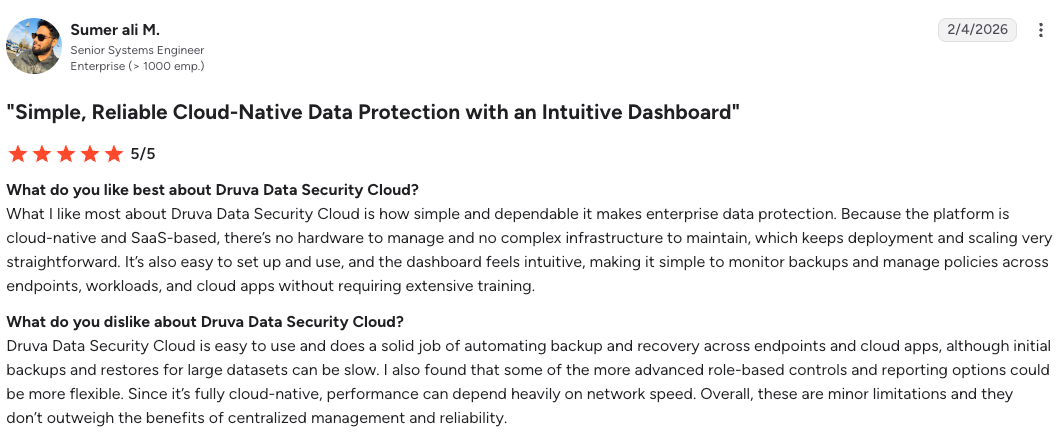
"There’s no hardware to manage and no complex infrastructure to maintain." – Sumer Ali M., G2
"The product has many screens and options and getting used to the functionality can take a while." – Alan B., G2
Rubrik
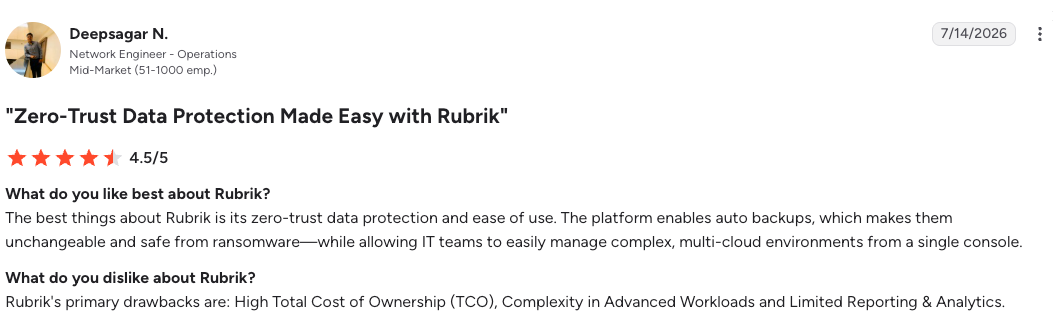
"The best things about Rubrik is its zero-trust data protection and ease of use." – Deepsagar N., G2
"It can be expensive, especially for smaller organizations." – Shivanshu S., G2
Eon
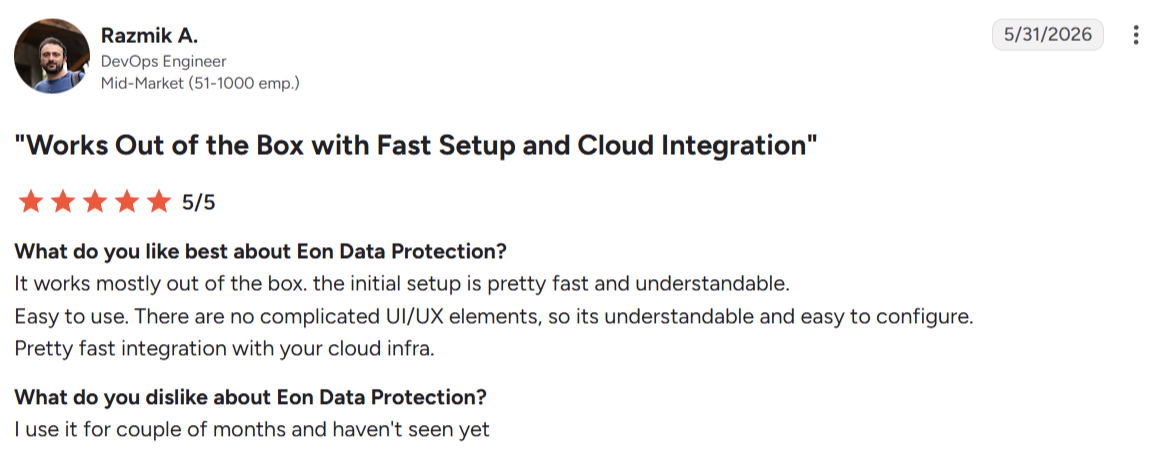
"Pretty fast integration with your cloud infra." – Razmik A., G2
"I would like to see more detailed restore progress and additional reporting customization." – Deepak C., G2
Which platform should you choose?
Choose Druva if you:
- Protect a workforce first, meaning laptops, Microsoft 365, Google Workspace, and identity systems.
- Want managed SaaS backup with no infrastructure decisions at all.
Choose Rubrik if you:
- Run a serious on-prem footprint alongside cloud and want one policy engine over both.
- Prioritize ransomware investigation tooling across your whole environment.
Choose Eon if you:
- Operate hundreds of TB to multi-PB of cloud databases, object storage, and VMs.
- Want restores scoped to the damaged data and backup data your analysts can query.
7 tests to run before you sign
Run these in a proof of concept, in your own account, with your own data. Whichever vendor passes the most of these on your workloads is your answer.
- Restore a single database row without touching the surrounding tables.
- Recover one file from a VM snapshot, and count the compute each platform stands up to do it.
- Restore a deleted Microsoft 365 mailbox or Entra ID object, if SaaS and identity sit in scope.
- Recover the same workload in your data center and in cloud under one policy, if you run both.
- Query a backup directly, with no restore, from your warehouse of choice.
- Find every unprotected resource across at least three accounts, then trace one month of backup spend to a single named resource.
- Simulate an encryption event, identify the last clean recovery point, and recover only the affected data.
The final verdict
For the cloud infrastructure job specifically, Eon wins this comparison. Druva remains the stronger pick for endpoint and SaaS protection, and Rubrik for hybrid environments that need one engine across the data center and the cloud.
If your cloud backup bill keeps climbing while your restores stay slow and broad, what would a single-record restore on your own data be worth? Book a demo and see how Eon restores one record without touching the surrounding tables.
Frequently asked questions
What is the main difference between Druva and Rubrik?
The main difference between Druva and Rubrik is architecture. Druva is a fully managed SaaS platform built endpoint-first, while Rubrik pairs a SaaS control plane with components that run in your own cloud account, including EKS-based Exocompute for cloud file recovery.
Is Druva better than Rubrik for cloud backup?
Neither leads for cloud infrastructure. Druva CloudRanger's support matrix doesn't cover RDS cluster backup and restore, and S3 buckets in a private VPC aren't discovered or protected. Rubrik's cloud file recovery requires compute in your account, so cloud-first buyers should also evaluate a cloud-native platform like Eon.
Does Rubrik require infrastructure in my cloud account?
Yes, for some capabilities. File search and recovery for EC2 and EBS run on EKS clusters inside your AWS account, configured per account and region. Rubrik offers a managed Exocompute mode alongside a customer-managed one, so teams can choose whether Rubrik or their own cluster admins hold cluster permissions.
Can Eon replace Druva or Rubrik?
Yes, for cloud infrastructure workloads on AWS, Azure, and Google Cloud. Eon does not back up endpoints or on-prem systems, so organizations with those needs would keep a separate tool for them.
Which is cheaper, Druva, Rubrik, or Eon?
No vendor publishes a flat list price for cloud infrastructure backup. Druva bills credits per deduplicated TB-month, Rubrik sells quote-only capacity licenses with median contracts near $150,000 per year, and Eon bills per GB of protected storage.