

Every disaster recovery as a service (DRaaS) contract answers a set of questions before it commits to anything: who runs the failover, what the SLA's RTO clock actually measures, what the coverage leaves out, and what a real month of billing looks like.
The differences among providers live in those answers, and only a line-by-line read of the contract surfaces them.
What is disaster recovery as a service (DRaaS)?
Disaster recovery as a service (DRaaS), also sold as recovery as a service or DR as a service, is a subscription service in which a provider replicates your production workloads and performs failover when production goes down. Backup as a service restores data onto infrastructure you rebuild yourself.
The provider owns the recovery target, the replication engine, retention depth, and the orchestration that boots systems in order. Declaring the disaster stays yours, along with validating that applications came up clean and keeping the runbook current as production changes.
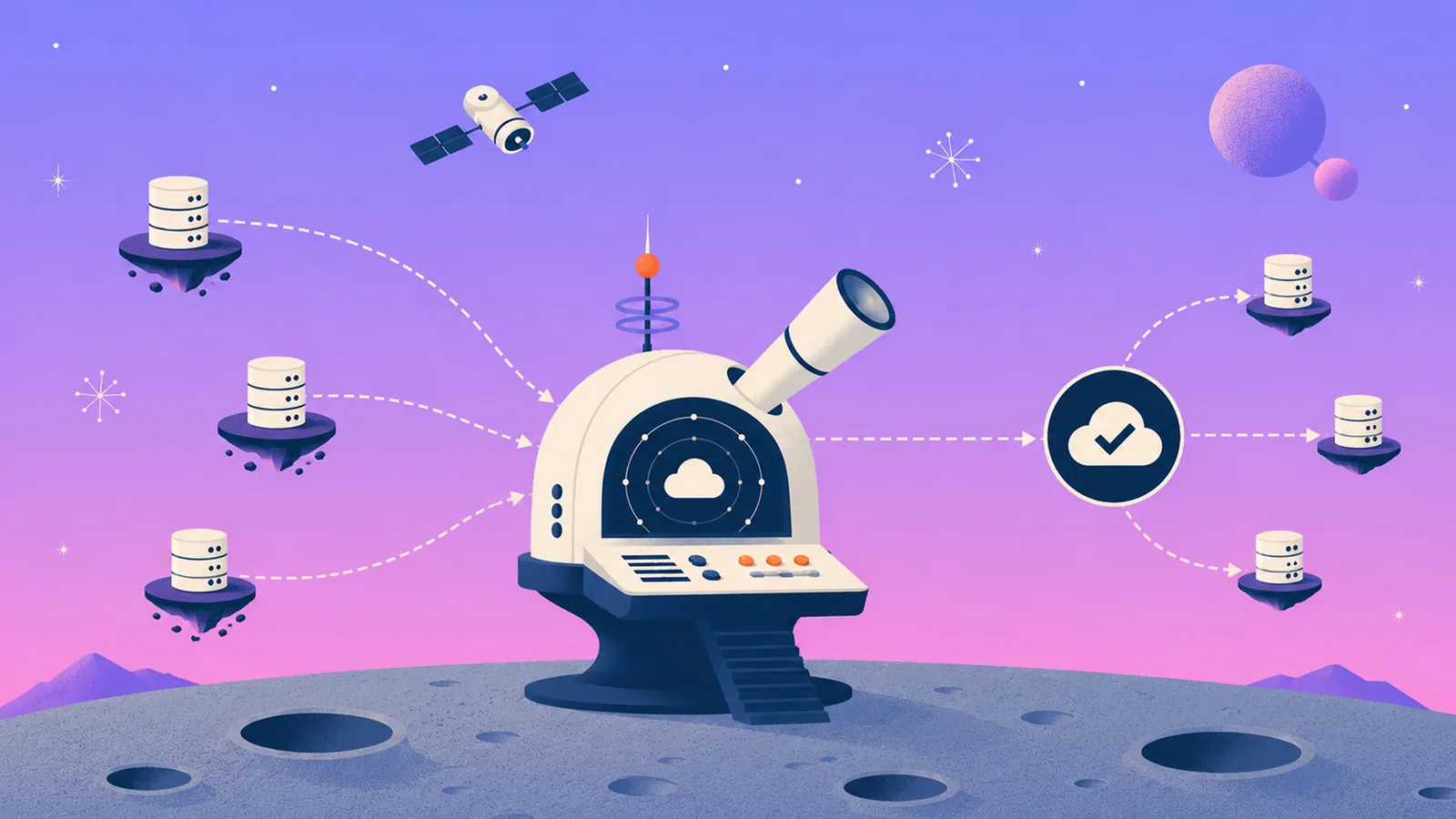
How DRaaS works
A DRaaS service takes each protected workload through six stages, from the first full copy of its disks to its return to the primary site.
Replication cadence sets the RPO. Continuous block-level replication, the model AWS Elastic Disaster Recovery uses, holds a recovery point measured in seconds. Scheduled snapshot replication holds one measured in minutes or hours. The window between snapshots is the data lost if production goes down between cycles.
Failback takes the longest on large environments. Users keep writing to the recovery site for the whole outage, so the primary site returns behind by every one of those changes.
That delta has to replicate back and pass verification before cutover, and production keeps running from the recovery site until then. On a large environment, failback needs its own runbook and its own maintenance window.
DRaaS delivery models: From fully managed to self-service
Providers package the same underlying technology at three levels of service, and the model you buy determines who executes the failover during a live incident. Vendors across the wider DR tooling market sort into these same three tiers.
Fully managed DRaaS
The provider designs the recovery environment, writes the runbook with you, executes failover and failback, and runs scheduled tests. You declare the disaster and validate the applications.
This model suits organizations without a dedicated resilience function. The tradeoff is dependency. When failover is a service ticket, your recovery speed is bounded by the provider's response commitment.
Assisted DRaaS
You retain day-to-day control through the provider's console and pull in their engineers for declarations, complex tests, or failback. Responsibility is shared and defined in the contract.
This is the common landing spot for mid-sized cloud organizations. It also carries the widest ambiguity, so the split belongs in the contract in writing.
Self-service DRaaS
The provider supplies the replication platform and the recovery capacity. You drive everything else through their console or API.
Cost is lowest, and control is highest. It works when you already employ engineers who exercise failover regularly, and it degrades badly when nobody has run a drill in a year.
Benefits of disaster recovery as a service
DRaaS earns its price on five fronts, each with a condition attached.
- Recovery capacity without a standby site: Storage and replication run continuously, and full compute bills only during drills and real recoveries. Capacity used above your reserved level during a long outage bills at a separate rate.
- Recovery objectives written into a contract: A contractual RTO comes with a named owner and a remedy, which an internal target lacks. It covers only what the contract's RTO clock measures.
- Failover tested on a schedule: Bundled tests put drills on a calendar someone is paid to keep, and drift between production and the recovery setup surfaces in each one. Environments that change weekly need more tests than a contract usually includes.
- Specialist skills without hiring: Failover orchestration and recovery networking are narrow skills that are expensive to hire and hard to retain when they sit unused for months. A provider spreads those engineers across its customer base.
- Spend matched to the cost of an outage: Outages per site have declined for five straight years while the cost of each one has risen. In Uptime Institute's 2026 outage analysis, 57% of survey respondents said their most recent major outage cost more than $100,000.
What a DRaaS SLA commits to
A DRaaS SLA commits the provider to having a recovery environment provisioned and reachable within a stated window. Full business recovery sits outside that promise. Gartner's 2026 Hype Cycle for Backup and Data Protection Technologies expects 35% of enterprises with external SLA obligations to include minimum viable recovery in their incident response plans by 2030.
- What the RTO clock measures. The clock usually starts when the provider accepts a valid declaration and stops once recovery instances are running. Application startup and validation fall outside it, which can add hours on a multi-tier application.
- Service credits as the remedy. Missed commitments pay out in service credits, so confirm whether credits are capped and over what period. If the cap is a month of fees, the credits won't cover a day of lost revenue, so the SLA belongs in the risk register next to insurance.
- Financially backed RTOs. Some providers put money behind their RTO, which signals confidence in their recovery process. The commitment still covers only the stages the provider controls.
- Availability and recovery as separate clauses. An uptime commitment on the recovery platform says nothing about how fast workloads come up on it. Each clause is measured on its own terms.
DRaaS pricing components
DRaaS pricing stacks several meters, and the headline subscription is rarely the largest one.
Replicating 100 servers with 30TB of disk through AWS Elastic Disaster Recovery costs $2,044 a month in service fees, and $6,389.03 once staging volumes, retained snapshots, and replication instances are added.
The service line is under a third of that bill, and data transfer sits outside the example entirely.
Any DRaaS quote deserves the same decomposition. Ask the provider to model a real month and a real eight-hour failover before comparing numbers across vendors.
How to evaluate a disaster recovery as a service provider
Seven questions separate DRaaS providers in practice, and every answer should arrive in writing. Feature lists look alike across DRaaS solutions.
- What does the RTO clock measure? Get the start trigger and the stop condition named explicitly, along with what sits outside the measured window.
- How many test failovers are included per year? Then ask what an additional test costs and how much notice it requires.
- Who writes and maintains the runbook? Under assisted models, this is a frequent point of dispute during contract review.
- What does a declaration cost and who can trigger it? Confirm the authorized roles, the response commitment, and the billing rate above your reserved capacity.
- Which cloud services fall outside replication? Ask for the exclusion list covering object storage, managed databases, and container platforms.
- What does failback look like? Ask for a documented process, an expected duration for your data volume, and who executes it.
- What happens at exit? Confirm how your replicated data is returned or destroyed, in what format, and over what period.
The vendors that reach most cloud DR shortlists will answer these questions in writing before the contract is signed, and the answers vary more than the marketing pages suggest.
Where DRaaS coverage stops
Cloud disaster recovery as a service covers the loss of an environment: production is down, and workloads have to run somewhere else. A dropped table or an encrypted bucket leaves the environment running, and replication has no clean copy to fall back to.
Corruption at the recovery site
A replication engine copies whatever it receives, so that corruption reaches the recovery environment within seconds, in the same state it landed in production.
One SaaS company relied on cross-region replication as its DR. A staff error corrupted more than 1,000 customer records, and because the replica held the same corrupted data, the fix meant restoring a multi-terabyte RDS instance into a temporary environment: more than a day of work for two engineers.
Retention is the only defense, and retention windows are short. Once corruption is older than the oldest retained point, the recovery site holds the same damaged data as production.
In Eon’s 2026 Cloud Data Infrastructure Report, 98% of executives said they're confident in their organization's recovery, yet 55% of executives reported three or more recovery failures in the past 12 months.
Recovery granularity fixed at the machine level
Failover restores whole servers. When the incident is one corrupted table, recovery means launching a recovery instance to pull the table out, then tearing the instance down.
Managed cloud services outside the replication scope
Server replication protects servers. AWS Elastic Disaster Recovery replicates through an agent on each source machine, and managed services such as Amazon S3 and DynamoDB have no machine to install one on.
For Azure SQL Database, the recommended BCDR path is the database's own geo-replication and auto-failover groups. Site Recovery covers other Azure layers.
How to cover what DRaaS misses
What DRaaS misses is recovered at the data layer: restoring the exact records an incident touched, and rolling back ransomware or rogue-agent damage in minutes, without rebuilding the environment. DRaaS stays the right tool when an environment is lost; this layer runs alongside it, where the blind spots live.
The combined stack is often called backup and disaster recovery as a service. Eon works at this layer, built by the team behind CloudEndure, who ran AWS's disaster recovery business.
Recovery copies in a logically air-gapped vault
Eon holds recovery copies in a separate account from production, logically air-gapped and immutable for the retention period, outside the blast radius of compromised production credentials. Geographic redundancy is not security isolation. Eon scans recovery points for ransomware and anomalies, which gives you a starting point when you look for a clean one to restore from.
Retention depth drives storage cost. NETGEAR cut backup storage costs by 35% with Eon's storage model and autonomous policy management.
Granular restore at the file, table, and record level
Granular recovery returns a single file, table, or record without launching an environment around it. Because recovery copies are searchable in place, you can query them and restore only the records or tables you need, instead of restoring the whole environment.
StructuredWeb cut backup retrieval time by 98% with Eon. Large restores still scale with data size, though: NETGEAR brought a 10TB SQL Server database from 24 hours to under three, an 88% faster recovery.
Coverage for managed cloud services
Replication installs an agent on every source machine. Eon connects through a single read-only IAM role and installs no agents or appliances in your environment.
Because Eon works through cloud APIs, it reaches services that have no server to host an agent. On AWS, that includes Amazon S3, DynamoDB, RDS, and Amazon EKS. On Google Cloud, it covers Cloud Storage, Cloud SQL, and BigQuery, and on Azure, it covers Storage Account blobs.
Cloud Backup Posture Management (CBPM) assigns backup policies to new resources across accounts and regions as they appear, so a new bucket or database has coverage from its first day.
Choosing disaster recovery as a service for your environment
Disaster recovery as a service is the right purchase when downtime itself is the cost you are managing.
Regional outages, infrastructure loss, and any workload where an hour offline carries a contractual penalty all justify a provider-run failover path, provided a cloud DR plan naming those workloads and their recovery-time targets is already in place.
The purchase covers one class of failure. Data-layer incidents replicate into the recovery environment intact and need recovery at the record level: corrupted tables, deleted objects, encrypted buckets, and agents acting on production with valid credentials.
Book a demo to watch Eon query a recovery copy and restore only the table or records you need.
Frequently asked questions
What is a disaster declaration in a DRaaS contract?
A disaster declaration is the formal request that authorizes your provider to begin failover. The contract names who can submit it, how it is submitted, and how quickly the provider must respond. A declaration usually starts the RTO clock and often changes your billing, since capacity consumed above your reserved level bills at a separate rate.
How long does failback take after a DRaaS failover?
Failback typically takes longer than the original failover. Data written while you ran in the recovery environment has to replicate back to the primary, get verified, and cut over during a planned window. Duration depends on your data volume and change rate, so ask the provider for an estimate for your environment.
Does DRaaS protect Amazon S3 buckets and DynamoDB tables?
Generally no. DRaaS replication is built around servers and virtual machines, and it works through an agent or hypervisor hook that managed cloud services do not expose. Object storage, managed databases, and serverless services usually need separate protection through native cloud mechanisms or a cloud-native backup platform.
What RTO and RPO can DRaaS providers realistically deliver?
Continuous block-level replication supports an RPO measured in seconds and an RTO measured in minutes for the provisioning stage. Snapshot-based replication lands closer to minutes for RPO and low hours for RTO. Both figures cover infrastructure only, so application startup and validation add time on top.
How many failover tests does a DRaaS contract usually include?
Managed contracts commonly include one to two tests per year, with some providers offering quarterly testing windows. One to two a year suits stable environments. If your infrastructure changes weekly, negotiate more tests or choose a model where you can run drills yourself on demand.
Who handles DNS and IP changes during a DRaaS failover?
Responsibility splits by delivery model, and the contract should name the line explicitly. Fully managed providers typically rebuild the network configuration inside the recovery environment. Public DNS cutover usually stays with the customer, because redirecting live traffic is a business decision.