

AI data governance is the practice of deciding which data your AI systems can learn from, retrieve, and act on, and being able to prove those decisions later. Most enterprises already run a data governance program.
The trouble is that it was built for dashboards and quarterly reports, and AI touches data in places that the program never watched.
The data feeding a fine-tuning job or a retrieval pipeline also sits in snapshots and retained copies across accounts and regions, usually outside the data catalog. One VP of Engineering we spoke with put it this way: “100 new databases get turned on every day, and we don’t know what data is residing in them.” In our 2026 survey of 583 cloud IT leaders, 57% named a data-layer problem as the single biggest barrier to AI or analytics progress. Only 11% pointed to AI models or tooling.
What is AI data governance?
AI data governance is the set of owners, policies, and technical controls that keep the data used to train, test, and run AI systems accurate, access-controlled, traceable, and lawful. It covers training datasets, the documents a retrieval pipeline pulls from, the context an agent receives at runtime, and the outputs those systems produce.
The cost of getting it wrong is already measurable. Gartner found that 63% of organizations either don’t have, or aren’t sure they have, the right data management practices for AI. Gartner also predicted in February 2025 that organizations will abandon 60% of AI projects unsupported by AI-ready data through 2026.
A quick test: if you can’t say where a model’s data came from, who was allowed to touch it, and how you’d restore a clean copy after something goes wrong, that system isn’t governed yet.
How it differs from traditional data governance
Traditional data governance manages data assets for reporting and compliance. Governance for AI keeps all of that and extends it across the model lifecycle, from the training set to each inference request to whatever an agent does with the answer.
Three things stretch the old model the most:
- Copies multiply. A training set gets sampled, cleaned, chunked into embeddings, and cached in a feature store. Each copy carries the same obligations as the source, and most of them never show up in the data catalog.
- Requests happen at machine speed. An agent can pull data dozens of times in a single task. A human approval queue can’t sit in that path, so the policy has to run automatically at request time.
- Outputs can leak inputs. A model can repeat personal data it saw in training. Under the European Data Protection Board’s Opinion 28/2024, a model counts as anonymous only when the chance of extracting personal data from it, directly or through queries, is insignificant.
Data governance for AI vs AI governance
The main difference is scope. Data governance for AI controls the data going into and coming out of AI systems. AI governance controls the systems themselves: model design, risk assessment, fairness testing, human oversight, and who signs off on deployment.
The two overlap on data integration, quality, security, privacy, and accessibility. A simple way to tell them apart is to ask what failed.
Say a credit model starts rejecting applicants from one region. The data team checks whether that region is under-represented or mislabeled in the training set. The AI governance team checks the model’s thresholds, its fairness tests, and whether a person reviews borderline decisions. Most real incidents need both teams in the room.
Security for the models themselves is a separate discipline: AI security posture management covers prompt injection, exposed endpoints, and shadow AI services.
The 4 core components of AI data governance
Governance for AI rests on four building blocks:
- Data quality: Datasets have to be relevant, representative, and as complete and error-free as you can make them. In practice, that means validation rules, deduplication, dataset versioning, and drift checks. Skip it and a model trains on stale or duplicated records, then repeats those errors at scale.
- Access control: This decides which people, service accounts, and agents can read which classes of data, and whether sensitive fields get masked before they reach a prompt. Agents make this harder, because a broad credential handed to an agent gets used in ways nobody planned.
- Lineage and traceability: Record the path from source system to transformation to dataset version to model version. Without it, you can’t answer an auditor, honor an erasure request, or work out which models a bad dataset touched.
- Runtime context for agentic systems: Agents need governed context at the moment they act. That means scoping data to the task and the specific customer or case, applying policy before the model reasons over it, keeping data current, and logging every action the agent triggers.
A fifth belongs on that list yet rarely makes it: retention and recoverability, where a lot of regulated AI data ends up living.
Why governance for AI breaks down in large cloud environments
Governance for AI usually breaks down over ownership, because nobody owns the data end to end. In a large cloud estate, data sits across hundreds of accounts, a few regions, and two or three providers, and each team tags (or forgets to tag) its resources its own way.
Findings from our 2026 report show how this plays out:
- Unprotected data: 63% of cloud teams frequently or sometimes discover workloads left unprotected because of misconfiguration.
- AI on production: 75% run AI against production data, largely because retained and backup data is hard to get at.
- Prep time: 84% need a day or longer to make data usable for AI, and 23% need more than a week.
Agents create and modify resources quicker than any tagging process can follow, which is why multi-cloud governance breaks in the AI era.
If your policies depend on someone applying the right tag, the newest and busiest data is the least governed, and tags only take you so far.
What the EU AI Act and GDPR require
Regulation is the main reason governance for AI has moved from a data team project to a board-level item. The two rules most enterprises feel first are the EU AI Act and GDPR.
EU AI Act
Article 10 of the EU AI Act sets the data rules for high-risk AI systems. Training, validation, and testing data must be "relevant, sufficiently representative, and to the best extent possible, free of errors and complete."
Providers also need documented practices covering data origin, preparation steps like labeling and cleaning, bias examination and mitigation, and known data shortcomings.
The timeline moved this year. The AI Omnibus entered into force on July 27, 2026, pushing high-risk obligations to December 2, 2027 for stand-alone systems and August 2, 2028 for AI embedded in regulated products.
That’s a little over a year for stand-alone systems, which is less time than it sounds if your lineage records don’t exist yet.
A few other provisions are already live or close:
- Training data summaries: Since August 2, 2025, providers of general-purpose AI models placed on the EU market have had to publish a sufficiently detailed summary of the content used for training.
- Record retention: Providers of high-risk systems must keep technical documentation available for 10 years after the system goes on the market.
- Penalties: Breaching high-risk obligations can cost up to €15 million or 3% of worldwide annual turnover, whichever is higher.
GDPR
GDPR applies whenever personal data trains, tunes, or feeds an AI system, regardless of the model’s risk tier. Its principles of purpose limitation, data minimization, and storage limitation all bite harder in AI pipelines, where data gets reused for purposes nobody listed at collection time.
Two provisions cause the most work.
The right to erasure (Article 17) reaches beyond live systems. Under the UK ICO’s guidance, that covers backups too: data you can’t immediately overwrite has to be put “beyond use.”
And Article 22 limits decisions made solely by automated processing that significantly affect people. Fines reach €20 million or 4% of worldwide annual turnover.
Other frameworks worth mapping to
- NIST AI RMF: The AI Risk Management Framework, released in January 2023, organizes the work into four functions: Govern, Map, Measure, and Manage.
- ISO/IEC 42001: Published in December 2023, ISO/IEC 42001 is a certifiable management system standard for organizations that build or use AI.
- OECD guidance: The OECD’s June 2024 report on AI, data governance and privacy maps its Privacy Guidelines to its AI Principles, which helps when you operate across jurisdictions.
These frameworks assume you already have the underlying cloud security compliance controls in place.
How to build an AI data governance framework in 6 stages
A framework only works if each stage produces something you can show an auditor. These six stages follow the order most enterprises can realistically run them in, and each one names what breaks if you skip it.
Stage 1: Charter the program and name owners
List your AI use cases, then assign a data owner and a model owner to each one. Sort them by risk, using the EU AI Act’s categories if you operate in Europe. Start with the three or four use cases that touch personal or financial data.
Skip this and every later decision stalls, because no one has the authority to say a dataset is approved for training.
Stage 2: Discover and classify every copy
Find the data across every account and cloud, including the copies people forget: notebook exports, feature stores, embedding indexes, and snapshots. The sources a retrieval pipeline reads count too; an ungoverned wiki can leak as much as a badly trained model. Classify it all by sensitivity (personal, financial, health) and by environment.
Manual tagging falls behind within weeks in any environment that agents or CI pipelines touch. CSPM, DSPM, and CBPM each discover a different slice of the estate.
Stage 3: Turn policy into code
Map each data class to its allowed uses: approved for training, approved for retrieval only, or off-limits to AI entirely. Then encode those rules where they run, in access policies, masking rules, and retention settings.
Once a rule lives in the access layer, it runs on every request, including the ones an agent makes with no human in the loop.
Stage 4: Trace lineage and document it
Tie each dataset version to the model versions trained on it, and record the transformations in between. Store that documentation somewhere you’ll still have it in a decade, given the AI Act’s 10-year retention rule.
When a regulator asks what data trained last year’s model, this stage is the difference between a query and a month of forensics.
Stage 5: Control runtime access for agents
Give agents short-lived, task-scoped credentials. Check policy before data reaches the model, mask sensitive fields at the source, and log every tool call and write action the agent makes.
Broad, long-lived agent credentials are how a routine task turns into a deleted database.
Stage 6: Monitor, test, and recover
Watch for data drift, quality regressions, and access anomalies, and review permissions on a schedule. Then practice recovery, because prevention tools miss something eventually.
For AI data, that means tested restores, validated permissions, and a known clean point to return to.
Where backups fit in the governance framework
Backups are the part of the data estate most governance programs never look at, and they hold complete copies of the same regulated data your AI systems use. Customer records, financial transactions, health data, and the source tables behind your training sets all sit in snapshots for months or years, usually outside the data catalog.
That creates four specific problems:
- Erasure requests reach backups. Restore an old snapshot to rebuild a training set and you can quietly bring back records you already deleted on request. Under the ICO’s guidance, backup data has to be put “beyond use” until it expires on schedule, so a maximum retention window short enough to let erased records age out does most of the work, and any restore used to rebuild a training set should filter out records already erased.
- Backups are your provenance record. When you need to reproduce the dataset behind a model version, retained snapshots are often the only complete copy of what the data looked like on that date.
- Backups are already an AI data source. In our survey, 54% of teams use backup or retained data for AI despite infrastructure limits. Once backups feed AI, they need the same access controls as production.
- Recovery is the last control. In the PocketOS incident, an AI coding agent deleted a production database and its backups in about nine seconds. Governance that can’t restore a clean copy only documents the loss.
How we govern backup data at Eon
We built Eon around a view we hold firmly: if you can’t prove coverage, you don’t have coverage. That’s why we created the Cloud Backup Posture Management (CBPM) category.
CBPM discovers resources across accounts and regions through read-only APIs, classifies them by data class (PII, financial information, PHI) and environment, and applies the backup policies you define to the resources that match. It keeps running as the environment changes, so coverage never depends on someone remembering to tag a new resource.
Posture controls then check the result: a minimum number of copies, a copy in another region or account, and minimum and maximum retention. That maximum retention rule is how storage limitation becomes something you can enforce. Violations show on the dashboard with a severity, so drift gets caught while it’s small. Long retention windows carry a storage bill too, and forever-incremental copies with global deduplication keep it down, at up to 50% lower cost.
Access to backup data follows governance rules too. RBAC with custom roles, SAML SSO, and data access controls can block querying or downloading PII or PHI based on a resource’s classification. The audit log records who did what and when.
The recovery copies sit in immutable, logically air-gapped vaults in a dedicated account, outside the blast radius of compromised production credentials. That separation is what lets a clean copy survive a rogue agent or a ransomware attack. Eon also identifies AI apps such as Claude, ChatGPT, Cursor, and Ollama running on discovered resources, and the point-in-time copies let you restore data an agent deleted or corrupted.
When something does go wrong, granular recovery restores a file, a table, or a set of records for supported services, without rebuilding the full environment. Restore time still scales with data size, but you only bring back what you need.
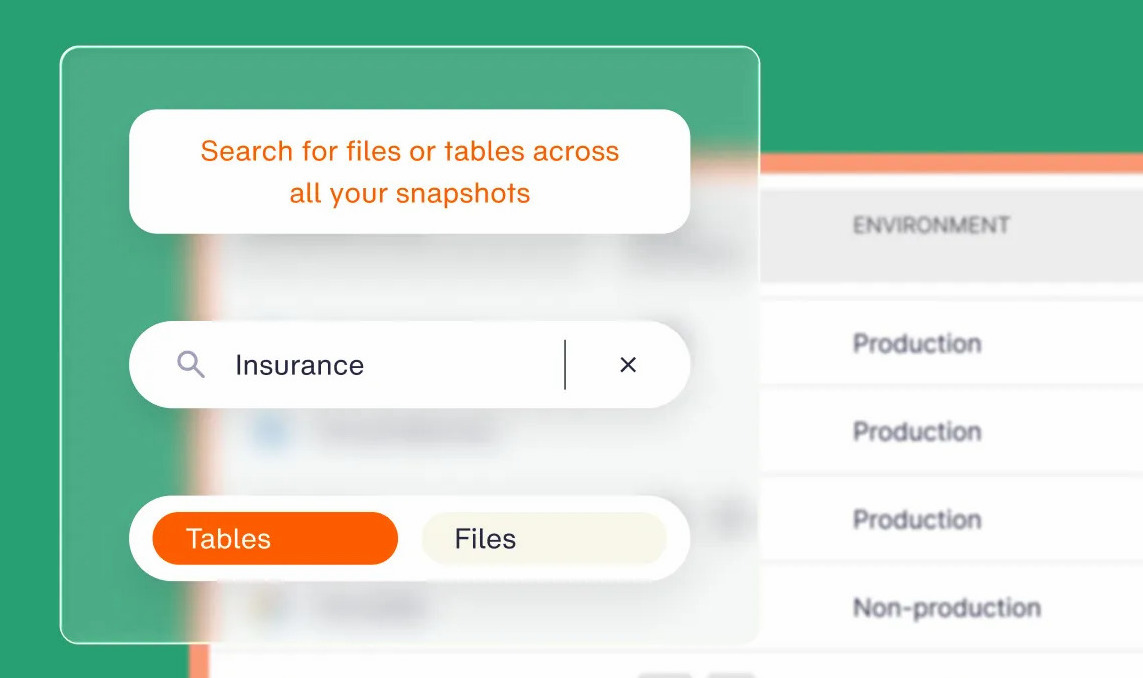
And the data stays usable after the backup job ends. Global Search finds files and records across clouds, and the Database Explorer lets teams run SQL queries on backed-up databases without restoring the entire environment.
The Eon AI Assistant adds natural-language queries over backup data, and works with agents such as Claude Code through MCP. These AI-facing features are the newest part of the platform, and we’re still expanding them.
Retention changes keep pace with regulation, too. After SoFi moved to Eon, retention changes that once took hours or days applied in seconds. As CJ Keefe, then Director of Corporate Infrastructure, DevOps & SRE at SoFi, put it in the case study: “We had to update a retention policy for a new student-loan servicing requirement. By the time I hung up, it was done.”
Cloud data protection is the wider picture that backup, recovery, and posture fit into.
Best practices for governing data used by AI
These seven habits separate programs that pass an audit from programs that produce a policy document and stop there.
- Start with high-risk use cases. Govern the three or four AI systems that touch personal, financial, or health data first, then expand.
- Classify at creation time. Automatic classification labels new resources on day one, before anyone points a pipeline at them.
- Apply policy before the model sees the data. Mask and filter at the source, because anything that reaches a prompt can end up in an output.
- Scope agent credentials to the task. Short-lived, narrow permissions limit how far one bad instruction can reach.
- Version datasets alongside models. Every model version should point to the exact dataset versions that trained it.
- Set a maximum retention on AI data copies and backups. Keep what you need for lineage and recovery, and let the rest expire on schedule, with the windows set in a backup retention policy.
- Test restores of AI-relevant data. A backup you’ve never restored is an assumption. Pick a clean recovery point and prove it works.
AI data governance as a posture problem
Governance for AI usually fails at the edges of the data estate: the copies, the snapshots, and the agent sessions nobody logged. Most programs write good policies for the training pipeline and leave everything around it ungoverned.
The fix is to treat governance for AI as a posture problem. Know where every copy lives, classify it automatically, enforce policy where data is actually read, and keep a clean, isolated copy you’ve proven you can restore. Regulators will ask for the evidence, and so will your own incident review.
Backups are part of that estate. Leave them out and your framework has a blind spot exactly where your oldest, most complete copies of regulated data sit.
Bring your backups into your governance plan
Eon is the Autonomous Data Foundation that keeps enterprise data safe and recoverable. For platform, infrastructure, and security teams, it puts backup data under one set of governance controls across AWS, Azure, and Google Cloud.
- Coverage you can prove: CBPM discovers and classifies resources, then applies the backup policies you define across accounts and regions.
- Access that follows the data: RBAC, SAML SSO, and data access controls that can block queries on PII and PHI.
- Recovery after an AI mistake: Immutable, logically air-gapped vaults plus granular restore of files, tables, and records.
- Backups your teams can use: Global Search, plus SQL and natural-language queries without a full restore.
Can’t say what regulated data is sitting in your backups? Book a demo and see how Eon puts it under the same governance as production.
Frequently asked questions
What are the four pillars of AI governance?
The most widely used four pillars are the NIST AI RMF’s core functions: Govern, Map, Measure, and Manage. Govern sets policy and accountability, Map identifies context and risk, Measure tests systems against those risks, and Manage prioritizes and acts on them. Other frameworks group principles such as transparency, accountability, fairness, and privacy instead.
How is AI used in data governance?
AI speeds up the manual parts of data governance: classifying sensitive data, extracting lineage from pipelines, flagging quality anomalies, and letting people search governed data in plain language. People still need to own and approve the policies.
Does GDPR apply to AI training data?
Yes, GDPR applies whenever personal data is used to train or tune an AI model. You need a lawful basis for the processing, and under the EDPB’s Opinion 28/2024, a trained model counts as anonymous only when extracting personal data from it is insignificantly likely.
Do backups fall under governance for AI?
Yes, backups fall under governance for AI whenever they hold personal or regulated data that AI systems use or were trained on. Erasure requests, retention limits, and access controls all apply to backup copies, and retained snapshots are often the provenance record for a model’s training data.
Is governance for AI the same as data security?
No, data security is one part of governance for AI. Security controls who can access data and protects it from attack, while governance also covers quality, lineage, lawful use, retention, and accountability for how AI systems use the data.