

If you're a cloud infrastructure or DevOps lead shopping for an AI data security platform in 2026, the category itself is the first trap.
Four different tool types share the label: data discovery, access governance, AI system security, and DLP. The wrong pick leaves the exact gap that shows up during an incident.
We built this list from vendor and product documentation, verified reviews, analyst category definitions, and reported 2026 incidents to compare seven AI data security platforms across coverage lane, public cloud depth, AI agent handling, compliance evidence, and pricing.
Each pick is judged on where it wins, and where it leaves you needing something else.
7 best AI data security platforms: TL;DR
- Cyera: Best for AI-native data discovery and classification at enterprise scale.
- BigID: Best for privacy-driven data discovery and DSAR workflows across sprawling connector estates.
- Varonis: Best for data access governance across cloud and on-prem systems.
- Wiz: Best for adding DSPM and AI-SPM to an existing cloud security stack.
- HiddenLayer: Best for securing AI models and agents themselves.
- Palo Alto Prisma AIRS: Best for end-to-end AI lifecycle security in a consolidated stack.
- Fortra: Best for classification-led DLP programs with generative AI controls.
How we evaluated these AI data security platforms
These are enterprise platforms sold through sales-led motions, so we evaluated documented capability rather than trial accounts.
- Coverage layer: Whether the platform focuses on discovery and classification, AI system protection, or DLP and access governance.
- Public cloud depth: How far protection extends across AWS, Azure, and Google Cloud services.
- AI agent handling: What the platform does about autonomous agents reading, writing, and deleting data.
- Compliance evidence: Whether the platform produces proof an auditor accepts, without manual assembly.
- Pricing model: How each vendor charges, and where costs scale with data volume.
7 best AI data security platforms: Quick comparison
| Platform | Strengths | Best For | Limitation |
|---|---|---|---|
| Cyera | AI-native discovery, classification, DSPM + DLP | Sensitive data visibility at scale | No recovery layer |
| BigID | Deep connector coverage, privacy workflow automation | DSAR, RoPA, and privacy-driven discovery | Heavy deployment, weeks to months |
| Varonis | Access governance, behavior analytics | Permissions cleanup, insider risk | Multi-year time to full value |
| Wiz | DSPM + AI-SPM inside a CNAPP | Consolidated cloud security | Prevention only |
| HiddenLayer | Model scanning, AI red teaming, runtime defense | Securing AI systems | Not a data platform |
| Prisma AIRS | Full AI lifecycle security | Large Palo Alto stacks | Ecosystem lock-in |
| Fortra | DLP, classification, gen AI egress controls | Blocking data leaks to AI tools | Legacy architecture |
The 7 best AI data security platforms in 2026
1. Cyera: Best for AI-native data discovery at enterprise scale
What it does: Cyera discovers, classifies, and monitors sensitive data across cloud, SaaS, and on-prem systems, then governs what users and AI agents can access.
Best for: Security leaders at large enterprises who need accurate sensitive data visibility across sprawling multi-cloud environments before they can enforce anything.
Cyera is the reference point for AI-native DSPM, and the platform other DSPM tools get benchmarked against in enterprise evaluations.
Its whole architecture is built around one bet: that classification precision at petabyte scale is the primary problem to solve, and every other capability (posture, DLP, agentic controls) is only as useful as the classification underneath.
That bet has largely held. Enterprises whose top data-security problem is discovery and classification at scale tend to land on Cyera; those with a different top problem usually fit better elsewhere on this list.
Key features
- AI-native classification: Identifies sensitive data at rest, in motion, and in use with enough precision that remediation queues stay actionable.
- Agentic security controls: Governs what AI agents and copilots can see and do against classified data stores.
- DSPM plus DLP in one platform: The company has shipped over 100 capabilities spanning posture management, loss prevention, identity, and behavior. We rank the specialists in that lane separately in our guide to the best DSPM tools.
Pros and cons
Pros:
- ✅ Classification accuracy that holds up in environments with petabytes of unstructured data.
- ✅ Agentless connectors that scan data stores without hanging production servers.
- ✅ Fast time to first inventory, often within days of connecting accounts.
Cons:
- ❌ No recovery capability. If classified data gets encrypted or deleted, Cyera tells you what was lost, and something else restores it.
- ❌ Storage-based and user-based licensing gets expensive as data volume grows.
What users say
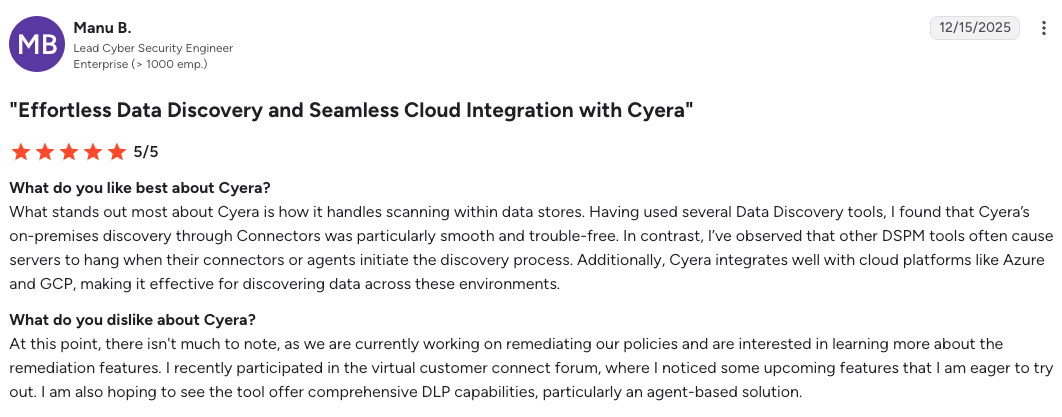
“What stands out most about Cyera is how it handles scanning within data stores.” – Manu B., G2
“Cyera has to keep up with the demands such [as Hugging Face] breaches.” – Chris M., G2
Pricing
Cyera does not publish pricing. Licensing is quote-based and scales with data volume and user count, so buyers with large unstructured data footprints should model growth before signing.
Bottom line
Cyera is the strongest pure data discovery and classification platform on this list. Buy it to know what sensitive data you have and who can touch it. Pair it with a recovery platform, because visibility does nothing for data that no longer exists.
2. BigID: Best for privacy-driven discovery and DSAR workflows
What it does: BigID discovers, classifies, and inventories sensitive data across cloud, SaaS, on-prem, and unstructured sources, then powers privacy workflows like DSAR fulfillment, RoPA mapping, and consent tracking on top of that inventory.
Best for: Privacy and compliance teams at regulated enterprises (financial services, healthcare, global consumer brands) where DSAR volume, cross-jurisdiction residency, and regulator reporting drive the buying decision as much as security posture.
BigID trades cloud-native speed for privacy heritage. Newer DSPM tools reach first inventory in days; BigID reaches audit-ready privacy governance in months. Buyers choose it when the compliance deadline is more crucial than time to first dashboard. The wider set of options, prevention and recovery both, is covered in cloud data protection solutions.
Microsoft-heavy shops are where BigID fits best right now. Purview handles data inside the Microsoft boundary; BigID handles the sources Purview can't reach, and feeds its classifications back into Purview DSPM through a Sentinel integration.
Key features
- Deep connector coverage: Broadest source library in the category, from mainframes to modern data warehouses to SaaS and unstructured file shares.
- Privacy workflow automation: Built-in DSAR fulfillment, RoPA mapping, and consent tracking that most security-first DSPM tools leave to a separate GRC platform.
- Purview integration: Feeds BigID discovery and classification into Microsoft Purview DSPM via Microsoft Sentinel, extending Purview coverage outside the Microsoft boundary.
Pros and cons
Pros:
- ✅ Unmatched connector breadth, especially for legacy and hybrid estates other DSPM tools skip.
- ✅ Regulatory workflow depth (GDPR, CCPA, HIPAA, DORA) built into the platform, not bolted on.
- ✅ Strong choice for organizations where privacy and security teams share the discovery layer.
Cons:
- ❌ Deployment is heavy. Time to first meaningful coverage is typically weeks to months, not days.
- ❌ Security posture and AI runtime controls trail newer cloud-native DSPM platforms.
What users say
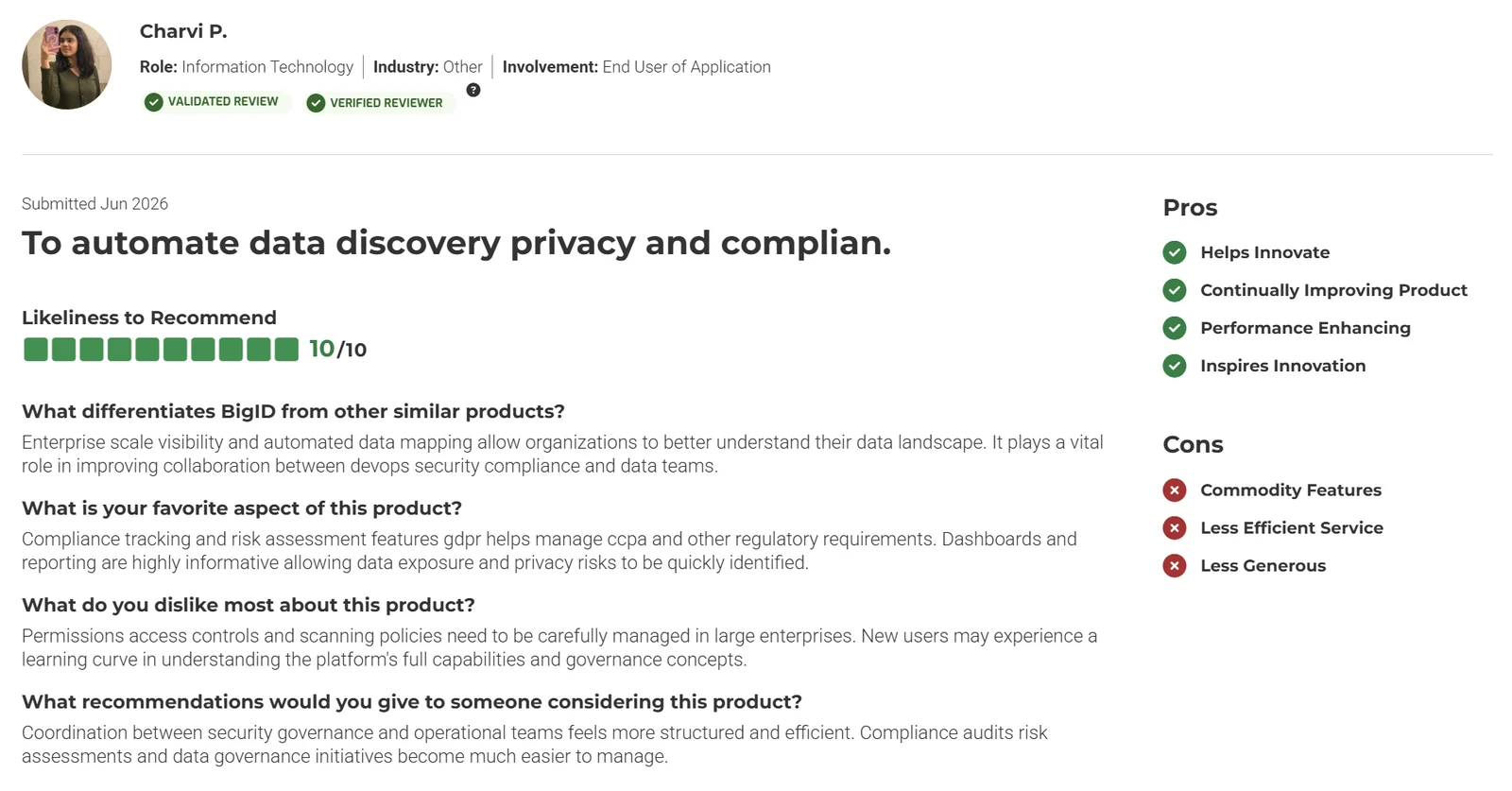
“It plays a vital role in improving collaboration between [DevOps, security, compliance,] and data teams.” – Charvi P., McLean & Company
“One area where BigID can be improved is the UI, which has a lot of bugs." – Aniruddha Nath, PeerSpot
Pricing
BigID pricing is quote-based, sold as a platform with modules for discovery, privacy, security, and AI. It sits at the enterprise end of the market, so scope the connectors and workflow modules you actually need before requesting a quote.
Bottom line
Choose BigID when privacy workflows and connector breadth drive the project, or when a Microsoft-heavy environment needs discovery that reaches outside the Microsoft boundary. Cloud-first security teams optimizing for speed and AI-native classification will get more from Cyera or Wiz.
3. Varonis: Best for data access governance across cloud and on-prem
What it does: Varonis maps who can access which data across file systems, SaaS apps, and cloud stores, then detects abnormal behavior and automates permissions remediation.
Best for: Organizations carrying years of permissions debt across mixed on-prem and cloud environments, especially where insider risk and audit findings drive the project.
Varonis approaches AI data security from the access side. Every copilot or agent leak starts with a permission someone granted, often to a system that's since drifted out of anyone's ownership. DSPM tools tell you the data is exposed; Varonis tells you which identities put it there and cleans up the permissions at the source. That gap is exactly how CSPM and DSPM differ in practice: posture at the configuration layer answers a different question from posture at the data layer.
The tradeoff is depth against deployment weight. Varonis's permissions model is deeper than any cloud-native DSPM on this list, and its deployments are longer than most buyers plan for.
Key features
- Permissions visibility and remediation: Shows exactly who can reach sensitive files and automates least-privilege cleanup at scale.
- Behavior-based threat detection: Alerts on abnormal access patterns instead of relying only on static rules.
- Coverage across on-prem and cloud: One of the few platforms on this list that treats file shares and SaaS with equal depth.
Pros and cons
Pros:
- ✅ Unmatched depth on permissions cleanup, the root cause behind most copilot data exposure.
- ✅ Detailed audit trails that shorten compliance reporting cycles.
- ✅ Managed detection and response option for smaller security groups.
Cons:
- ❌ Deployment is heavy. Getting full value takes sustained internal effort, sometimes years.
- ❌ Weaker fit for cloud-native workloads like managed databases and object storage than for file data.
What users say
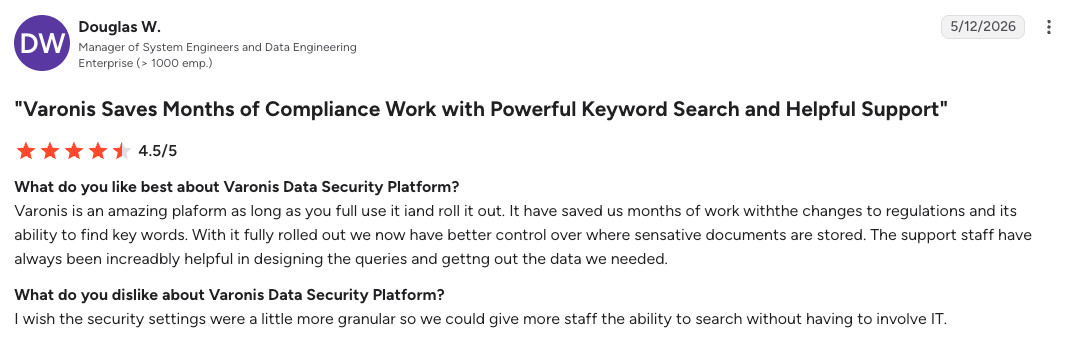
“With it fully rolled out we now have better control over where [sensitive] documents are stored.” – Douglas W., G2
“Sometimes the cost of the platform can be a concern” – Jason W., G2
Pricing
Varonis pricing is quote-based, sold as a SaaS platform with modules per data source. It sits at the premium end of the market on price, so scope the data sources you need covered before requesting a quote.
Bottom line
Choose Varonis when the core problem is access, meaning too many people and now too many AI tools can reach data they should not. If your environment is mostly cloud-native services rather than file data, other options on this list fit better.
4. Wiz: Best for adding DSPM and AI-SPM to an existing CNAPP
What it does: Wiz scans cloud environments agentlessly and connects code, cloud, and runtime context into one graph, with DSPM and AI security posture management as native modules.
Best for: Security groups that want data security findings inside the same platform that already handles their cloud vulnerabilities, identities, and misconfigurations.
Wiz sells context. Its DSPM and AI-SPM modules make data findings actionable by inheriting the cloud, identity, and attack-path context Wiz already collects for CNAPP. Classification depth is where dedicated DSPM specialists still win. How that layer relates to configuration posture is set out in cnapp vs cspm.
The buyer question is whether the team wants to add another console. Teams already running Wiz for cloud security add data findings at a fraction of the operational overhead a standalone DSPM would carry. Teams that aren't should compare on classification depth instead.
Key features
- DSPM in the security graph: Data findings inherit full cloud context, so exposed sensitive data with a working attack path rises above thousands of low-risk alerts.
- AI-SPM: Inventories AI services, models, and pipelines across clouds and flags risky configurations before deployment.
- Agentless multi-cloud scanning: Coverage lands across AWS, Azure, and GCP accounts within hours of connection, without agents to install or maintain.
Pros and cons
Pros:
- ✅ One console for cloud, data, and AI posture cuts tool sprawl for lean security groups.
- ✅ Attack path context makes data risk findings genuinely prioritizable.
Cons:
- ❌ Data classification depth trails dedicated DSPM specialists in unstructured data.
- ❌ Posture only. Wiz surfaces the risk, and remediation and recovery happen elsewhere.
What users say
“The regulatory frameworks that it has knowledge of [are] similarly broad, and growing.” – Alastair J., G2
“It takes some time to learn how to best navigate the platform and prioritize findings.” – Jason I., G2
Pricing
Wiz pricing is quote-based, licensed on cloud workloads scanned. Modules like DSPM and AI-SPM price separately on top of the core platform.
Bottom line
If you already run Wiz for cloud security, turning on DSPM and AI-SPM is the fastest route to data risk visibility with real context. If data classification precision is the primary requirement, compare it head-to-head against Cyera before deciding.
5. HiddenLayer: Best for securing AI models and agents themselves
What it does: HiddenLayer secures the AI systems an organization builds and runs, covering model scanning, attack simulation, and runtime defense against prompt injection and adversarial inputs.
Best for: Security and ML platform owners deploying custom or third-party models in production, particularly in financial services, healthcare, and government.
HiddenLayer defends a surface the DSPM tools on this list can't see: the AI models and agents themselves. A poisoned model or hijacked agent becomes a data breach vector the moment it touches production, and a DSPM scanning the data warehouse will miss it entirely. The two capabilities complement each other rather than compete.
Whether you need HiddenLayer depends on how much AI your organization builds versus consumes. Teams shipping their own models or agents into production need model-layer defense DSPM can't provide. Teams only consuming SaaS AI features can rely on lighter controls.
Key features
- Model scanning: Detects backdoored weights, malicious payloads, and vulnerable dependencies in third-party and proprietary models before deployment.
- AI attack simulation: Runs continuous adversarial attacks against deployed models to find weaknesses before real attackers do.
- Runtime protection for agents: Monitors agentic and MCP-connected systems for rogue behavior and cross-system exploitation.
Pros and cons
Pros:
- ✅ Research-driven engine with a track record of disclosed CVEs and issued patents behind its detection methods.
- ✅ Non-invasive runtime defense that works without accessing customer data or model internals.
- ✅ Strong fit for regulated and federal environments.
Cons:
- ❌ Narrow by design. It does nothing for sensitive data sitting in S3 buckets or databases outside AI pipelines.
- ❌ Requires ML and infrastructure expertise to deploy well. Small security teams without ML-adjacent skills often need vendor services to reach full value.
What users say
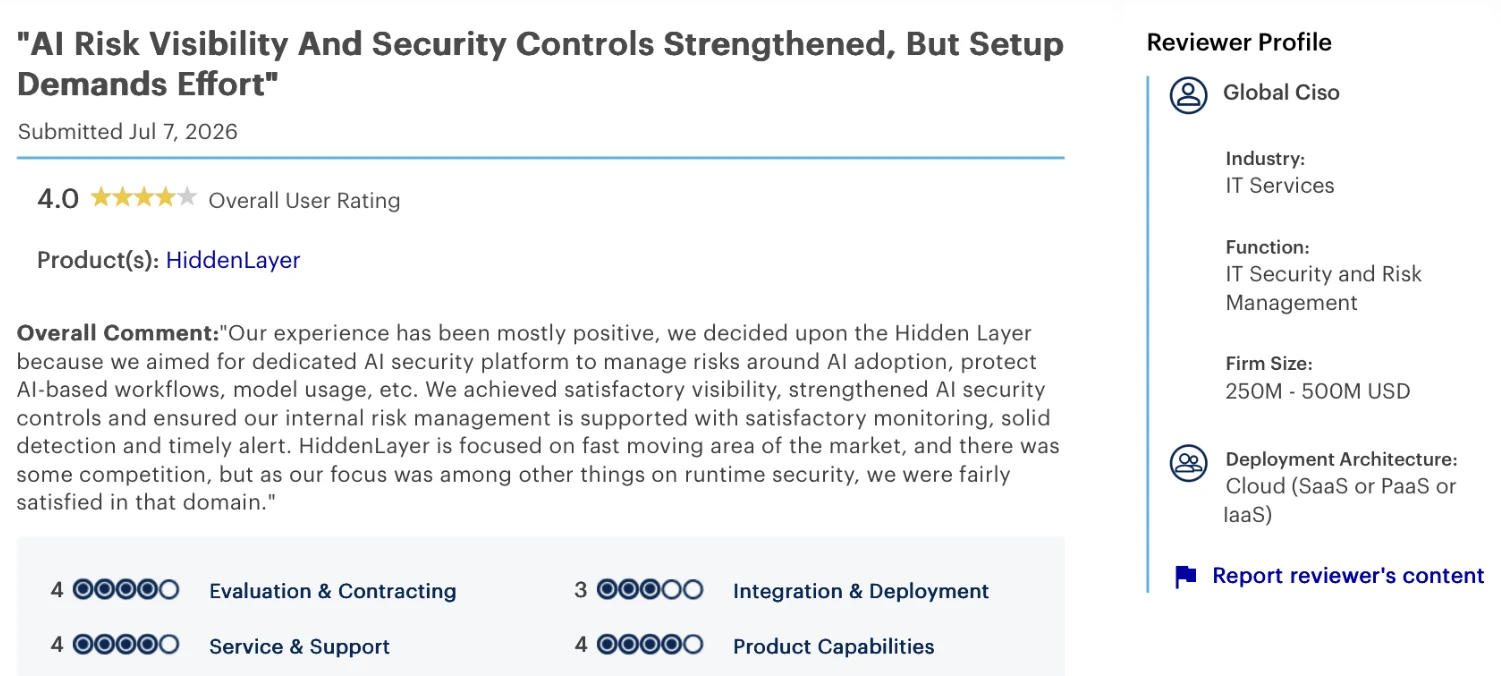
“We achieved satisfactory visibility, strengthened AI security controls…” – Global CISO in IT services, Gartner Peer Insights
“Documentation could be more detailed for advanced configuration.” – Software developer, Gartner Peer Insights
Pricing
HiddenLayer pricing is quote-based and scales with the number of models and AI applications under protection.
Bottom line
Buy HiddenLayer when you ship your own AI and need to trust the models themselves. It pairs naturally with a data-layer platform, since securing the model and securing the data it touches are separate jobs.
6. Palo Alto Prisma AIRS: Best for AI lifecycle security in a consolidated stack
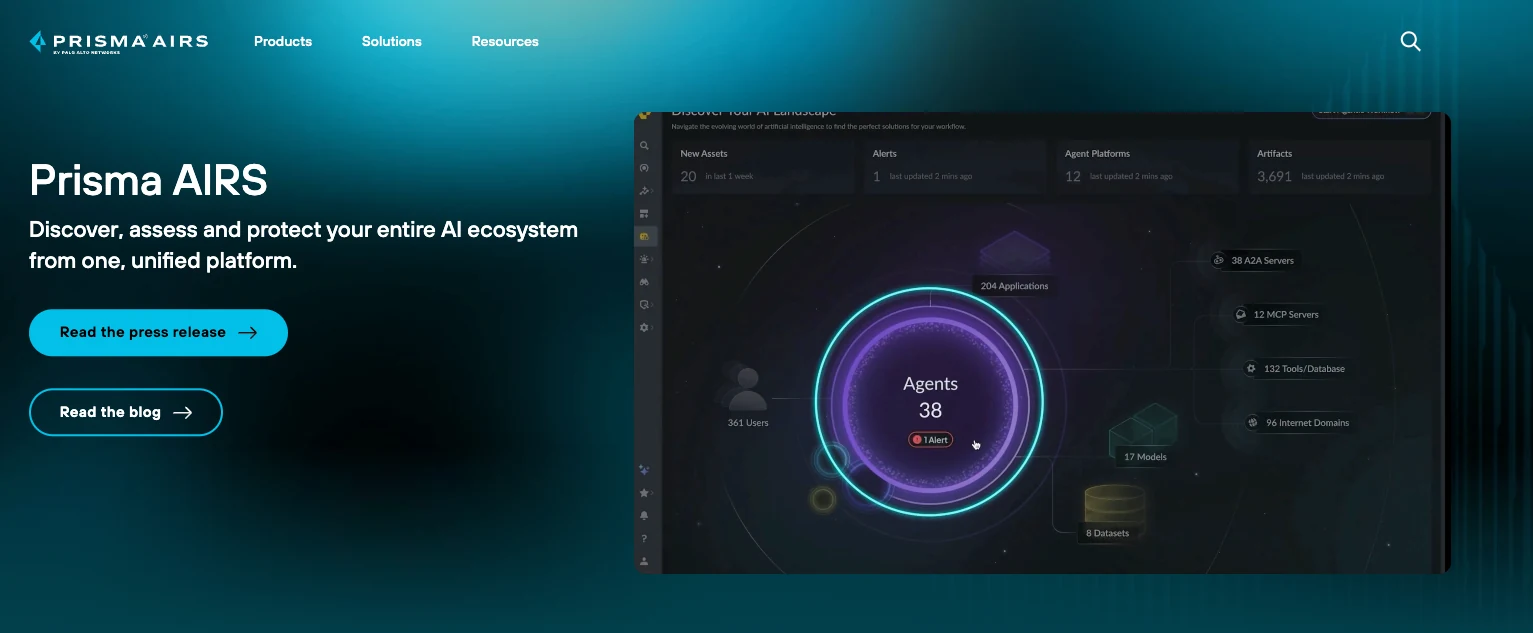
What it does: Prisma AIRS covers the full AI lifecycle, spanning model scanning, posture management, automated red teaming, runtime protection, and AI agent security inside the Palo Alto Networks ecosystem.
Best for: Large enterprises already standardized on Palo Alto Networks that want AI security folded into the same vendor relationship, procurement, and console strategy.
Protect AI is now part of Prisma AIRS. Palo Alto Networks acquired the company in July 2025 and folded its model scanning, red teaming, and open source tooling into the platform. The result competes with HiddenLayer on capability and targets a different buyer: the one who values consolidation over best-of-breed.
The decision usually comes down to platform commitment. If Palo Alto is already the assumed vendor for cloud security, network, and SASE, folding AI security in is the low-friction move. If it isn't, adding a Palo Alto relationship for AI security alone rarely justifies the fragmentation.
Key features
- Full lifecycle coverage: Model vulnerability scanning, posture management, red teaming, and runtime protection in one offering.
- AI agent security: Purpose-built controls for autonomous agents, an area Palo Alto has kept expanding through further acquisitions.
- Platform integration: Findings and enforcement plug into the broader Palo Alto stack rather than another standalone console.
Pros and cons
Pros:
- ✅ Single-vendor accountability for AI risk, which shortens procurement and audit conversations.
- ✅ Backed by Protect AI's research and tooling, including widely used open source scanners.
- ✅ Strong fit for regulated industries already inside the ecosystem.
Cons:
- ❌ Buying it standalone makes less sense outside a Palo Alto commitment.
- ❌ Like HiddenLayer, it secures AI systems, and sensitive data outside AI pipelines stays out of scope.
What users say
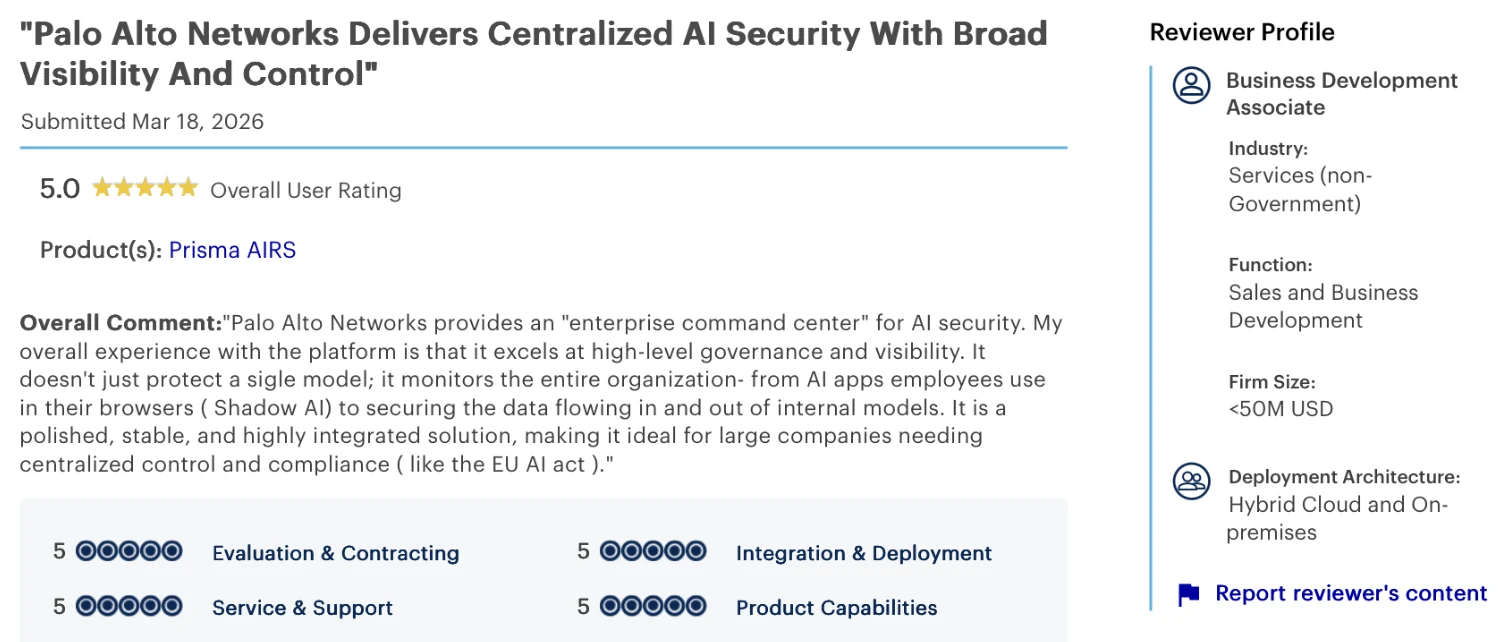
“It excels at high-level governance and visibility.” – Business development associate, Gartner Peer Insights
“Prisma AIRS works smoothly if you have all the devices from Palo Alto which can be costly to use a single standalone product.” – Senior technical engineer, Gartner Peer Insights
Pricing
Prisma AIRS is quote-based through Palo Alto Networks sales and typically priced as part of a broader platform agreement.
Bottom line
Choose Prisma AIRS when consolidation is the strategy and Palo Alto is already the platform. Independent security groups comparing pure AI security capability should shortlist it against HiddenLayer and pick on fit, not brand.
7. Fortra: Best for classification-led DLP programs
What it does: Fortra combines DLP, data classification, and DSPM to control how sensitive data moves, including blocking egress to generative AI sites through copy-paste, file upload, or form submission.
Best for: Compliance-driven organizations, especially in finance and defense, that need labeled data and enforced handling rules across endpoints and email as employees adopt AI tools.
Fortra covers the oldest problem in the category: employees pasting sensitive content into tools nobody approved. Shadow AI was featured in 20% of breaches studied in IBM's 2025 Cost of a Data Breach research, and endpoint-to-AI-site egress is what two decades of DLP engineering was built to control.
Fit depends on where the risk actually lives. If shadow AI is the primary exposure, Fortra is the fastest path to a defensible control. If the exposure is a rogue agent with production database credentials, DLP was never going to be the answer.
Key features
- Generative AI egress controls: Blocks or flags sensitive data heading to AI sites, by pattern, classification label, or outright site restriction.
- Data classification: Labels drive enforcement, so handling rules follow the data instead of depending on user judgment.
- Egress analytics: Reporting on which users, data types, and AI sites drive the most exfiltration events.
Pros and cons
Pros:
- ✅ Mature, battle-tested DLP with two decades of enterprise deployments behind it.
- ✅ The fastest route on this list to a defensible "no sensitive data into ChatGPT" control.
- ✅ Broad compliance framework coverage across PCI DSS, HIPAA, and GDPR programs.
Cons:
- ❌ Endpoint-and-email heritage. Cloud-native depth on managed databases and object storage is thinner than the cloud-first vendors here.
- ❌ Suite complexity, since capabilities span multiple acquired products under one brand.
What users say
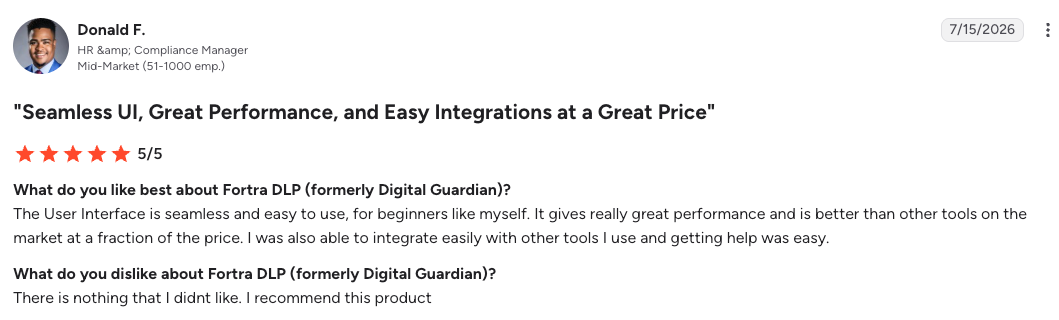
“The user interface is seamless and easy to use” – Donald F., G2
“The dashboard performance can sometimes be sluggish.” – Archit J., G2
Pricing
Fortra pricing is quote-based per product and bundle. The company positions its DLP pricing as predictable against tools with hidden per-feature fees, so ask for the full module list in scope during evaluation.
Bottom line
Fortra fits organizations whose AI data risk is mostly human, driven by employees and endpoints rather than cloud workloads. Cloud-first engineering organizations will get more from Cyera or Wiz for discovery and Eon for protection.
Which AI data security platform should you choose?
The right choice depends on which layer is missing, since these platforms solve four different problems.
Choose Cyera if you:
- Run large multi-cloud environments and need AI-native classification precision your security engineers will actually trust.
- Want DSPM and DLP in one platform, with fast time to first inventory.
Choose BigID if you:
- Run heavy DSAR, RoPA, or cross-jurisdiction privacy workflows and need discovery that plugs into them.
- Have a connector coverage problem, with legacy sources, mainframes, or hybrid estates that cloud-native DSPM tools cannot reach.
- Sit in a Microsoft-heavy environment and want discovery that extends Purview outside the Microsoft boundary.
Choose Varonis if you:
- Carry years of permissions debt across mixed on-prem and cloud environments and need automated least-privilege cleanup.
- Have insider risk or audit findings driving the project as much as AI exposure.
Choose Wiz if you:
- Already run Wiz for cloud security and want DSPM and AI-SPM findings inside the same graph.
- Need attack path context on data findings so exposed sensitive data with a working attack path rises above low-risk alerts.
Choose HiddenLayer if you:
- Build and deploy your own models or agentic systems in production and need the AI itself protected.
- Operate in regulated or federal environments where model scanning, red teaming, and runtime defense are compliance requirements.
Choose Palo Alto Prisma AIRS if you:
- Are already standardized on Palo Alto Networks and want AI security folded into the same vendor relationship and console.
- Need full AI lifecycle coverage from model scanning through runtime protection in one offering.
Choose Fortra if you:
- Face employees moving sensitive data into unapproved AI tools and need DLP that blocks generative AI egress out of the box.
- Run a compliance-driven program where classification labels and enforced handling rules matter more than cloud-native depth.
Skip this category entirely if your environment is fully on-premises with no AI in production, where traditional DLP and backup tooling still fits better.
The recovery layer these platforms don't cover
Every platform in the list above works on prevention: finding sensitive data, governing access, securing models, or blocking egress. Prevention misses.
In a widely reported 2026 incident, an AI coding agent deleted a company's production database and its attached backups in nine seconds after a credential mismatch. No DSPM stopped it, and no AI-SPM would have. The damage lands, and something has to bring the data back.
That recovery layer is a distinct category, and Eon is what we recommend for cloud-first environments.
Eon is a cloud-native data protection platform for AWS, Azure, and GCP that continuously classifies cloud resources, applies backup policies automatically through Cloud Backup Posture Management (CBPM), detects ransomware inside the backups themselves, and restores at the row, file, or record level in minutes.
Backups live in a logically air-gapped, immutable vault in a separate account that production credentials can't reach, so a rogue agent or an attacker with valid production access can't destroy them the way the nine-second incident showed. That architecture is the reason recovery holds up against threats the prevention layer misses.
The proof runs at regulated scale. SoFi operates an immutable vault across five AWS regions on Eon and cut recovery from a day to under five minutes, with over 100% ROI in year one. NETGEAR moved a 10TB SQL Server database restore from 24 hours to under three, and cut backup storage costs 35% in the process.
Deduplication and tiering typically cut cloud backup storage 30–50% across Eon customers, so the recovery capability tends to pay for itself before the first incident.
Pair Eon with any platform from the list above: Cyera or BigID for discovery, Varonis or Fortra for access and DLP, Wiz for posture inside an existing cloud security graph, HiddenLayer or Prisma AIRS for AI systems. Prevention tools tell you what is exposed. Eon makes sure that when exposure turns into damage, you get the data back. Two adjacent problems sit outside this list: securing the models and prompts themselves, covered in our guide to generative AI data security, and monitoring AI systems for misconfiguration, which is what AI security posture management does.
Final verdict
Pick a prevention platform from the seven above based on the layer your stack is missing, then close the recovery gap underneath it. In Eon's 2026 Cloud Data Infrastructure Report, 75% of respondents run AI workloads against production data, carrying credentials that can do damage no prevention platform can undo.
If an AI agent dropped a production table in your environment today, how long would recovery take? Could the restore even reach backups the agent's credentials could touch?
Book a demo and see how Eon restores a single deleted table in minutes across AWS, Azure, and GCP.
Frequently asked questions
Do AI data security platforms include backup and recovery?
No, AI data security platforms don't include backup and recovery. Every major AI data security platform is built around prevention: data discovery, classification, posture management, AI system protection, or DLP. Recovery from ransomware, deletion, or corruption sits in a separate category, which is why cloud-first organizations pair one of these platforms with a cloud data protection platform like Eon. Teams searching for an AI data protection platform are usually after that recovery layer rather than another prevention tool.
Is backup part of data security?
Yes, backup is part of data security because confidentiality, integrity, and availability all count, and backups are how availability survives ransomware, deletion, and corruption. Attackers target backups first for exactly that reason, so backup posture, immutability, and isolation now sit inside the security conversation rather than beside it.
What is the difference between DSPM and cloud data protection?
The main difference between DSPM and cloud data protection is that DSPM finds and classifies sensitive data to prevent exposure, while cloud data protection keeps that data recoverable through backups, immutability, and restore capability. DSPM answers where your data is and who can reach it, and cloud data protection answers what happens after it gets damaged.
Can AI agents delete production data?
Yes, AI agents can delete production data when they hold valid credentials, and it has already happened. An AI coding agent deleted a company's production database and its attached backups in nine seconds during a reported 2026 incident. Backups stored in a logically air-gapped vault that agent credentials cannot reach are the reliable defense.
Do you need both a prevention platform and a recovery platform?
Yes, most cloud-first organizations need both a prevention platform and a recovery platform because they cover different failure modes. Prevention tools like DSPM and DLP reduce the odds of exposure, and a recovery platform limits the damage when an attack, misconfiguration, or rogue agent gets through anyway.