Benchmarks
Fresh, query-ready tables. A fraction of the compute.
Eon Yukon keeps streaming data fresh and tables optimized with less compute. See how it compares with Spark and Flink across ingestion and compaction, using the same workload and freshness requirements.

Where the savings come from
Eon Yukon does the same ingest on far less compute and removes the jobs that reread the data. Queries start from the metadata written at ingest and are billed only while they run.
Land more data with less compute
Eon Yukon uses less compute to turn incoming events into query-ready tables. The savings begin with ingestion itself, even when landing event-level data is all you need.
Get more from a single pass
Add updates, deduplication or aggregates alongside event-level data, without separate jobs rereading the same data.
Keep tables fast, with maintenance included
Continuous compaction and sorting keep tables ready for demanding queries, with no separate maintenance cluster to manage.
Spend less getting answers
Metadata Eon Yukon writes at ingest helps queries find the data they need with less scanning. Compute runs only while queries do, with no idle cluster costs.
How the ingestion benchmark runs
Built to measure the whole job
Fresh data takes more than ingestion. Tables also need frequent commits and ongoing maintenance. Our benchmark measures ingestion, freshness and compaction together to show the compute needed to keep a streaming table ready to query. Every engine lands the same stream into the same kind of table under the same rules, so the only variable is the engine.
The same stream for every engine
One hour of Avro events at 1 million rows per second from Kafka, written into Apache Iceberg using the public ingest-bench harness.
The same guarantees
Every engine commits each row exactly once and keeps table lag under 90 seconds at p95 and under 120 seconds at most, for the full hour. The compaction comparison merges the resulting small small files toward the same 512 MiB target in every engine.
Measured in vCPU and memory
We measure every engine by the vCPU and memory it needed to keep up, so the result reflects work done rather than discounts or pricing.
Updates, too
A second stream of nearly 50,000 updates per second measures the compute each engine needs to keep one current row per key.
Open and repeatable
Explore Eon’s public ingestion benchmarks, including the harness, configurations and raw results. Anyone can rerun the Spark and Flink tests. Eon Yukon's results run under the same checks, and if you find a smaller configuration that passes, submit it and we'll update the comparison.
The results
Eon Yukon kept tables fresh with substantially less compute than Spark and Flink, including compaction. We also tested Kafka Connect with the Iceberg sink, but the tested configuration could not keep up with the workload while meeting our freshness requirements.
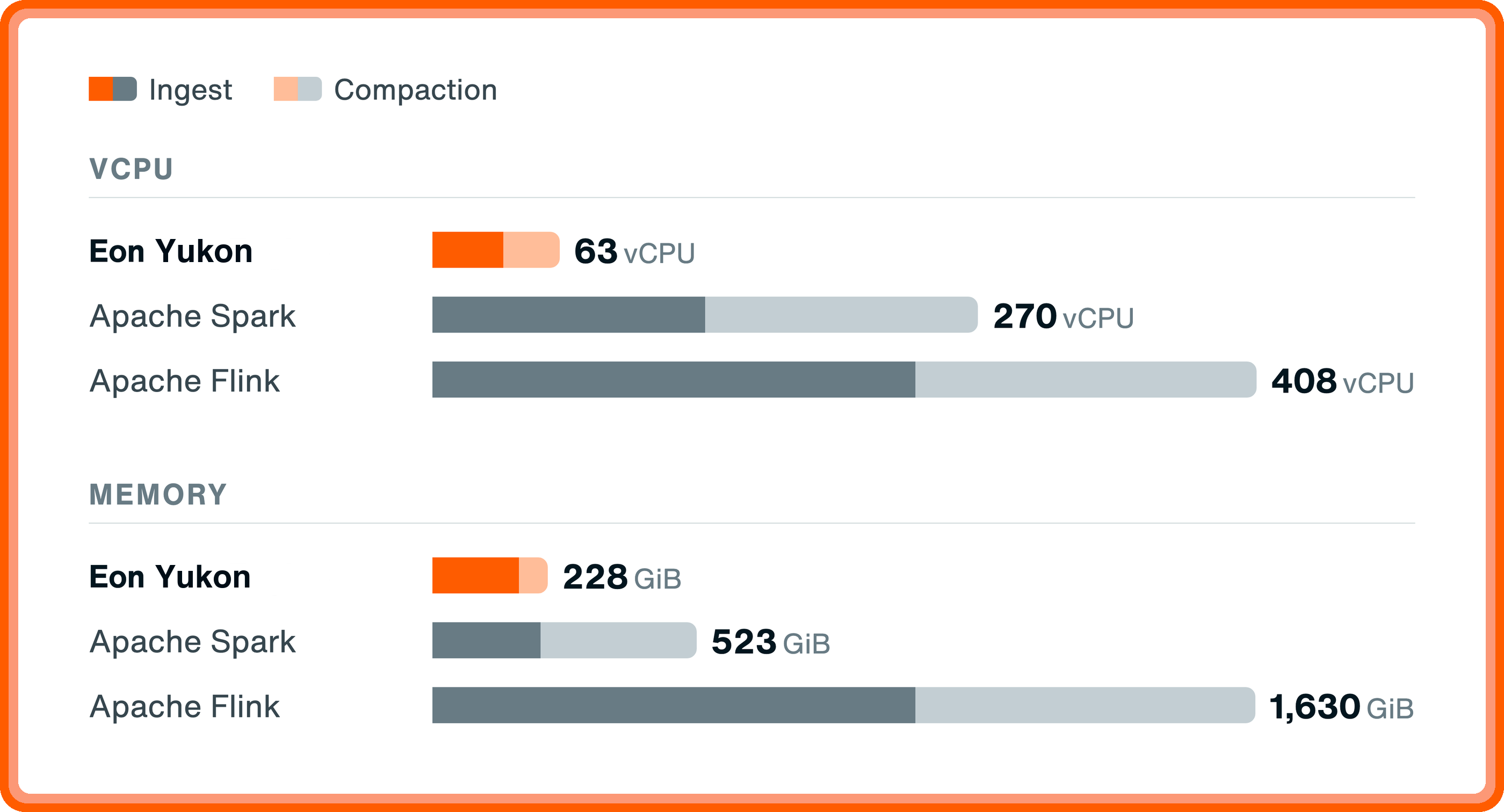
Compute used to keep up on skewed keys: requested vCPU and memory per engine, for ingest and compaction.
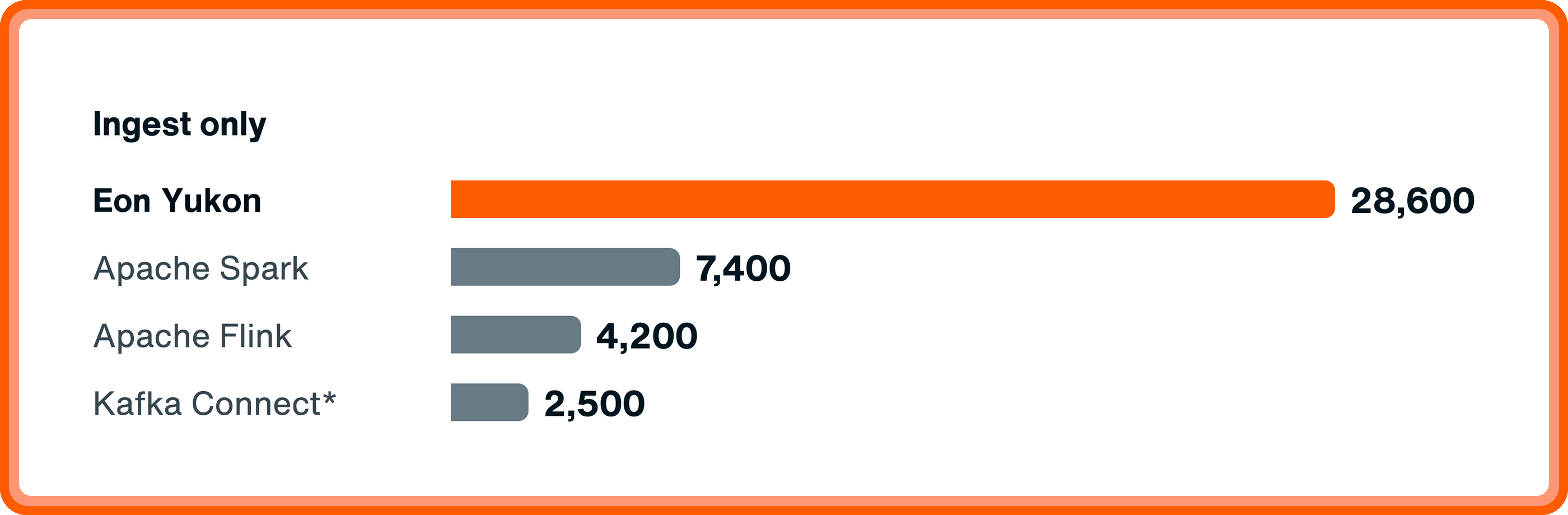
Rows per second per vCPU: ingest only. *Kafka Connect could not meet the freshness requirement.
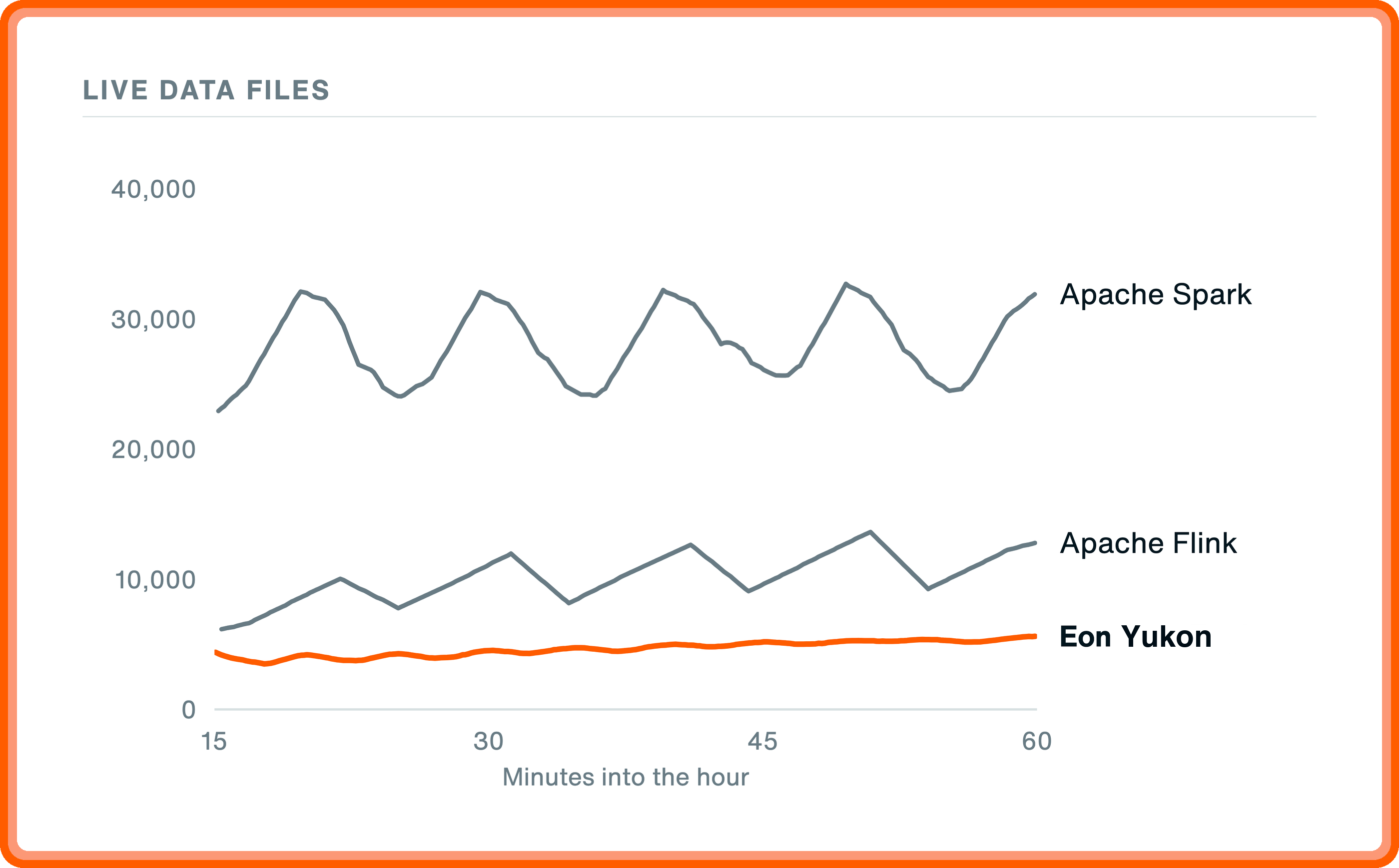
Live data files: file counts during ingestion and compaction, measured from minute 15 onward. Fewer small files reduce query overhead.
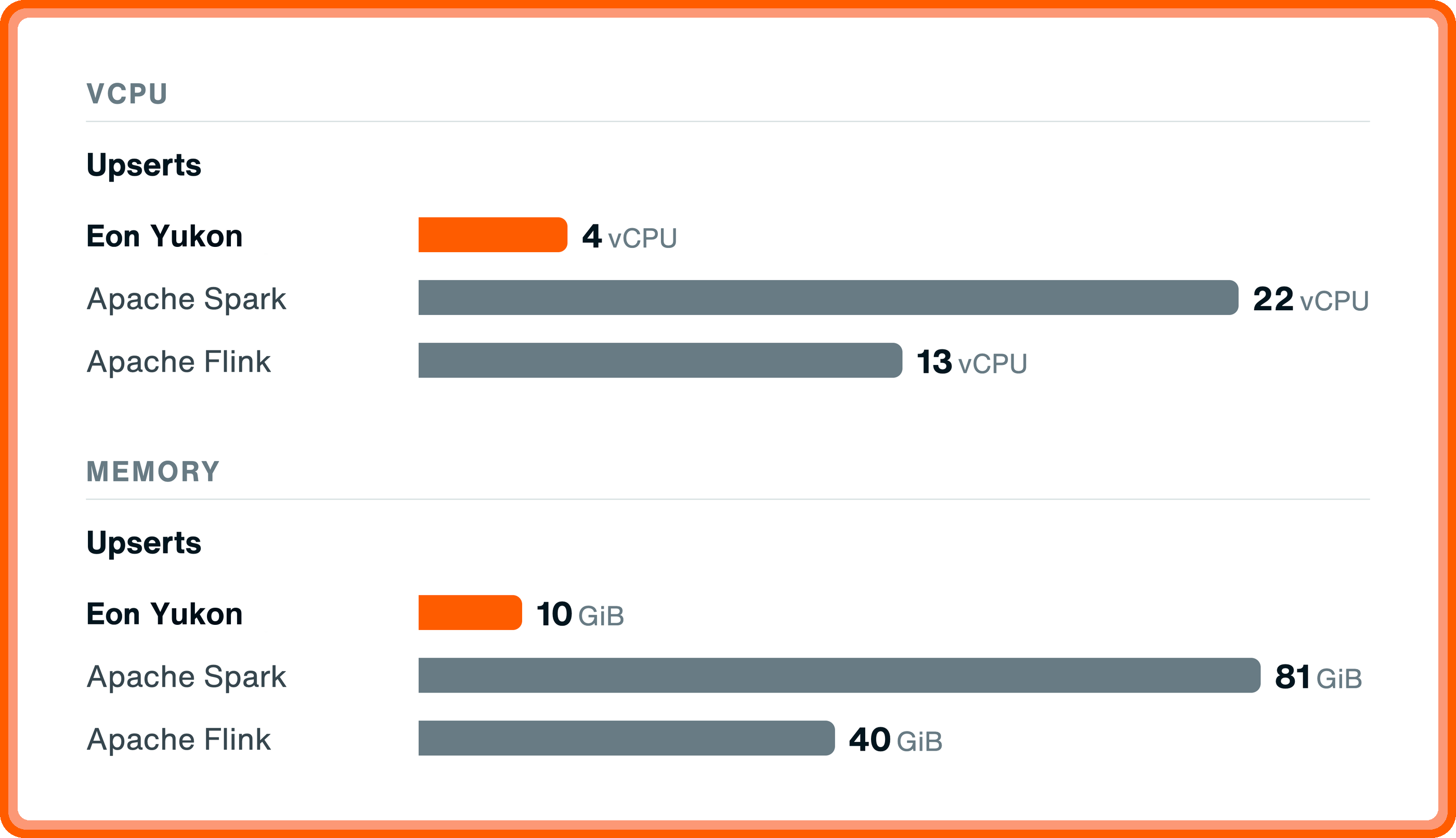
Compute used to keep tables current: requested vCPU and memory per engine, upserts at nearly 50,000 per second.
Proven at scale
Proven in production
The savings extend to production scale. Rise lands more than 200 billion events a day, generating tens of thousands of small files every minute. Eon Yukon handles that workload with 8× less compute than a comparable Apache Flink deployment.
8× less compute
Than a comparable Apache Flink deployment, on Rise's production workload.
Fresh data within seconds
At more than 200 billion events and over a petabyte of data a day, arriving at 40,000 files a minute.
What the numbers mean for your workloads
01
Streams and files into query-ready tables
Streams landed by Spark, Flink or Kafka Connect take 4× to 7× less compute with Eon Yukon. Compaction and cleanup run continuously, with nothing to schedule. See Replace Spark and Flink pipelines.
02
Change streams and upserts
Keep one current row per key as updates arrive, on 3× to 5× less compute than Flink and Spark.
03
Spark batch ETL
Run your PySpark and SQL jobs on Eon Yukon over Spark Connect, with no cluster to size or keep running between jobs.
04
Ad-hoc and agent queries
Eon Yukon replaces clusters kept up for queries with per-query compute that costs nothing when idle. See Reduce data processing costs.
See how Eon works in your environment
Bring a stream you run on Spark or Flink today and we will show you that data landing in Eon Yukon tables, with freshness and compute compared side by side.