Eon Yukon vs. RisingWave
Why teams choose Eon Yukon for streaming into the lake

Maintenance on by default
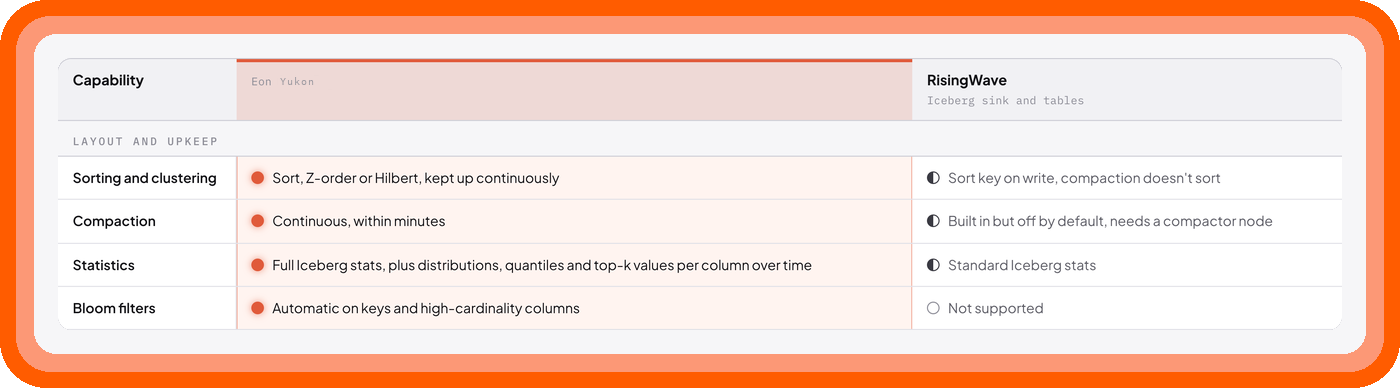
Eon compacts, sorts and cleans up every table continuously. In RisingWave, automatic Iceberg compaction is off by default and needs a dedicated compactor node.
Built for skew
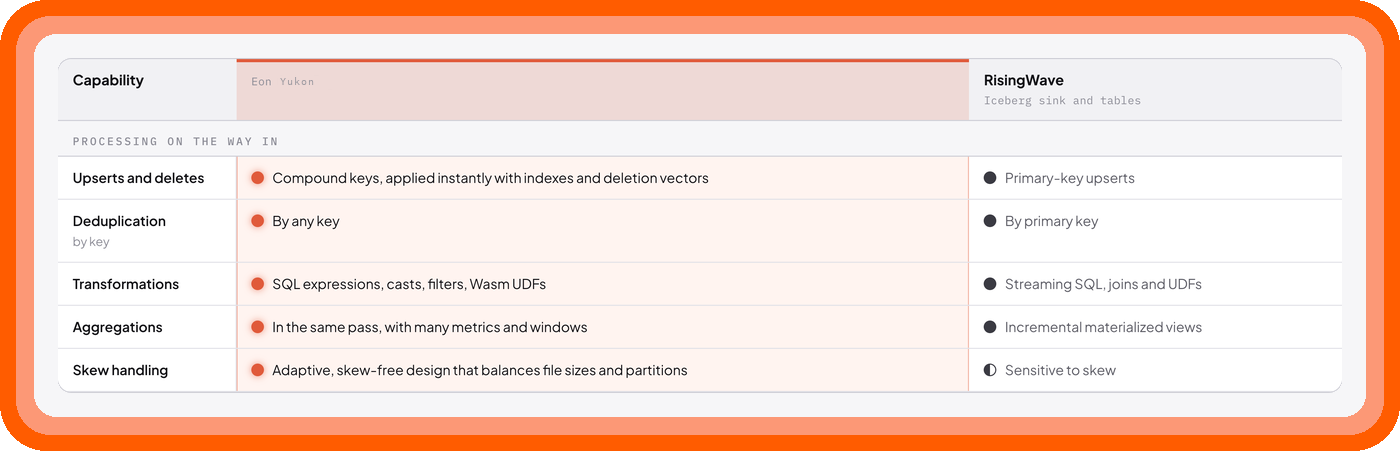
Eon splits work by bytes rather than by partition, so hot keys don't stall the pipeline. Eon's comparison of streaming engines rates RisingWave as sensitive to skew.
Context agents can read
Eon writes table descriptions, joins and changes with every commit and serves them over MCP. RisingWave offers an MCP demo for querying streaming data.
Eon vs. RisingWave at a glance

Data freshness
Query-ready data within seconds.
Materialized views update incrementally, and Iceberg commits about every 60 seconds by default.
Data preparation & maintenance
Event-level data lands ready to query, with optional updates, deduplication and aggregates. Table maintenance is built in.
Primary-key upserts and dedup. Automatic Iceberg compaction is off by default, needs a compactor node, and doesn't sort.
Pipeline complexity
Eon Stream: one managed pipeline produces the tables you choose in one pass, with no separate processing or maintenance jobs.
Streaming SQL for sources, materialized views and sinks, in one system.
Context for AI agents
Eon Context: built-in table descriptions, statistics and change history help agents understand and query the data.
Standard Iceberg statistics. An MCP demo connects an LLM to streaming data.
Open formats & interoperability
Iceberg tables, readable by compatible engines.
Iceberg v2 and v3 in your bucket, with Glue, REST, Unity, JDBC or a hosted catalog.
Querying & compute management
Eon Query: serverless SQL and Spark Connect, billed per query with no idle compute cost.
Postgres-compatible SQL on clusters you size in RWUs.
Real-time application serving
Eon Realtime: current values, looked up by key in under 1 ms through Redis-compatible and HTTP APIs.
Low-latency serving of materialized views from serving nodes, over SQL.
Real-time aggregations
Summaries update alongside event-level data, written to tables and served live, with no state for your team to manage.
Incremental materialized views, RisingWave's core strength.
Operational overhead
Fully managed by Eon, with no tuning required. Dedicated deployment in your region or BYOC.
Managed cloud, BYOC or self-hosted. Your team sizes the cluster and turns on and tunes compaction.
How Eon Yukon compares with RisingWave
Tables that stay fast without tuning
Streaming into Iceberg writes small files and snapshots all day, and tables slow down unless something compacts and sorts them.
RisingWave can manage Iceberg tables, but automatic compaction is off by default, runs hourly once enabled, and needs a dedicated compactor node. Compaction doesn't sort, and RisingWave doesn't support manifest rewrites on v3 tables. Teams choose a commit interval that trades freshness against small files.
Eon runs compaction and sorting by column, Z-order or Hilbert continuously, within minutes, and removes expired snapshots and orphaned files on its own, so you don't have to trade freshness against file sizes.
Skewed streams that don't stall
Real event streams are skewed: a few customers, devices or partitions carry most of the traffic.
RisingWave processes streams with shared state, and Eon's comparison of streaming engines rates it sensitive to skew.
Eon designed Yukon to be skew-free. It splits work by bytes rather than by partition, balances file sizes and partitions, and scales writing and maintenance independently, so a hot key doesn't hold back the rest of the stream.
Context for agents, written with the data
Agents need to understand a table before they can query it well.
RisingWave offers Postgres-compatible SQL and an MCP demo that lets an LLM query streaming data in natural language. Users document table meaning and joins themselves.
Eon writes a description of every table with each commit: grain, column meaning, distributions, joins found by matching values, and what changed, and serves it over MCP, so one call replaces the exploratory queries.

Serving by key, without a cluster to size
Apps and customer-facing agents need the current value for a key in milliseconds.
RisingWave serves materialized views from dedicated serving nodes over SQL, with the cluster sized in RWUs.
Eon Realtime serves the same aggregates it keeps in the lake by key in under 1 ms, over a Redis-compatible API, with hot keys in memory and warm keys on local disk on their own. Read replicas and shards scale with traffic, and queries over the tables are serverless, with nothing to pay when idle.
How streaming costs compound
Compaction
Included, continuous.
A dedicated compactor node, once enabled.
Sorting and bloom filters
Included: sorting kept up continuously, bloom filters on keys.
Sort key on write, no bloom filters.
Rich column statistics
Included, on every commit.
Standard Iceberg statistics.
Ad-hoc queries
Per query, nothing to pay when idle.
The same cluster, or another engine.
Where the difference shows up most:

Spiky or skewed traffic
a cluster sized in RWUs is paid for at its size whether or not traffic peaks. Eon bills on data volume.

Many Iceberg tables
each one needs compaction turned on and a compactor to run it. On Eon, maintenance is part of the price.

Ad-hoc and agent queries
they compete with streaming work on the same cluster. Eon runs them serverless next to the data.

See how Eon works in your environment
Bring a stream you process with RisingWave today and we will show you that data landing in Eon Yukon tables, with freshness and compute compared side by side.