Eon Yukon vs. Apache Flink
Why teams replace Flink ingest and aggregation jobs with Eon Yukon
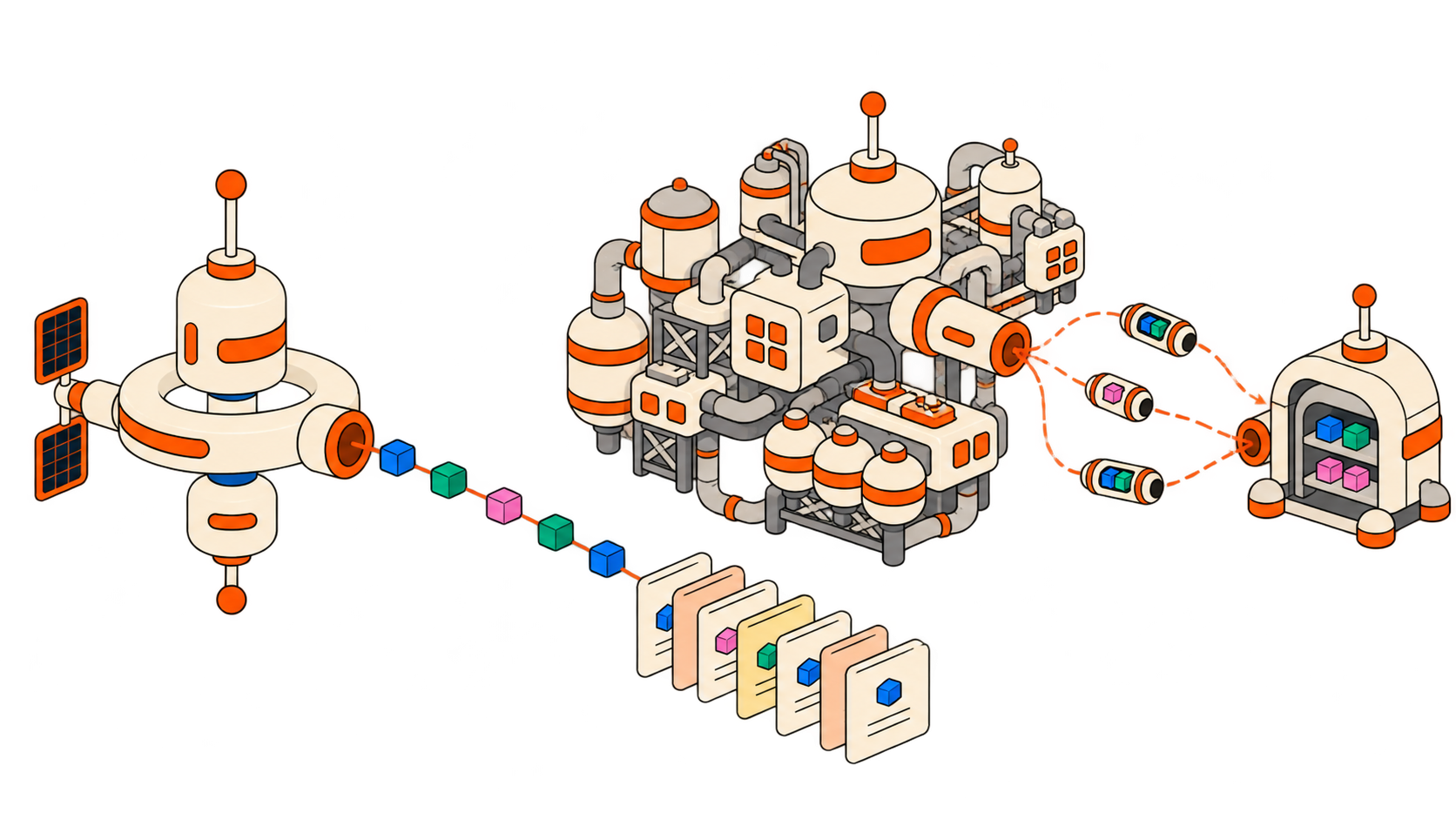
7x less compute
Eon lands and compacts your streams with 7× the compute efficiency of Flink, as shown in Eon's public benchmark.
No state to babysit
Keep tables and metrics current without managing streaming state, recovery or scaling. Eon Yukon handles the operational work as your data grows.
Query-ready tables, with maintenance built in
Eon Yukon lands event-level data ready to query, with continuous compaction and sorting to keep tables fast. Add upserts, deduplication or aggregates as needed. Those tables stay current alongside your event-level data, all in one pass, with no separate jobs to run or wait for.
Eon vs. Apache Flink at a glance


Data freshness
Query-ready data within seconds.
Iceberg data becomes queryable when checkpoints complete.
Data preparation & maintenance
Event-level data lands ready to query, with optional updates, deduplication and aggregates. Table maintenance is built in.
Updates need follow-up maintenance. Compaction and cleanup require extra tasks.
Pipeline complexity
One managed pipeline produces the tables you choose in one pass, with no separate processing or maintenance jobs.
Streaming jobs, state, checkpoints and maintenance to operate.
Context for AI agents
Built-in table descriptions, statistics and change history help agents understand and query the data.
Standard Iceberg statistics. Agent context requires a separate system.
Open formats & interoperability
Iceberg tables, readable by compatible engines.
Writes Iceberg, Delta Lake and other formats through connectors.
Querying & compute management
Serverless SQL and Spark Connect, billed per query with no idle compute cost.
Lakehouse queries require a separate query engine.
Real-time application serving
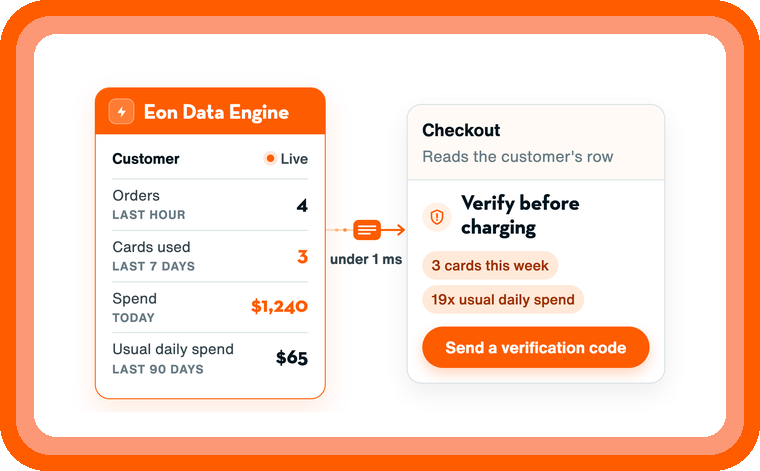
Current values, looked up by key in under 1 ms through Redis-compatible and HTTP APIs.
A separate cache and sync jobs serve current values to apps.
Real-time aggregations
Summaries update alongside event-level data, written to tables and served live, with no state for your team to manage.
Stateful jobs, with state to size, checkpoint and tune.
Operational overhead
Fully managed by Eon, with no tuning required. Dedicated deployment in your region or BYOC.
Your team manages clusters, recovery, upgrades and table maintenance.
Compute efficiency
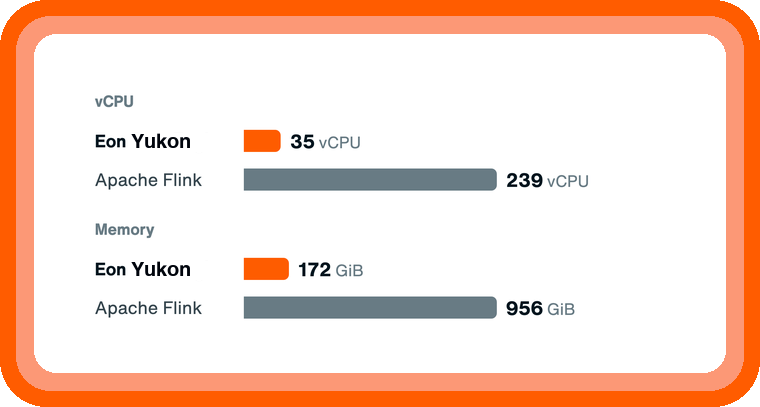
At 1M events/s: 35 vCPU for ingest and 63 with compaction, 7× Flink's compute efficiency.
At 1M events/s: 239 vCPU for ingest. 408 with compaction.
How Eon Yukon compares with Apache Flink
Freshness that doesn't wait on a checkpoint
Freshness has a cost. More frequent commits take more streaming compute and leave more small files to compact.
Flink commits to Iceberg when a checkpoint completes, so freshness is tied to the checkpoint interval, and recovering from a failure or rescaling restarts the job from its last checkpoint.
Eon Yukon writes continuously and commits on a short interval, so new data is queryable within seconds. Eon has no global checkpoint, so when a node fails its work moves elsewhere while the rest keeps writing, and you can add capacity without a restart.
In Eon's public benchmark, landing 1 million events per second from Kafka into Iceberg, Eon kept up on 35 vCPU against 239 vCPU for Flink.
Current tables, maintained continuously
A Kafka-to-Iceberg job is only half the work. The tables it writes still need updates applied, small files merged and old snapshots cleaned up.
With Flink, updates land as separate delete records that slow every query until a later job cleans them up. Compaction and snapshot cleanup are more maintenance jobs to set up, size and run, and Iceberg still marks in-sink maintenance for Flink as experimental.
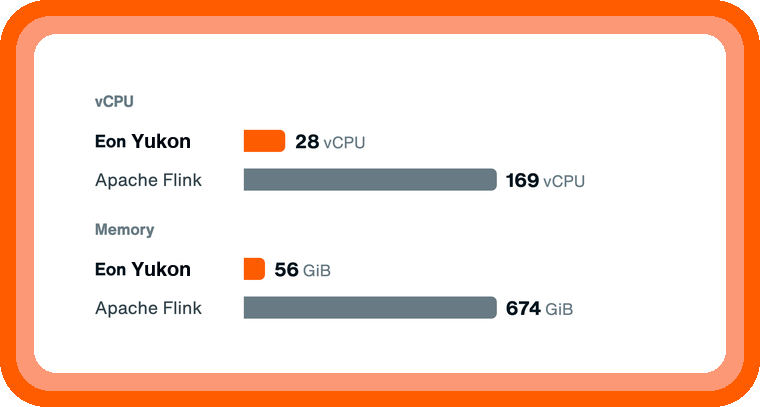
Eon Yukon applies updates, deletes and deduplication as data lands, in the same commit as the new data, so queries never pay for them later. Compaction and sorting run continuously, and Eon Yukon removes expired snapshots and orphaned files on its own. In Eon's public benchmark, with both engines merging the same small files toward the same target file size, Eon Yukon's compaction was 6× more compute-efficient than Flink's maintenance job.
The same metrics for analytics and applications
Build customer profiles, usage metrics and model features as events arrive. Eon Yukon keeps them current in open tables and serves them directly to applications with sub-millisecond reads.
With Flink, your team manages the processing jobs and a separate serving store. Eon Yukon brings both together, with no extra cache or sync pipeline to operate.
How Flink pipeline costs compound
Software
$0.01 per GB ingested, with everything below included.
Free software; you pay for clusters and people.
Ingest and aggregation
Included, in one pass.
A Flink cluster sized for state and peak load.
Compaction and snapshot cleanup
Included, continuous.
Separate maintenance jobs, often a Spark job running alongside Flink.
Checkpoint storage
No global checkpoint.
Durable storage for state, sized with the job.
Serving current values
Included, by key in under 1 ms.
A separate cache and its sync jobs.
Engineering time
Managed by Eon.
State, savepoints, upgrades and skew tuning.
Where the difference shows up most:

High-volume streams
compute grows with event rate, and Eon Yukon needs about a seventh of Flink's compute to land and compact the same stream.

More pipelines
each Flink job brings its own cluster, state and maintenance. With Eon Yukon, cost follows data volume rather than the number of jobs.

See how Eon works in your environment
Bring a stream you process with Flink today and we will show you that data landing in Eon Yukon tables, with freshness and compute compared side by side.