Eon Yukon vs. Confluent
Why teams add Eon Yukon to turn Kafka topics into finished tables
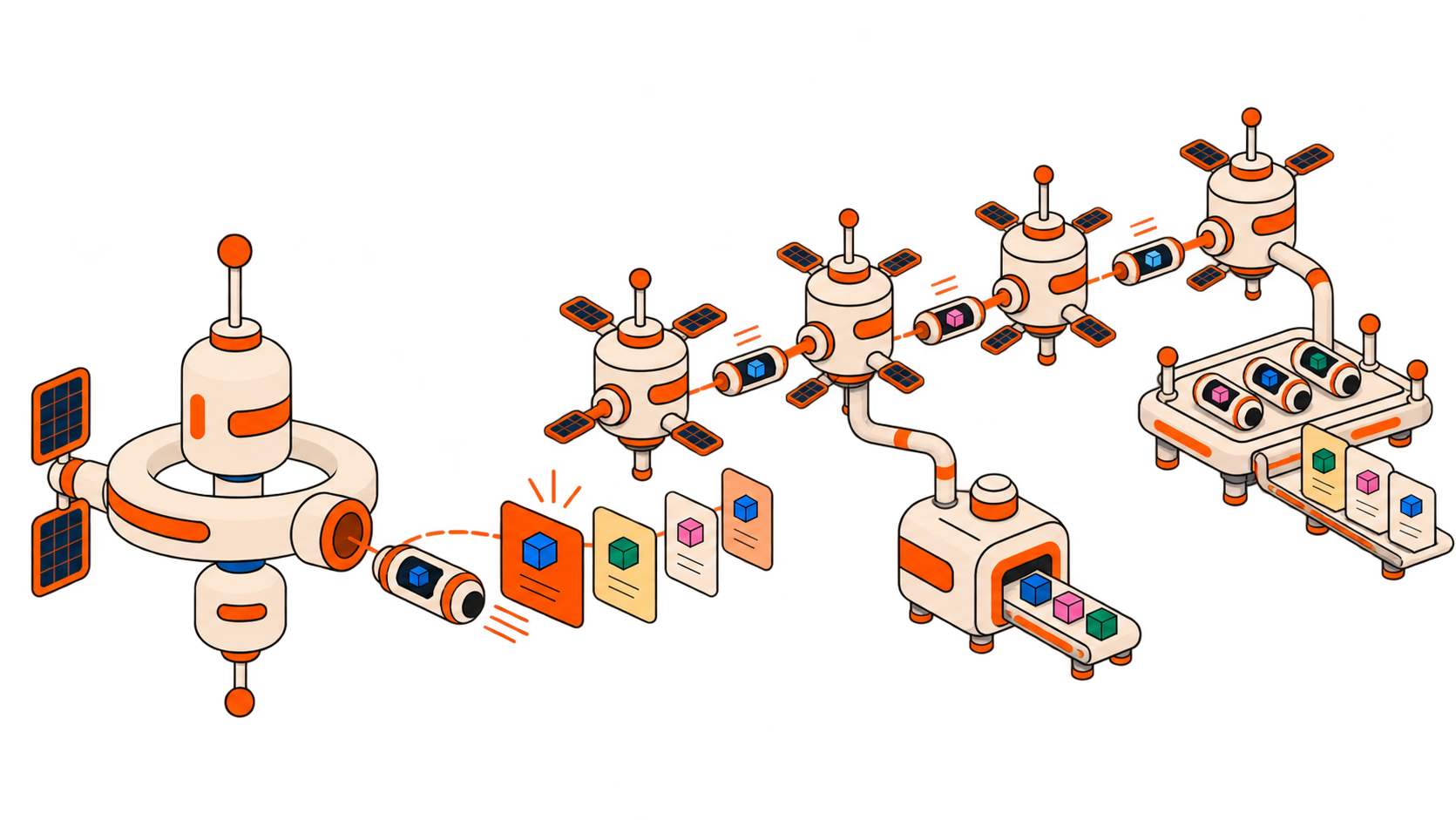
Queryable within seconds
Eon makes new data queryable within seconds, where Tableflow publishes to a table about every 5 minutes.
Transforms and aggregates built in
Eon applies SQL transforms, deduplication by any key and aggregates in the same pass. With Tableflow, transforms and aggregations need Confluent's Flink, billed separately.
Any Kafka, plus your buckets
Eon reads any Kafka, and Amazon S3 and GCS files, into the same Iceberg tables. Tableflow materializes Confluent Cloud topics only.
Eon vs. Confluent at a glance


Data freshness
Query-ready data within seconds.
Tableflow publishes to a table about every 5 minutes.
Data preparation & maintenance
Event-level data lands ready to query, with optional updates, deduplication and aggregates. Table maintenance is built in.
Automatic compaction and schema evolution. Upserts by Kafka key and partition, 10-20k events/s per table. No sorting beyond partitioning.
Pipeline complexity
Eon Stream: one managed pipeline produces the tables you choose in one pass, with no separate processing or maintenance jobs.
Kafka topics, Flink statements for transforms and aggregates, and Tableflow for the lake: three managed services to configure and pay for.
Context for AI agents
Eon Context: built-in table descriptions, statistics and change history help agents understand and query the data.
The Real-Time Context Engine serves Kafka data to agents over MCP, on AWS only. Lake tables carry standard Iceberg statistics.
Open formats & interoperability
Iceberg tables, readable by compatible engines.
Iceberg or Delta Lake, with a built-in Iceberg REST catalog and Glue, Unity, Polaris and Snowflake Open Catalog integrations.
Querying & compute management
Eon Query: serverless SQL and Spark Connect, billed per query with no idle compute cost.
No lake query engine. Flink compute pools handle stream processing, and the tables need another engine.
Real-time application serving
Eon Realtime: current values, looked up by key in under 1 ms through Redis-compatible and HTTP APIs.
Key lookups for agents through the Real-Time Context Engine, on AWS only.
Real-time aggregations
Summaries update alongside event-level data, written to tables and served live, with no state for your team to manage.
Flink SQL statements on Confluent Cloud, billed per CFU.
Operational overhead
Fully managed by Eon, with no tuning required. Dedicated deployment in your region or BYOC.
Fully managed by Confluent. Your team writes and monitors Flink statements and Tableflow settings.
How Eon Yukon complements Confluent
Tables that keep up with the stream
Teams stream into Kafka so data is current, and want the lake to keep up.
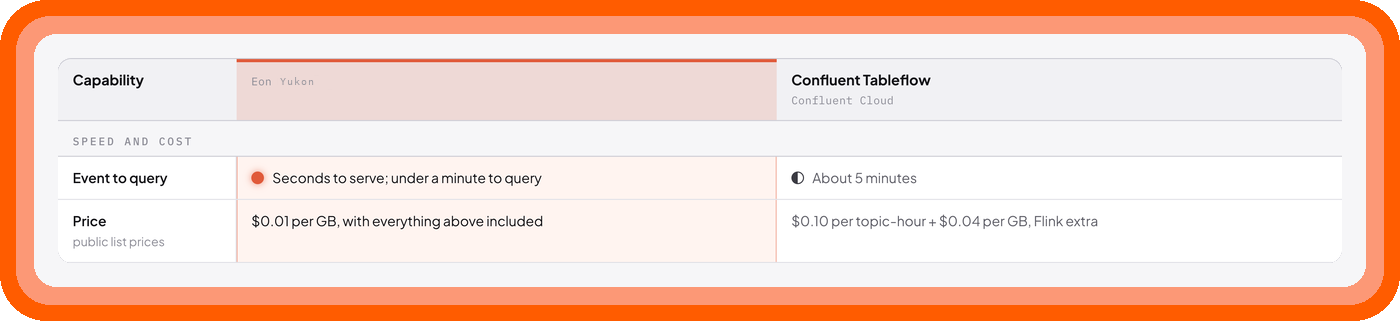
Tableflow turns topics into tables, handles compaction and schema evolution, and publishes new data about every 5 minutes, sooner on busy topics. It keeps between 10 and 100 snapshots, a range you can't configure.
Eon Yukon commits continuously: new data is queryable within seconds, with statistics and context written in the same commit, and compaction and sorting kept up within minutes.
Clean, keyed tables in one pass
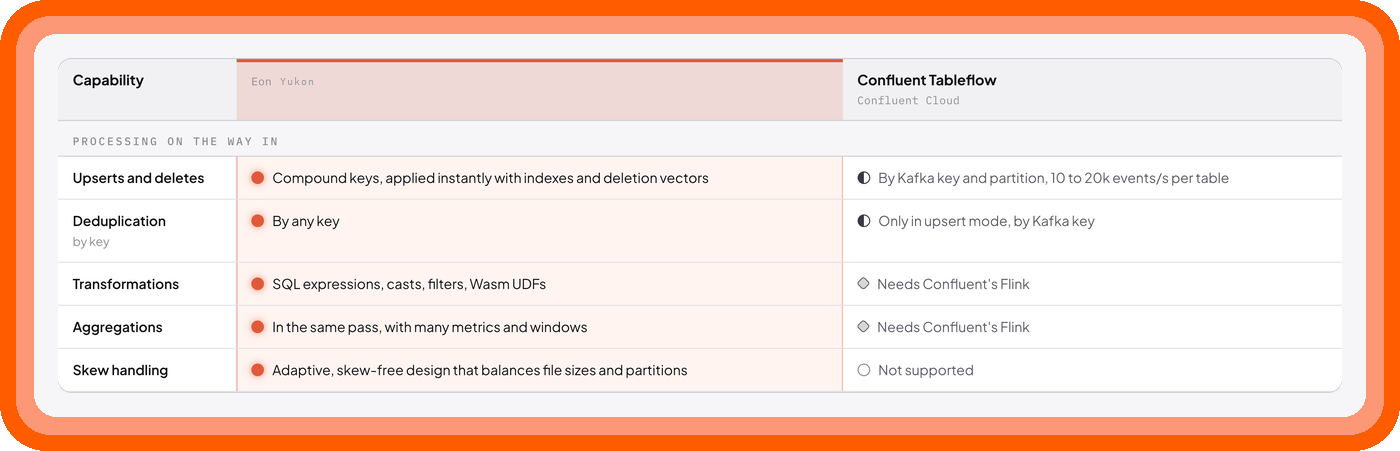
Event streams carry retries, updates and deletes keyed by business IDs rather than Kafka partition.
Tableflow's upsert mode keys rows on the Kafka key plus partition number, caps at 30 billion keys, and slows from 20,000 events/second as tables grow. Deduplication happens only in upsert mode, and SQL transforms and aggregations need Confluent's Flink, a separate service.
Eon merges by any compound key, with indexes and deletion vectors, deduplicates by any key, and applies SQL transforms, casts, filters, Wasm UDFs and aggregates as data lands, all in the same pass.
One lake for Kafka and files
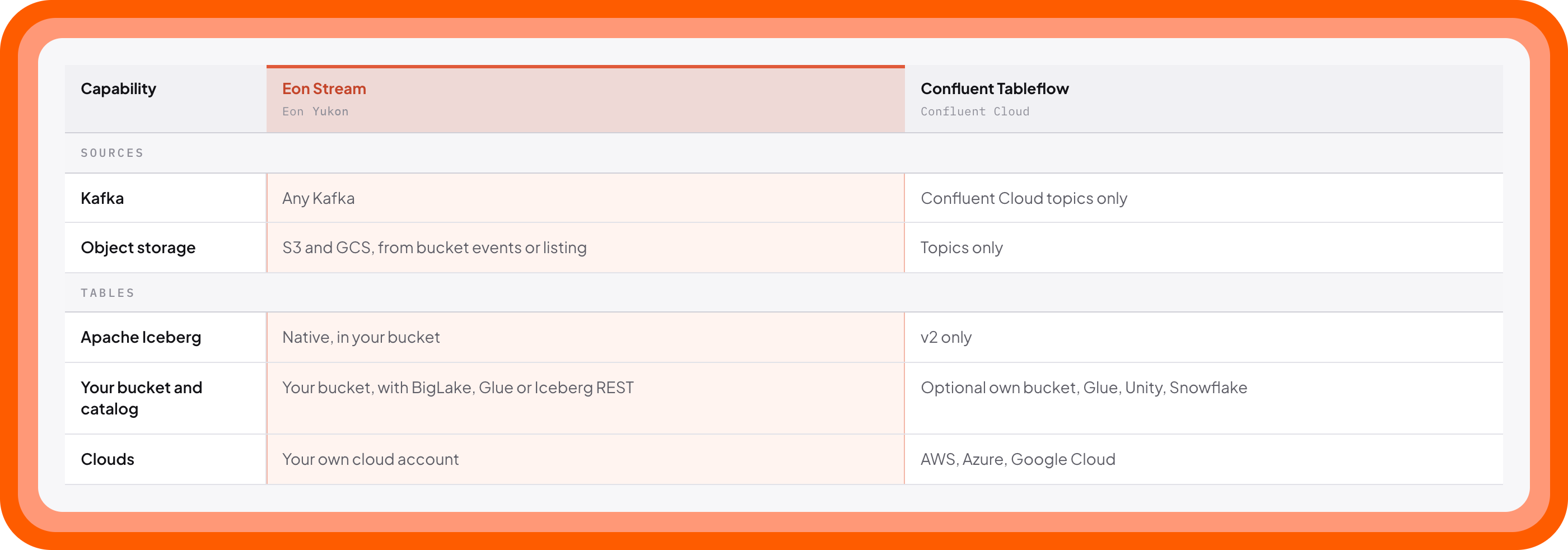
Some data sits on other Kafka clusters, and much of it lands as files in buckets rather than on Confluent Cloud.
Tableflow materializes Confluent Cloud topics only, and doesn't read object storage.
Eon reads any Kafka, and S3 and GCS files from bucket events or listing, into the same Iceberg tables and catalog, so streams and files meet in one lake.
Context in the lake as well as the stream
Agents need to understand the tables they query, as well as look up the latest event for a key.
Confluent's Real-Time Context Engine serves key lookups and filters over Kafka data to agents over MCP, on AWS only. The lake tables Tableflow writes carry standard Iceberg statistics.
Eon writes a description of every table with each commit: grain, column meaning, distributions, joins found by matching values and what changed, and serves it over MCP alongside the data. Apps and agents read current values by key in under 1 ms over a Redis-compatible API.

How streaming-to-lake costs compound
Upserts
Included, applied as data lands.
Upsert mode adds index processing that grows with the table.
Transforms and aggregations
Included, in the same pass.
Confluent Cloud for Apache Flink at $0.21 per CFU-hour.
Rich column statistics
Included, on every commit.
Standard Iceberg statistics.
Query compute
Per query, nothing to pay when idle.
Another engine.
Where the difference shows up most:

Many topics
Tableflow bills per topic-hour, so cost grows with the number of topics as well as the data. Eon bills on data volume.

Upsert tables
index processing recurs and scales with each table's size on Tableflow. On Eon, upserts are part of the same pass.
Transforms
every Flink statement that cleans or aggregates a topic is billed on its own compute. On Eon, transforms and aggregates run where the data is written.

See how Eon works in your environment
Bring a stream you send through Confluent today and we will show you that data landing in Eon Yukon tables, with freshness and compute compared side by side.